
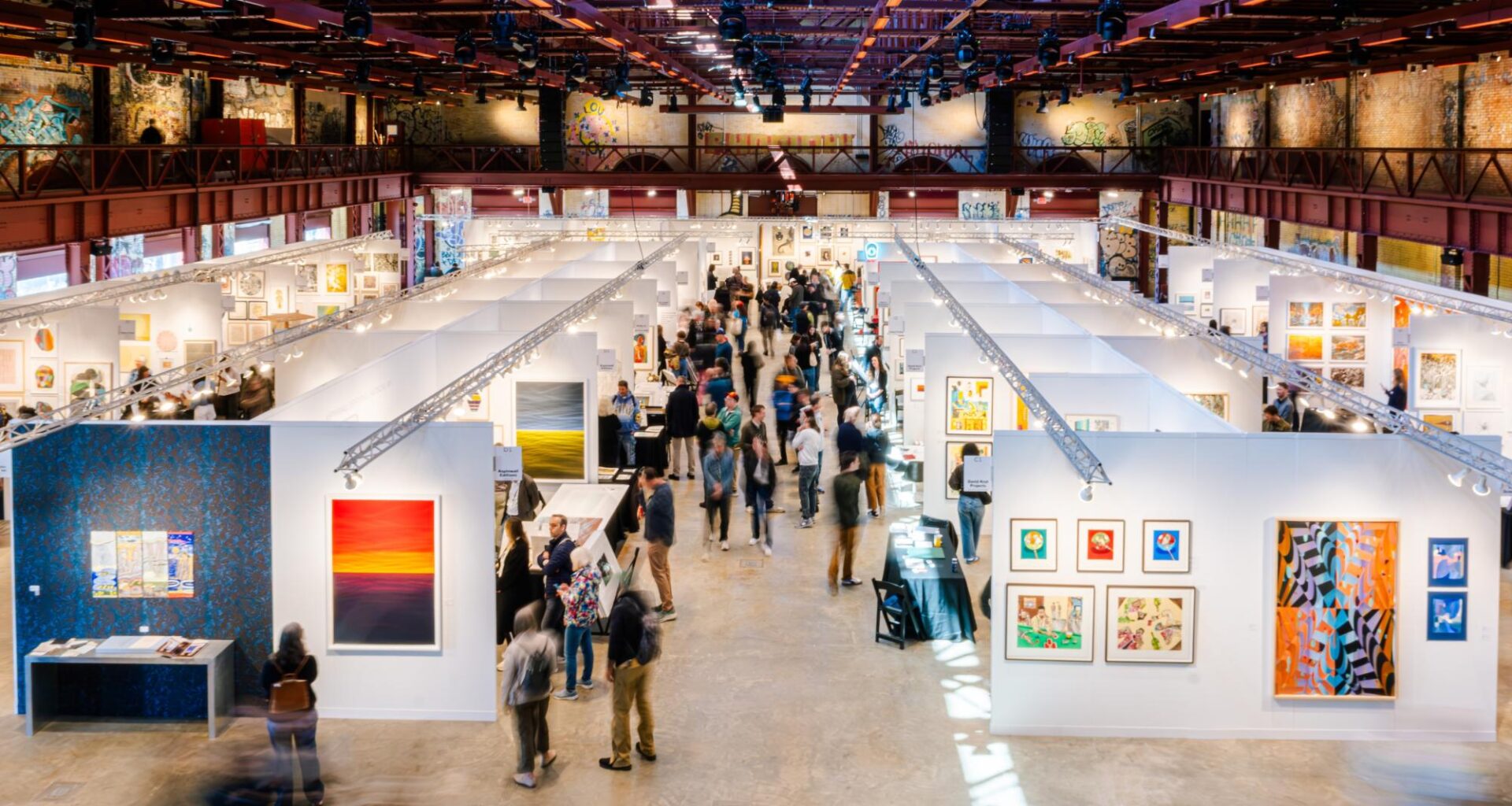
Inside a 120-year-old power-plant-turned-art-center, rows of booths replace machinery to showcase the diverse world of printmaking. Amid bustling crowds, the Brooklyn Fine Art Print Fair remains an intimate space where artists prioritize connection over commerce to bring their crafts into the spotlight.
The four-day event — the borough’s only fair dedicated solely to the fine arts — returned to Gowanus from April 9 to April 12 at the Powerhouse Arts building, offering a rare deep dive into the printmaking process while showcasing some of the field’s most compelling artists. Following its successful 2025 debut, which drew around 7,500 visitors, this year’s fair featured over 60 exhibitors, including galleries, print publishers, independent artists and academic printmaking organizations.
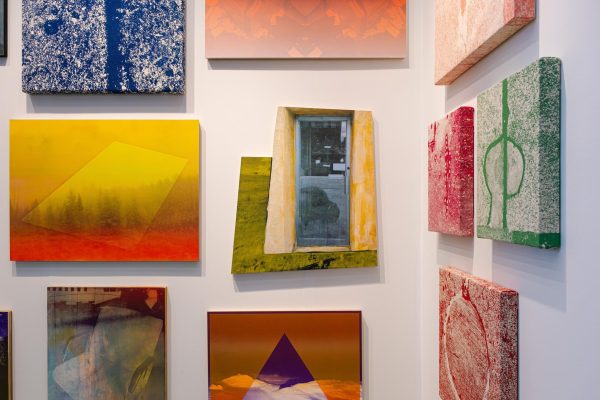 (Suditi Sircar for WSN)
Divided into two sections based on artist level, the fair aimed to serve as a welcoming space for New Yorkers seeking visibility in the art world. Workshops and panels focused on techniques and history were held throughout the weekend, providing an educational and immersive experience beyond the exhibitor booths.
Noah Breuer stood out for his striking, colorful prints on fabric. A former printmaking professor at NYU’s Steinhardt School of Culture, Education, and Human Development, Breuer has been making prints since high school. His choice of medium is inspired by his family’s ties to textile production in Bohemia, a region of the Czech Republic.
While he got his start printing on paper, Breuer now also uses fabrics typically found in tablecloths, bed sheets and handkerchiefs — the same ones his ancestors produced, complete with similar textile motifs.
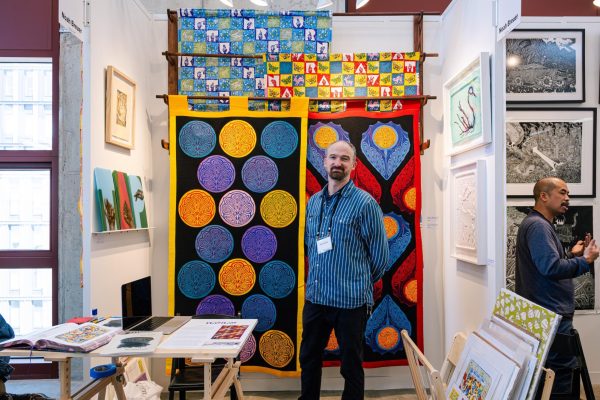 Former NYU professor Noah Breuer. (Suditi Sircar for WSN)
His 2024 work “Návrat Banner 3 (Zwirn)” is eye-catching for its scale and composition. The felt piece is over seven feet tall, featuring bright red, blue and yellow teardrop shapes on a primarily black background. Breuer used silkscreen printing, forcing fine line ink details through a mesh screen before sewing each piece together. The manual, multi-step process reflects a philosophy that values the collective over the individual.
“Printmaking lends itself to community building by its nature and collaboration,” Breuer told WSN. “One of the things I like most about print media is that it is egalitarian and collaborative.”
The Tribeca art gallery NowHere focused on New York-based Japanese artists who are either emerging or historically underrepresented. The booth presented Masaaki Sato’s iconic prints from the ’70s through the ’90s. His subject was the classic, cluttered New York newsstand — Sato’s works often use hundreds of colors, requiring him to produce an equal number of corresponding screens, each crafted with intense precision to be applied properly.
The fair also highlighted academic organizations like The New School’s printmaking club, which featured a strong display of works from over 50 students. The selected prints reflected a diverse range of identities and techniques, from lithography to screen printing.
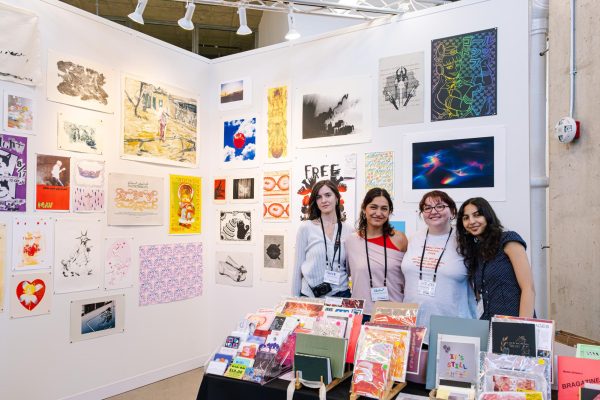 Members of the New School’s printmaking club. (Suditi Sircar for WSN)
While The Grand Hall section housed booths for formal galleries, The Loft showcased self-representing artists and academic printmaking departments. Student representative and Parsons senior Liz Roff noted that despite the physical separation, the fair’s intimacy created a sense of belonging, rather than hierarchy.
“It puts us on a very equal level, even though we’re on this side of the gallery,” Roff told WSN. “In there, you see where we’ll be in a couple years and all the professionals who can help us get to that point.”
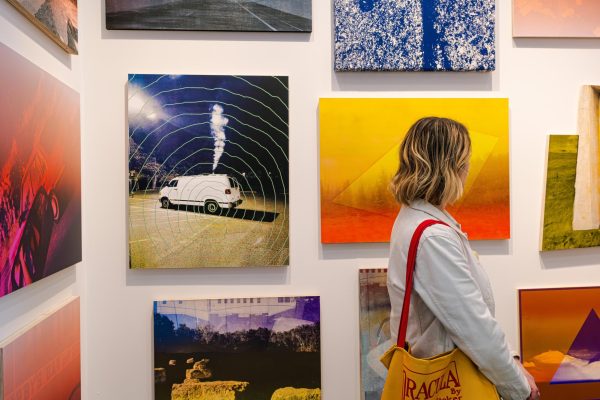 (Suditi Sircar for WSN)
Contact Meghan Mandra at [email protected].