
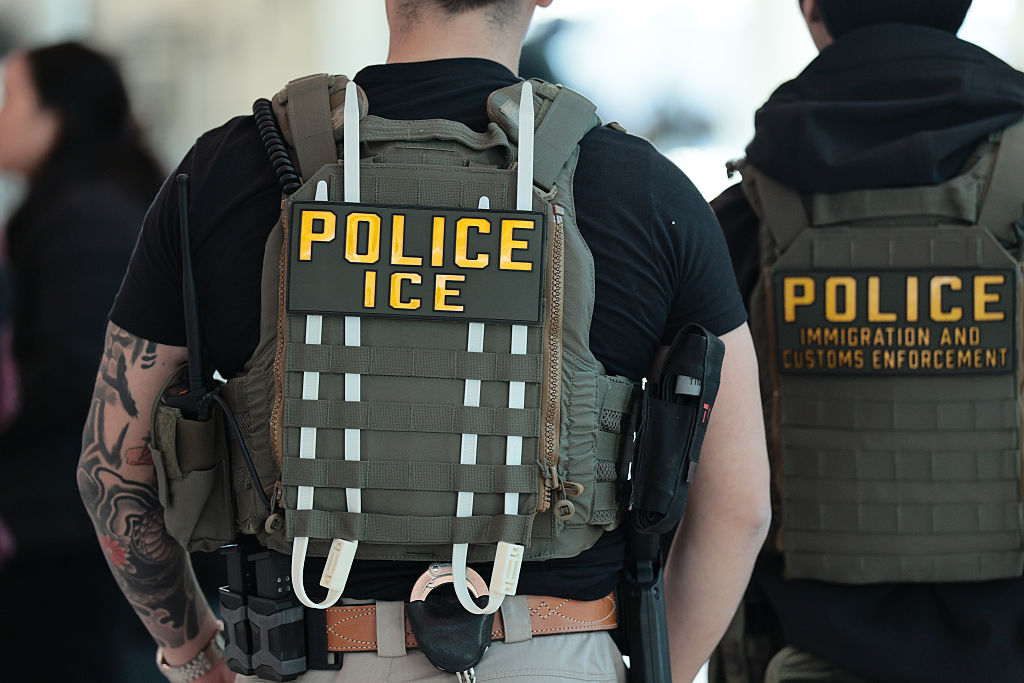
Immigration and Customs Enforcement agents patrol Terminal C at LaGuardia Airport on March 24, 2026, in New York. On Tuesday, the state Senate moved forward a wide-ranging bill to place additional limits on federal immigration enforcement in Connecticut.
Michael M. Santiago/Getty Images
State Sen. Gary Winfield, Senate chair of the Judiciary Committee, left, listens to state Sen. John A. Kissel, right, the committee’s ranking Republican member, making a point during a Senate debate Tuesday on a wide-ranging bill to place additional limits on federal immigration enforcement in Connecticut.
Paul Hughes/Hearst Connecticut Media
HARTFORD — Democrats in the state Senate moved Tuesday evening to establish new restrictions and legal consequences for federal immigration agents operating in Connecticut, including banning these agents from wearing masks and granting people a right to sue them in state court over civil rights violations.

The move came a day after the U.S. Department of Justice filed a lawsuit against the state and the city of New Haven for allegedly obstructing federal immigration law.
Article continues below this ad
The upper chamber of the Democrat-controlled General Assembly voted 24-10 along party lines to approve a so-called “ICE oversight bill.” Senate Democrats said it would hold federal Immigration and Customs Enforcement agents accountable for civil rights violations and crimes committed in Connecticut. Senate Republicans said it would protect from deportation immigrants in the U.S. illegally who are criminals and said it would violate the U.S. Constitution.
The partisan vote sends Senate Bill 397 to the state House of Representatives for possible final legislative approval before the 2026 legislative session ends May 6 at midnight.
At the outset of the debate, state Sen. John A. Kissel, R-Enfield, the ranking Senate member of the Judiciary Committee, predicted the legislation would sail through the legislature, but would not withstand judicial review if signed into state law. He said it violates the Supremacy Clause of the U.S. Constitution that states federal laws take precedence over conflicting state laws.
Article continues below this ad
Make CT Insider a preferred source on Google to see more of our journalism when you search.
Add Preferred Source
“Most of this stuff is going to be thrown right out of the window as soon as there is a legal challenge,” Kissel said.
But state Sen. Gary Winfield, D-New Haven, the Senate chair of the Judiciary Committee, disputed Republican arguments that provisions of the legislation would violate the Supremacy Clause.
“I don’t know why people think the federal Supremacy Clause means that you can’t do some of the stuff we’re talking about,” he said.
Article continues below this ad
In closing the four-hour Senate debate, Senate President Martin M. Looney, D-New Haven, said Connecticut would be exercising state rights under the 10th Amendment that establishes the division of powers between the states and the federal government.
“This bill in no way violates the principle of the Supremacy Clause in the U.S. Constitution. Properly understood, what this bill does is uphold our principles of federalism and the 10th Amendment to the U.S. Constitution,” he said.
The Senate bill combines provisions of several immigration-related bills that the Judiciary Committee advanced. It also incorporates provisions of another committee bill regulating the use of data from automated license plate readers, including prohibitions on using the information for investigating a suspected immigration violation or assisting in civil or criminal immigration enforcement.
The legislation would create civil and criminal liabilities for federal, state and local law enforcement for constitutional violations related to immigration enforcement actions, including a private right of action for people to bring lawsuits in state court. It also would allow Connecticut’s attorney general to bring civil actions against any law enforcement officer violating constitutional rights, including seeking injunctions, declaratory relief and damages.
Article continues below this ad
The bill generally would require judicial warrants to make immigration-related arrests at hospitals, schools, homeless shelters, churches and other protected locations, and would ban all law enforcement officers from wearing masks while interacting with the public and would require they clearly be identified with a badge and a name tag.
The legislation also would clarify that the state inspector general has the authority to investigate and prosecute any law enforcement officer who uses deadly force, including federal officers. It also would guarantee that the state inspector general and the state Division of Criminal Justice have the right to access crime scenes and evidence related to a law enforcement officer’s use of deadly force.
Senate Democrats dropped a provision that had proposed requiring the governor’s permission before any armed military force from another state, territory or district entered Connecticut for military duty.
Senate Republicans offered an amendment that would have allowed federal law enforcement authorities to detain incarcerated individuals convicted of murder and other serious felonies upon completion of their prison sentences. It was defeated on a 24-10 vote along party lines.
Article continues below this ad
During a mid-day news briefing before the Senate session, Looney and Senate Majority Leader Bob Duff, D-Norwalk, reported that legislation has the support of Gov. Ned Lamont and fellow Democrats in the House. But both Democratic leaders stopped short of predicting House passage and final gubernatorial approval.
“We are here today putting forth legislation in the state of Connecticut to protect the residents of the state of Connecticut from the excesses of the federal government,” Duff said at the briefing. “I don’t know if that’s ever been done in this building, where we had to have a law to protect residents of Connecticut from their own federal government.”
The governor’s office issued a statement that the Senate bill reaffirms Connecticut’s commitment to public safety, civil rights and the rule of law.
“At a time when communities across the country are raising serious concerns about federal immigration enforcement practices, this bill makes clear that Connecticut will not tolerate actions that undermine trust, public safety or access to essential institutions like schools, courts and places of care,” the statement said.
Article continues below this ad
The Senate debate and vote took place a day after the Department of Justice sued Lamont, Attorney General William Tong, and the city of New Haven and its mayor, alleging state and city “sanctuary polices” were unconstitutionally interfering with the federal government’s enforcement of immigration laws.
The state Trust Act has limited state and local cooperation in federal immigration enforcement since 2013. The legislature voted in a November special session to update protections for immigrants, including adopting new statutory standards for federal enforcement activities on state courthouse grounds and clarifying the limits on state and local agencies on sharing personal information with federal immigration authorities.
The DOJ lawsuit alleges these state laws violate the Supremacy Clause. It also levels the same charge over an executive order that New Haven Mayor Justin Elicker issued in July 2020 to protect immigrant rights, including prohibiting city police officers or employees from inquiring about a person’s immigration status and limiting information shared with federal authorities, including a person’s immigration status.
Article continues below this ad
The Senate action also came about a week after the controversial arrest and detention of a Cheshire High School student who is the son of an Afghan interpreter for U.S. forces during the war in Afghanistan by ICE agents.
Sens. Cathy Osten, D-Sprague, and Heather Somers, R-Groton, missed Tuesday’s votes on the proposed amendments and the final bill.