
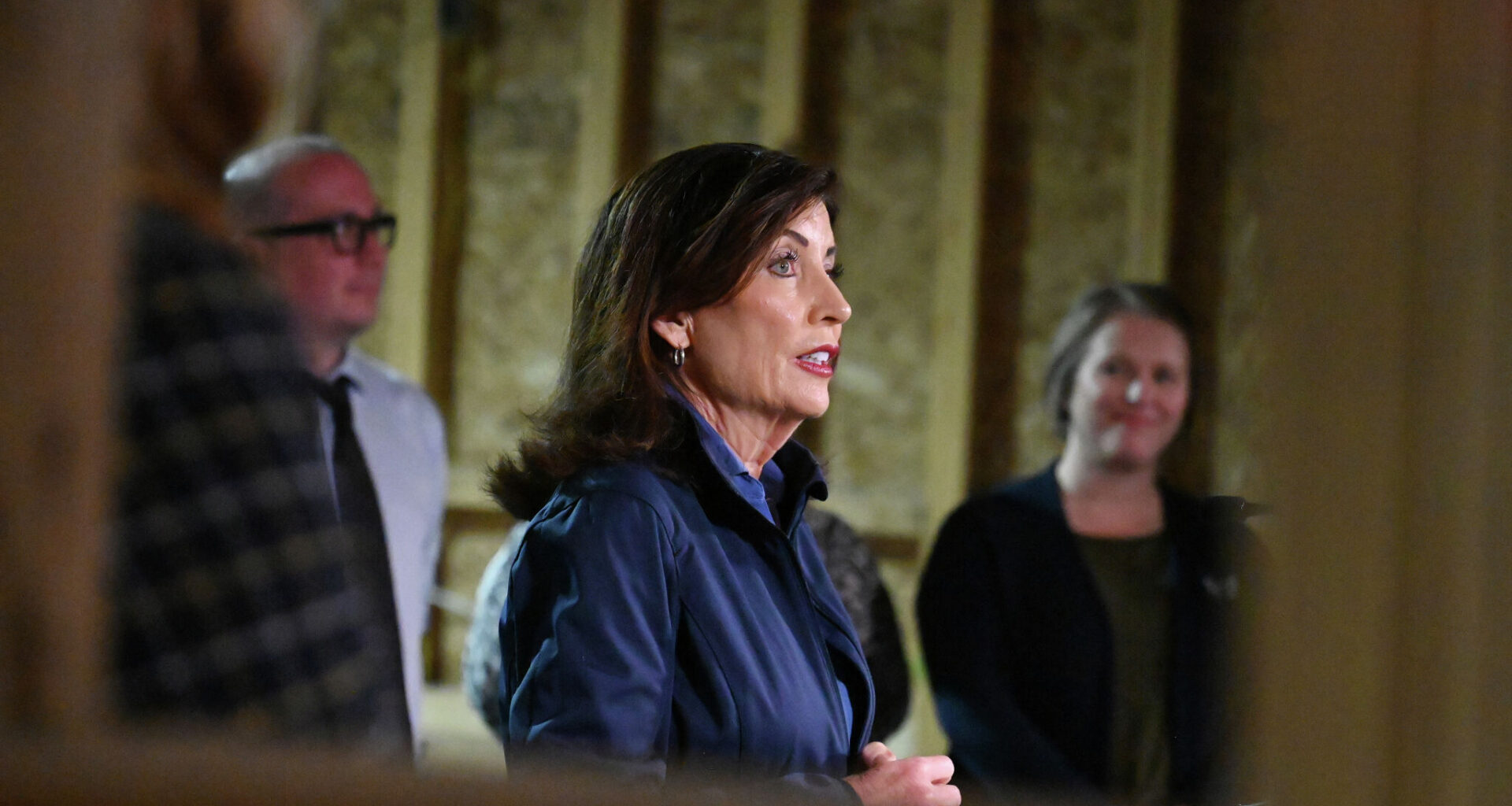
Gov. Kathy Hochul has proposed a tax on second homes in New York City valued at $5 million.
Will Waldron/Times Union
ALBANY — Gov. Kathy Hochul is backing a new tax on ultrawealthy second homeowners in New York City, reviving a long-stalled “pied-à-terre” tax aimed at helping close the city’s multibillion-dollar budget gap.

Hochul said that the proposed tax would impose an annual surcharge on residential properties “worth over $5 million” that are within the city and not used as primary residences. For the purposes of the tax, it’s unclear if the tax would be imposed based on a property’s value as determined by a city tax assessor. The governor said that the tax would ensure that those that own secondary luxury homes, but do not live in the city or pay income taxes, are still fairly contributing toward essential services.
Article continues below this ad
The proposal, she said, would allow the city to levy a tax surcharge that would generate at least $500 million in recurring annual revenue for the city. That would be on top of the $1.5 billion the state is earmarking to help the city with its budget gap.
The pied-à-terre tax has remained unmoved in the state Legislature for the past seven years. The bill was first introduced in 2014 by former state Sen. Brad Hoylman-Sigal, a Manhattan Democrat, and was initially blocked by Republicans who held the majority at the time.
With Democrats in control of the Senate, discussions around the tax resumed most recently in 2019 but was shut down by former Gov. Andrew M. Cuomo.
Make the Times Union a Preferred Source on Google to see more of our journalism when you search.
Add Preferred Source
Senate Majority Leader Andrea Stewart-Cousins said Wednesday that she hadn’t yet discussed the proposal with other Democrats in her chamber.
Article continues below this ad
Hochul proposed the tax two weeks after the April 1 budget deadline, a shift in her previous stance to resist calls for broad tax hikes on wealthy individuals and corporations.
During a news conference on Wednesday, Hochul denied that activists or influential politicians like New York Mayor Zohran Mamdani or U.S. Sen. Bernie Sanders, who are both self-described democratic socialists, had influenced her proposal.
“I feel no need to appease anyone,” she said. “I’m looking out for the city’s finances.”
Some Republicans were quick to criticize the proposal. Bruce Blakeman, the Nassau County executive and Republican gubernatorial candidate, said the proposal violates the governor’s prior pledge to taxpayers that she would not support increasing levies for high-income earners.
Article continues below this ad
Blakeman said Hochul’s pledge had “expired faster than the families fleeing New York’s affordability crisis.” He characterized the issue as “a war on homeownership and the American dream.”
State Senate Minority Leader Robert Ortt also criticized Hochul.
“It seems like Kathy Hochul is taking budget direction from the DSA-funded billboards outside the Capitol,” Ortt said. “She’s breaking her commitment not to raise taxes and surrendering the third chair in budget negotiations to Zohran Mamdani and the New York City socialists so they can push for tax hikes statewide.”
In the Capital Region, state Sen. Pat Fahy views the proposed tax as a sensible way to generate revenue with minimal negative consequences. Fahy drew on her seven-year battle to pass a short-term rental registry bill.
Article continues below this ad
Fahy said that second homes contributed significantly to the housing crisis because high-value properties owned by out-of-state or international investors sit empty most of the year, reducing available housing stock and driving up costs for locals.
Just as Airbnbs and short-term rentals “leveled the playing field” for hotels and housing, she sees this tax as a way to address the “compounding problems” of the housing market.
While the current proposal focuses on New York City, Fahy is open to a conversation about expanding it upstate, where other cities are facing budget deficits, provided the conversation is guided by data.
Fahy said that the impact upstate depends entirely on the chiseled nature of the tax. If the threshold is properties assessed over $5 million, it would likely only affect specific areas with highly valued homes like Saratoga Springs or Lake Placid.
Article continues below this ad
Assemblyman John T. McDonald III said that if the state grants New York City the permission to implement this tax, the financial burden falls exclusively on that city’s residents.
Because the tax is localized, a resident in Cohoes is not paying for New York City’s financial challenges, he said. That allows New York City to raise revenue without as adversely impacting taxpayers in other parts of the state.
“At least for the people outside of New York City, it’s a win,” McDonald said. “We’re not subsidizing New York City’s financial challenges.”
Article continues below this ad