
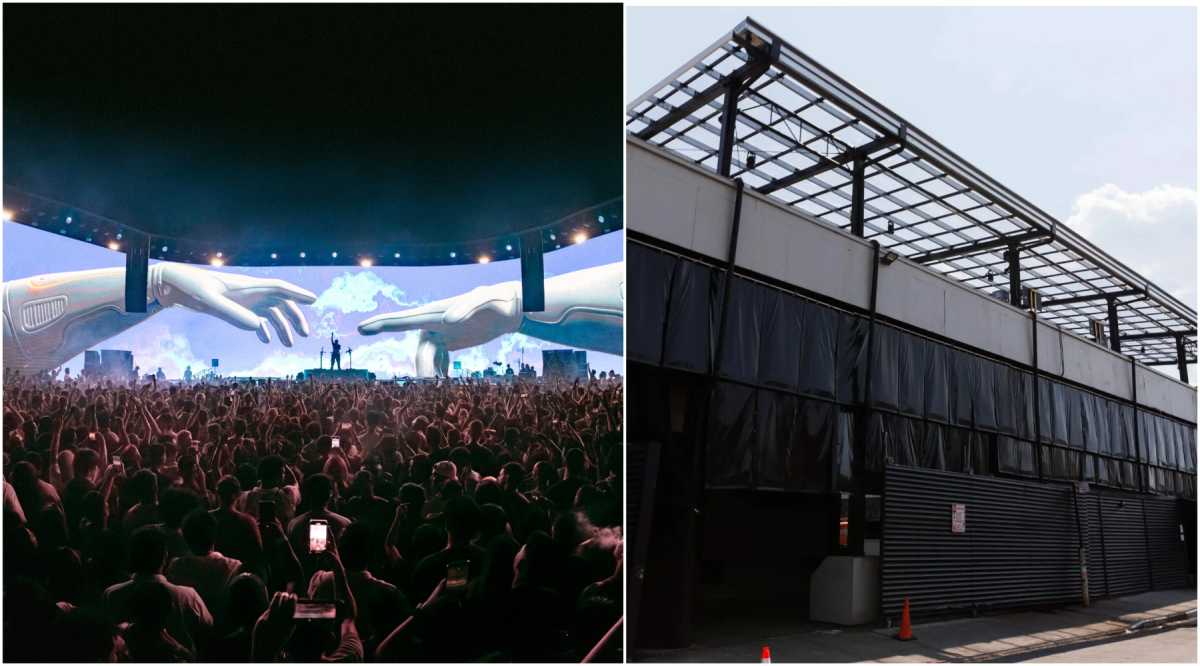
The team from Pacha New York got a taste of the sweaty, crowded nights to come on Tuesday night as their plans for the former Brooklyn Mirage space were met with skepticism and anger at Community Board 1.
Pacha and its parent company, FIVE Holdings, have been approved to take over operations of the old Mirage and its sister venue, The Great Hall, after the spectacular failure and subsequent bankruptcy of Avant Gardner.
While the deal has been settled and tickets sold for opening weekend, Pacha still needs a liquor license, which means seeking the advisory approval of CB1.
Exec says Mirage’s challenges should be blamed on management
In a packed and overheated room at the Swinging Sixties Senior Center, FIVE chair and chief executive officer Kabir Mulchandani said he knew the Mirage had left locals unhappy, but said Pacha would be different.
“Once talking to members of the community, it has become exceptionally clear that there were many challenges this venue faced, but I don’t think the venue deserves the blame,” he said. “It’s the management that deserves the blame.”
 FIVE Holdings executive Kabir Mulchandani (second from left) presented his plan for Pacha New York to Community Board 1 on Tuesday.Photo by Kirstyn Brendlen
Among those “challenges” were chronic overcrowding and safety issues — including three fatal drug overdoses — that repeatedly landed the Mirage in hot water with the State Liquor Authority. A 2023 lawsuit claimed that patrons had been assaulted and harassed by security staff. The same year, politicians lambasted the venue’s lack of security after two visitors were found dead in Newtown Creek.
Simultaneously, locals said they were plagued by booming bass emanating from the outdoor venue at all hours of night and by drunken patrons trashing the neighborhood in the early hours of the morning.
Then, there was the infamous failed renovation that eventually sent Avant Gardner into bankruptcy after the structurally-unsound “Mirage 2.0” failed to pass inspection and was later demolished.
Pacha plans for smaller venue, smaller crowds
For now, Pacha New York would be smaller and simpler than the Mirage, Mulchandani said. It would have a smaller capacity — room for 7,850 people between the former Mirage space and The Great Hall, less than the roughly 9,600 who would have fit in the never-opened “New Mirage.”
He said the Department of Buildings has already approved permits for the temporary structures they’re planning to build, noting that they had gone through a thorough approvals process with the DOB, where the old Mirage was self-certified and later found to have structural issues.
“This is a way to be sure that what you’re doing complies with the regulations and with safety,” he said. “ … it was far more expensive, far more time consuming, but we received approvals for everything we’re going to build.”
 A rendering of the renovated Brooklyn Mirage, which never opened, showing layers of mezzanines nad large screens on the walls. Image courtesy of Brooklyn Mirage
DOB spokesperson Andrew Rudansky confirmed that the structures have undergone a full plan examination and that permits have been granted. Because of the site’s history, any new construction applications have to go through the full DOB review, he said, and are not allowed to be self-certified.
Mulchandani emphasized the “simplicity” of the design.
“There’s no complicated walls and things hanging off things. It’s not an unsafe structure because it’s still using the great screen that made this venue incredible,” he said.
Permits show that Pacha plans to construct a temporary stage, platforms and a video screen on the empty lot where the Mirage used to be. Shipping containers will be used to create temporary spaces both backstage and in the concert area, and plans call for a 23-foot acoustic wall Mulchandani said will help dampen sound in the neighborhood.
He said the venue will also utilize new sound-reduction equipment and policies, including decibel monitors and directional speakers that will point in toward the crowd, rather than up and out. An analysis by geotechnical consulting firm GZA showed that the loudest noise would be restricted to the area directly surrounding the venue, though noise would still carry significantly in the area north of the venue.
When open, Pacha will axe the Mirage’s 18+ policy and only allow people 21+ to enter, he said. The venue would use “AI-powered” capacity tracking and walk-through security scanners.
Outside, he said the venue has already installed a 4G/5G macrosite to provide cell service for people entering and leaving, and that they will deploy temporary lights on “designated pedestrian routes” after shows.
Pacha is also planning to run shuttle buses to the Morgan Avenue, Jefferson Avenue and Union Square stations between 2:30-4:30 a.m. Those buses, modeled on an existing service at Pacha in Ibiza, would run every 30 minutes or “as needed,” according to the venue’s new director of security.
After performances, the venue would deploy cleanup crews to Meserole Street and Stewart Avenue to take care of trash — and, as some neighbors warned, copious amounts of vomit — left by its patrons.
‘How can we trust you?’
Mulchandani’s presentation was immediately greeted with pushback.
“How can we trust you when you’ve already sold 16,000 tickets for an event you’re having in June and you haven’t even gotten approved yet, as far as I know, for your liquor license?” asked board member Julia Amanda Foster.
Foster later said that Pacha’s lawyer, Max Bookman, had “crossed out” license stipulations suggested by the community board’s SLA committee.
Bookman and Mulchandani emphasized that they are applying to “transfer” the existing liquor license held by Avant Gardner, which is still valid but inactive.
Bookman said the team was referring back to stipulations the board approved for Avant Gardner in 2025, which allowed the venue to keep selling alcohol until 4 a.m. and remain open until 4:30 a.m.
“We relied on those stipulations, and we figured, if you were willing to approve old [Avant Gardner] with those stipulations, we feel that, based on all the improvements we’re offering, you ought to be willing to approve us for the same hours of operation,” Bookman said. “This is a transfer.”
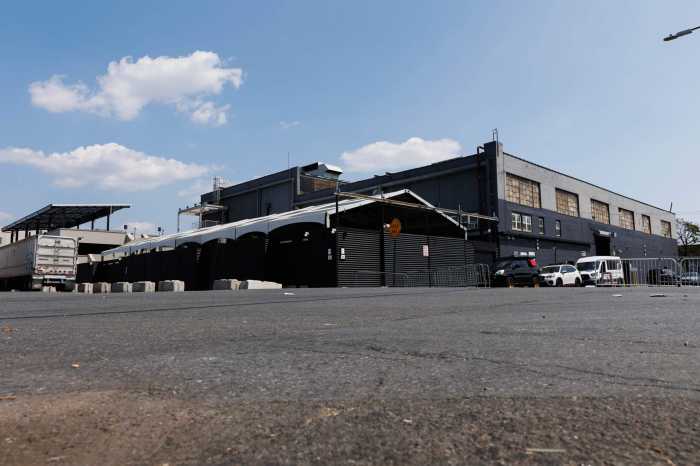 Avant Gardner, with the Mirage at left, in 2023. File photo by Paul Frangipane
Per state law, a “transfer” does not mean that an existing liquor license is moved to a new operator. A transfer refers to an application filed by a business that is buying over an already-licensed one. Both the application and permit are entirely new.
Mulchandani claimed that if the transfer application were not approved in time, Avant Gardner could operate the venue with its existing license.
“They have an existing liquor license that’s active and can be used, and we franchise our brand and we use our brand and we work in coordination with them,” he said. “Or we can have this transfer done and go through the process. So the venue is going to open either way, there is an existing liquor license.”
But a new owner or operator can’t just use a license issued to the previous operator, an SLA representative told Brooklyn Paper.
“If they did that, it would actually be a charge of availing the license,” they said. “That is definitely not allowed.”
Restrictions on franchises were not as clear, they said, but if a venue has a new owner and operator — as Pacha does — they could not make use of the old permit.
Avant Gardner’s existing license — which is inactive but valid until 2027 — was at risk of being revoked by the SLA last year due to its long list of violations. At an SLA board meeting in December 2025, SLA chair Lily Fan agreed to let Avant Gardner keep its license but upped a $50,000 fine to $175,000.
She also ordered that the new owner’s liquor license application would have to come before the full SLA board.
Nearly every speaker at Tuesday’s meeting registered their concerns about Pacha. A resident named Karina said she has lived near the venue for 20 years. The influx of music venues has changed an already under-resourced neighborhood for the worst, she said.
“It is very sad what is happening, people come in from other communities and they basically trash the neighborhood and the club owners make hand-over-fist while you see schools that are struggling, no green space,” she said.
Many of the residents at Tuesday’s meeting live in neighboring CB4, which they said has been largely excluded from the licensing conversations despite being deeply impacted by the clubs.
“I’m a caregiver. My dad is 84 years old, he has Alzheimer’s, and the streets are loud,” said Giovannies Justiniano, a member of CB4. “It’s an ecosystem that has been horrible for us. Trash, nightlife, piss, and it’s also exhaustive for a lot of resources in the city, for NYPD, DSNY.”
Bushwick resident Brian Konash told the committee that he supports Pacha opening a large venue with late-night hours. The site is “unique,” he said, and a magnet for artists and tourists.
“The Pacha site is in an M3 heavy industrial zoned area located in an already-established nightlife district,” he said. “Loud noises are supposed to happen in heavy industrial zoned nightlife areas.”
Several other residents said that while newer Brooklynites feel like East Williamsburg has always housed dozens of venues, it used to be much quieter.
Nina Melendez told Brooklyn Paper she has lived “a little over 1,000 feet” from the venue since 2008.
“I understand that back there is very industrial, and it seems like an ideal place to open a club, but then that flow of traffic comes right back into the residential area,” she said. “There was no mitigation, there was no, any kind of effort put into what to do after all of these drunk people left the club.”
The Mirage sitting dark and empty for the past year has provided a reprieve Melendez described as “wonderful.”
“There’s an overabundance of this type of business concentrated right over there, though, so it’s not like it went away,” said Hailey Desjardins. “The growth of that has been really fast and very unchecked.”
‘We are asking for a chance’
Evelyn Cruz, district director for U.S. Rep. Nydia Velázquez, said the congressmember and several other elected officials sent a letter to the SLA asking that the application review be delayed “until we’re able to go in and visit the location and get more information. The SLA agreed, se said.
“We want the community to do the right thing, and if it means taking a tour, delaying the vote, that’s what we do,” Cruz said.
While the full license application is being weighed, Pacha has applied for a temporary license, Bookman said. That application is set to be heard by the SLA board next month. If granted, a temporary license would carry restrictions — like a closing time of midnight at the latest and no outdoor music at all.
“We are asking for a chance,” Mulchandani said. “This can be done where you give us a temporary approval, we come back in October, we come back after a season’s been done. Put us to the test. Do whatever you reasonably need to do to test us. Hold me accountable. But give me an opportunity.”
Melendez said she was glad to hear about the things Pacha plans to put in place to address the issues raised by the community, but she remained hesitant. The feeling was shared — other speakers said they would “believe it when I see it” and urged additional controls, like real-time noise monitoring and a life complaint hotline similar to what’s used at Under the K Bridge Park.
“I would love to give him a chance,” Melendez said. “I would also love for there to be stipulations in place so when they break that trust, and when they violate the things that they’ve agreed to do, that there are consequences to that.”