
Of all the changes ushered in by the New York Giants’ hiring of John Harbaugh as head coach, the biggest shakeup in the front office was Kevin Abrams’ dismissal after 27 years with the organization. Abrams was replaced by Dawn Aponte, who inherited the same title of senior vice president of football operations and strategy.
“With her salary cap background, she’s basically an easy transition because it’s a lot of what Kevin Abrams was doing, if you guys remember his role,” general manager Joe Schoen said at the combine in February. “It’s essentially the same.”
Abrams, who was the Giants’ assistant GM from 2002 to 2021, primarily managed the salary cap and negotiated contracts. Now that the dust has settled on free agency, a review of the contracts handed out by the Giants reveals not much has changed.
The Giants dished out three mid-level contracts in free agency: Three years, $40 million for tight end Isaiah Likely, three years, $39 million for right tackle Jermaine Eluemunor and three years, $36 million for linebacker Tremaine Edmunds. The percentage guaranteed was nearly identical in the three deals: 65 percent for Likely, 65.3 percent for Eluemunor and 65.8 percent for Edmunds.
All of the contracts had the same structure with a reduced cap hit in the first year, followed by a significant spike in Year 2 and a similar hit in the third season. For example, Likely’s cap hits are $6.09 million in 2026, $17.67 million in 2027 and $16.17 million in 2028. All of the contracts are structured to give the Giants a relatively pain-free out after the second season (barring any restructures over the next two years).
The contracts handed out this year bear similarities to equivalent deals in the past when Abrams was the franchise’s top salary cap guru. Last offseason, safety Jevon Holland signed a three-year, $45.3 million contract and wide receiver Darius Slayton signed a three-year, $36 million contract. In 2024, guard John Runyan signed a three-year, $30 million contract.
Holland got 66.9 percent of his contract guaranteed compared to 61.1 percent for Slayton and 56.7 percent for Runyan. There are variables in every negotiation, but those percentages are at least in the ballpark of the guarantees in this year’s contracts.
The structure of the cap hits was also similar, as Holland had a $9.94 million cap hit in 2025 that jumped to $17.5 million in 2026 and $17.8 million in 2027 (those figures in 2026 and 2027 have increased slightly based on a minor restructure last October). The Giants were more aggressive in lowering the cap hits in Year 1 for this offseason’s signings, as Likely, Eluemunor and Edmunds all got the minimum base salary of roughly $1 million. Holland, Slayton and Runyan got a few million more than the minimum base salary in Year 1.
As with this year’s contracts, all three of the past deals provided an escape hatch for the team after Year 2. The Giants have elected not to take the out with Runyan, but they would have created $9.25 million in cap savings while eating just $2.5 million in dead money if they cut him this offseason.
Any impact from Aponte seems to be behind the scenes in her first months on the job after spending the past decade as the NFL’s chief administrator of football operations. An informal polling of agents who dealt with the Giants during free agency indicated that director of football operations Ed Triggs remained the point man on many negotiations, as has been the case in recent years. Agents with closer relationships with Schoen had more direct communications with the GM. Aponte’s name was rarely mentioned, although there is an expectation that her involvement could grow as she gets more familiar with her new role after so many years on the league side.
Notably, Aponte’s signature is on all of the free agent contracts on the line designated for a club executive. Schoen had signed the contracts for the team in recent years.
• The Giants used incentives heavily in many of their free-agent contracts. That’s a similar approach to past years, but it was more pronounced this offseason.
The most notable example is wide receiver Darnell Mooney, who signed a one-year contract with a base value of $3 million. That’s a bargain for a receiver who had 992 receiving yards in 2024. Clearly, there wasn’t a strong market for Mooney based on his low base value, but the Giants enticed him to sign by adding $7 million in incentives to the contract for a potential max value of $10 million.
It’s unlikely that Mooney will earn the full $7 million, which is based on playing time, receptions, receiving yards and receiving touchdowns. But the thresholds are low enough to realistically earn a chunk of the available incentives if he performs like he has previously in his career. For instance, Mooney would have earned $5.6 million of the incentives in his career-best season in 2021 when he had 81 catches for 1,055 yards and four touchdowns.
Having such a significant amount of the max value of a contract tied to incentives is unusual across the league, not just for the Giants. The incentives in other Giants contracts this offseason were more in line with past deals. Likely can earn $2.4 million in incentives in each year of his contract based on production, playing time and team performance. The highest-paid player on the team, outside linebacker Brian Burns, can earn $1.8 million in incentives based on making the Pro Bowl or first-team All-Pro or recording 12.5 sacks in a season. Burns signed his five-year, $141 million contract in 2024.
The liberal use of incentives is a staple of Schoen’s contracts. It’s not as common in Ravens contracts. As in the past, all of the incentives in the Giants’ contracts are categorized as Not Likely To Be Earned (NLTBE). This is important for salary cap purposes, since NLTBE incentives don’t count on the cap in the current year. If a player earns an NLTBE incentive, that amount will be charged to the following year’s cap. Conversely, Likely To Be Earned (LTBE) incentives count on the current year’s cap. If the player doesn’t earn the incentive, the team gets a credit in that amount on the following year’s cap.
The Giants lost $1.7 million from this year’s cap after the calculation of incentives and other rollover charges from last season. The biggest factors in that accounting were Burns earning his $1.8 million incentive and defensive tackle Dexter Lawrence earning $1 million in playing time incentives.
The classification of an incentive is based strictly on the previous season. For instance, Mooney will earn $375,000 if he has 35 or more catches this season. He only had 32 catches last season, so that incentive is classified as NLTBE. The Giants strategically set the baseline for incentives so they qualify as NLTBE but are attainable for players based on past performance.
The Giants have continued to incorporate workout bonuses to incentivize attendance for the voluntary offseason program in nearly every contract. Those range from as low as $25,000 in wide receiver Isaiah Hodgins’ one-year, $1.2 million contract to $500,000 in Lawrence’s four-year, $90 million deal. Players must attend 84.4 percent of the voluntary offseason program, as well as 100 percent of the 10 OTA sessions and minicamp, to collect a workout bonus. Barring a quick resolution to his contract standoff, Lawrence will sacrifice his hefty bonus as he pushes for a raise or trade.
The Giants also continue to heavily use per-game roster bonuses in contracts. Per-game roster bonuses provide the team insurance if a player misses time due to injury. For instance, linebacker Micah McFadden, who is returning from a major foot injury, can earn a maximum of $750,000 ($44,118 per game) in per-game roster bonuses this season. Like with NLTBE incentives, the cap charge this year is based on the previous season. Since McFadden appeared in just one game last season, only $44,118 from the per-game roster bonuses will count on this year’s cap. If he appears in more games, those cap charges will apply next year.
• A staple of the Ravens’ roster-building process has been accumulating compensatory picks, which teams get based on the free agents they lose compared to the free agents they sign. The Ravens have an NFL-high 64 comp picks since they were introduced in 1994.
The Giants had too many roster holes to prioritize comp picks in Harbaugh’s first offseason, but they may wind up with a pick based on how things have played out. Over The Cap projects the Giants to receive a fourth-round comp pick in the 2027 draft, but it’s a fluid projection with a formula that calculates compensation, playing time and postseason honors.
“It’s one of those, it could be four, five, six or nothing,” Schoen said of the round of a potential comp pick. “Some of it is out of your hands, like injury, play time — you don’t know. But as of right now, we’ll see how it plays out, but we would be hopeful right now that we could get one.”
Schoen said comp picks didn’t drive the Giants’ free-agent decisions. That’s obvious since they made Pat Ricard the highest-paid fullback in the NFL with a two-year, $7.63 million contract that could jeopardize the Giants’ comp pick.
“We weren’t going to lose out on a player because of a potential end of the sixth-round pick or something like that,” Schoen said. “It’s in the back of our mind, but if there’s somebody out there that we love and we want to make room for a $5 million player or whatever it is, we would certainly do it.”
The comp pick implications have clearly become more of a consideration as free agency has progressed. The Giants haven’t added a player for a contract worth more than the minimum since Mooney signed at the end of the first week of free agency.
Signings stop counting toward the comp pick formula on the Monday following the draft, so the Giants could make a move then. That also allows the team the benefit of seeing how the draft plays out before making a commitment to a veteran. The Giants have had veteran defensive tackles DJ Reader and Shelby Harris in for visits recently. Both players left without signing, but it’s entirely possible that parameters were put in place for a possible post-draft union. There could also be players added to the market if veterans get cut after their teams draft replacements.
The Ravens have made a habit of post-draft signings to preserve comp picks. So it’s no surprise that Baltimore, which is projected to have three comp picks in 2027, also hosted Reader for a recent visit. Harbaugh’s current and former teams could be in a competition for the top defensive tackle remaining on the market. The Giants could have greater urgency to land Reader depending on Lawrence’s status.
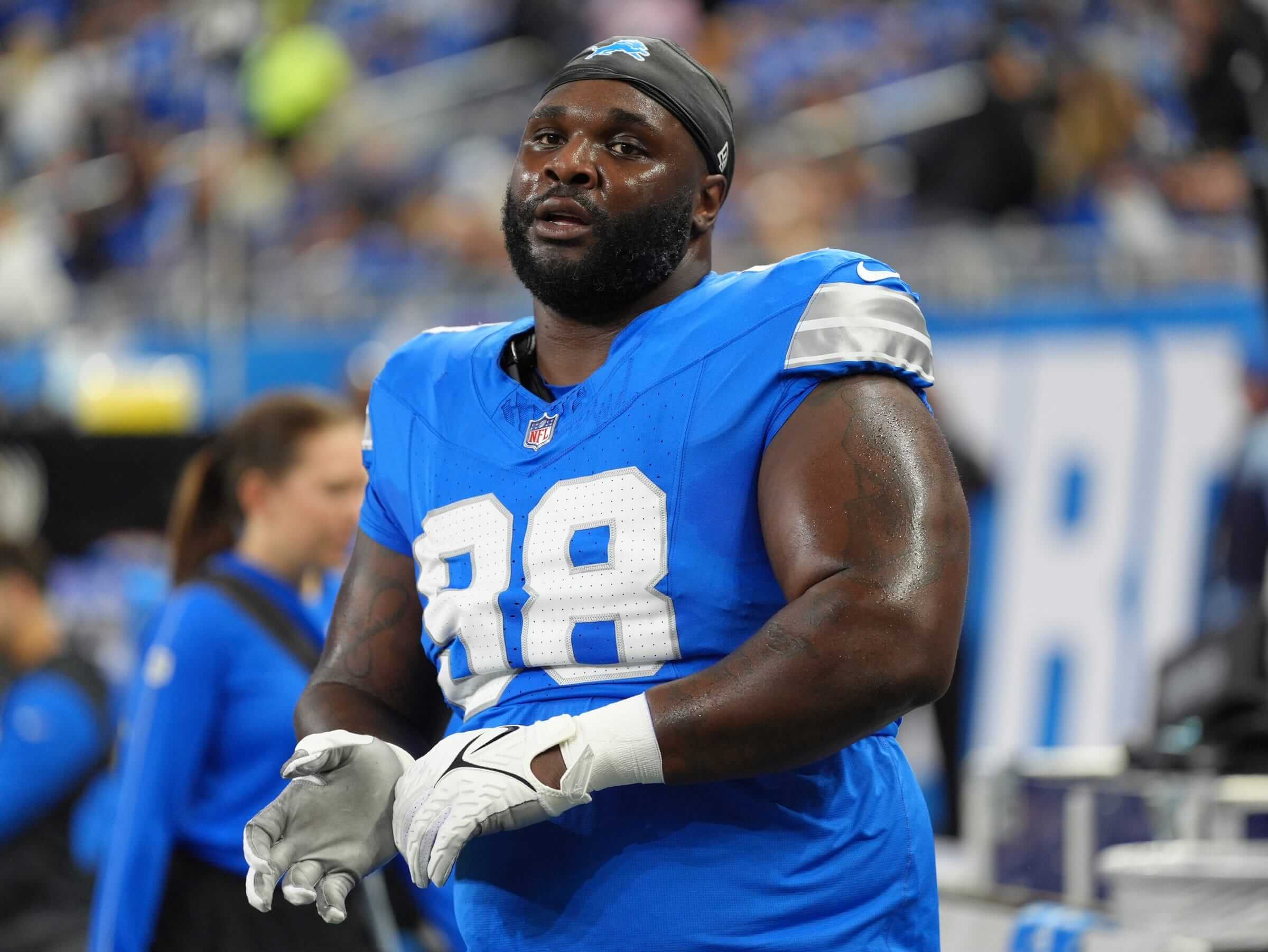
DJ Reader (98) could be a target for the New York Giants, depending on the fallout from star defensive tackle Dexter Lawrence’s trade request. (Kimberly P. Mitchell / USA Today via Imagn Images)
It’s also possible that the Giants could sign a right guard after the draft, with former Raven and Giant Kevin Zeitler the top option on the market. But it seems like the Giants may be content to stage a competition after throwing numbers at the position, with Daniel Faalele, Evan Neal, Aaron Stinnie and Josh Ezeudu mentioned by Schoen as options. The Giants also signed veteran Lucas Patrick, who has made 65 career starts at the three interior O-line spots, and drafting one in the second round is a possibility.
The Giants could re-sign Greg Van Roten, who played every snap at right guard the past two seasons. That would ensure there isn’t a downgrade and Van Roten wouldn’t count toward the comp pick formula since he was on the team last season. It seems like the Giants are keeping Van Roten on the back burner as a potential backup plan, but their preference appears to be going cheaper and younger than the 36-year-old.
One benefit of the Giants signing so many players to one-year contracts this offseason is that it could better position them for comp picks next year. There’s no chance that every player signed to a prove-it contract — Mooney, Faalele, Neal, McFadden, cornerback Greg Newsome and wide receiver Calvin Austin — will thrive this season. But if a few of them hit, the Giants will be in position to collect 2028 comp picks if those players cash in elsewhere next offseason. Outside linebacker Kavyon Thibodeaux is also in line for a payday elsewhere next offseason, as long as he’s not traded before then.