
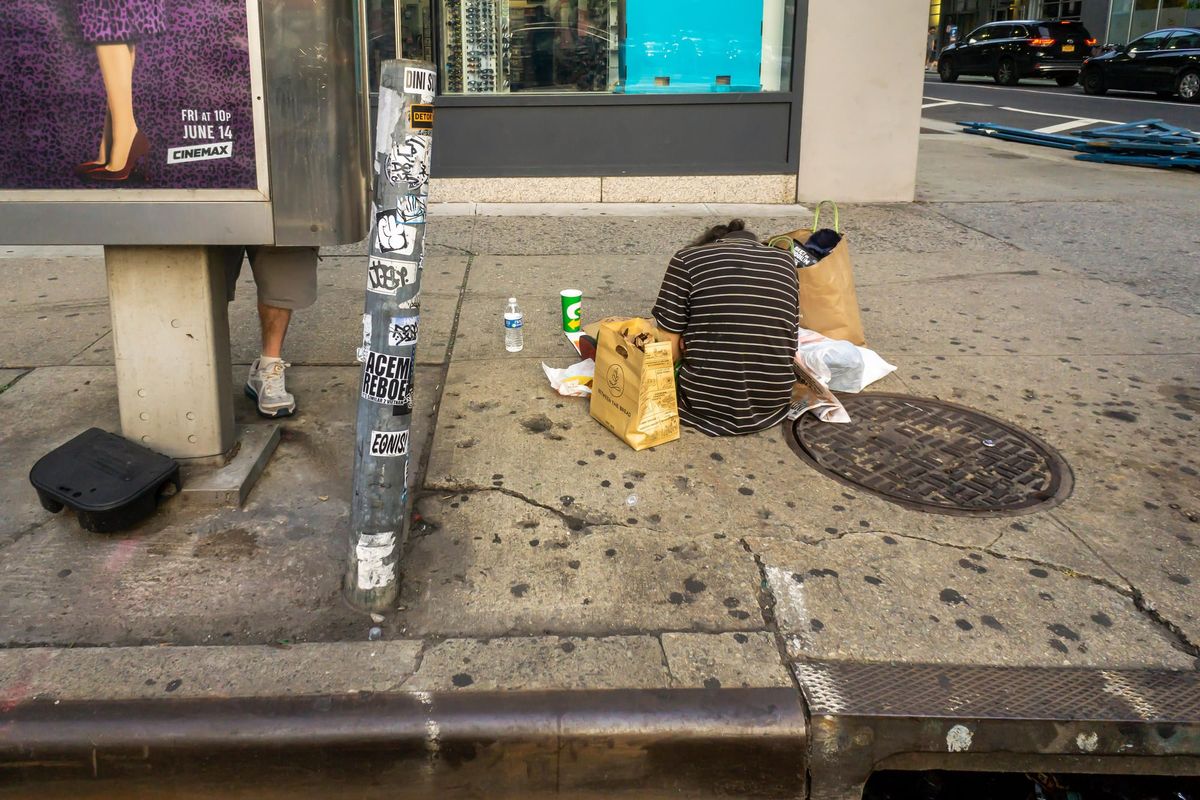
Understanding the complexity of troubled populations on sidewalks and subways
City governments are increasingly focused on reducing the number of people with serious mental illness who live on city streets — and with good reason. Living on the street is clearly dangerous. The presence of people with mental illness living on the street also disturbs other city residents, for reasons ranging from fear of violent behavior (whether well-founded or not) to compassionate and empathetic concern.
Censuses suggest that about one-quarter of unsheltered homeless adults have a serious and persistent mental illness, though the share varies by city depending on the availability of shelter. In New York, the city comptroller estimates that roughly 2,000 people with serious mental illness are living on the streets.
Research suggests that for many people with mental illness or serious addiction, supportive housing, which provides both subsidized shelter and the services they need to stabilize, is the best living option. The policy puzzle is that the counts of unsheltered people with serious mental illness and other maladies are quite small relative to the number of supportive housing units already in use — roughly 40,000 in New York City. Given existing inventories, it might seem relatively inexpensive and straightforward to expand supply by just 5% and house another 2,000 people in New York, thereby addressing the problem. Experience shows that it is not so simple.
One well-recognized challenge is that some people with serious mental illness choose not to remain in housing, even with supports, and instead return to the street. But these transitions are only one of the many dynamics that muddle the arithmetic of reducing street homelessness. Street homelessness is not a static condition — it is dynamic.
Part of that dynamic consists of inflows from and outflows to those living in the community in ordinary (often subsidized) housing. Most people with serious and persistent mental illness at risk of losing housing (a group that we have estimated constitutes at least 0.85% of the total adult population) are not homeless at a given point in time — they live in the community. However, about one-tenth of people with a serious mental illness currently living in the community had been homeless in the prior year and one-fifth had experienced one or more episodes of homelessness over their lifetimes. These statistics imply that for every person with serious mental illness living on the street at a point in time, there are roughly four others — currently housed — who have experienced homelessness in the past. They also imply that many people currently living on the streets will eventually return to housing in the community.
Flows into and out of jails, hospitals and other institutions add another dimension to this dynamic system. Nearly half of individuals with a lifetime history of homelessness (whether or not they had serious mental illness) have been incarcerated at some point. Studies of supportive housing interventions find that large shares of homeless people with serious mental illness have had prior stays in inpatient or state psychiatric facilities. Most people living on the street have also spent time in homeless shelters. At a point in time, about 97% of homeless adults in New York are in shelters.
The overall population at risk of homelessness also evolves over time. Young adults experiencing the onset of serious mental illness enter the population, while those already affected — whether living on the streets, in shelters or in the community — face elevated mortality risks.
Perhaps surprisingly, we find that adding supports to help people remain in supportive housing, so that they are less likely to return to the streets, has little effect on the overall street population.
Adding supportive housing units to this complex system sets off a cascade of effects. Supportive housing directly reduces the number of people sleeping on the streets, but it also (intentionally) reduces entry into jails, hospitals and institutions, and, proponents hope, improves life expectancy. It may also (unintentionally) reduce the likelihood that individuals return to other forms of housing in the community. These changes — many of them highly desirable — reduce outflows from the formerly street-homeless population. Combined with steady inflows into homelessness, this means that additional housing units may have more limited effects on the unsheltered population census than expected.
In recent research, we use an approach called Markov modeling to estimate how additional supportive housing targeted to people with serious mental illness would affect the street population in New York City. Under very restrictive targeting assumptions — where units are reserved exclusively for individuals who have lived on the street for at least two years — we find that more than two new units are required to reduce the street population census by one person. Under assumptions that more closely reflect existing supportive housing programs, we estimate that about four new units are needed to reduce the street population by one person. Other research, not limited to people with serious mental illness, suggests that as many as 10 new units may be required to achieve this outcome.
Perhaps surprisingly, we find that adding supports to help people remain in supportive housing, so that they are less likely to return to the streets, has little effect on the overall street population. These supports help individuals remain in their units and may keep them out of jail and hospitals, but that stability means that units turn over less frequently and become less available to new entrants. Our analysis suggests that strategies targeting the much larger population at risk — those currently housed in the community — might make a given supply of supportive housing go farther. Unfortunately, it’s difficult to design and target such strategies so that they don’t become prohibitively expensive.
The dynamics of homelessness, particularly among people with serious mental illness, make this a challenging policy problem. Significant investments in housing can yield smaller-than-expected reductions in the street population. But this does not reflect waste or inefficiency. Rather, the visible street population represents only the tip of a much larger underlying problem: a sizable population with serious mental illness who struggle to consistently secure stable housing. These conditions make it very unlikely that people can earn enough (or collect enough through disability benefits, which currently average about $1,000 a month) to consistently and continuously afford adequate and stable housing. Most people in this group manage to remain housed most of the time, but a substantial share is at ongoing risk of homelessness.
Supportive housing units targeted to those who are chronically homeless do have appreciable effects on the street census (even if not as large as anticipated). Perhaps more importantly, they provide people in this very vulnerable group with the stable shelter and services they need. While there is no way to entirely escape the effects of housing dynamics, policymakers may be able to achieve more from available units by strategically targeting them to those who are least likely to return to the community and by supplementing supportive housing units with more intensive services for those at high risk for homelessness who live in the community.
Sherry Glied is a professor at Robert F. Wagner Graduate School of Public Service, and was dean of the school from 2013 to 2025.