
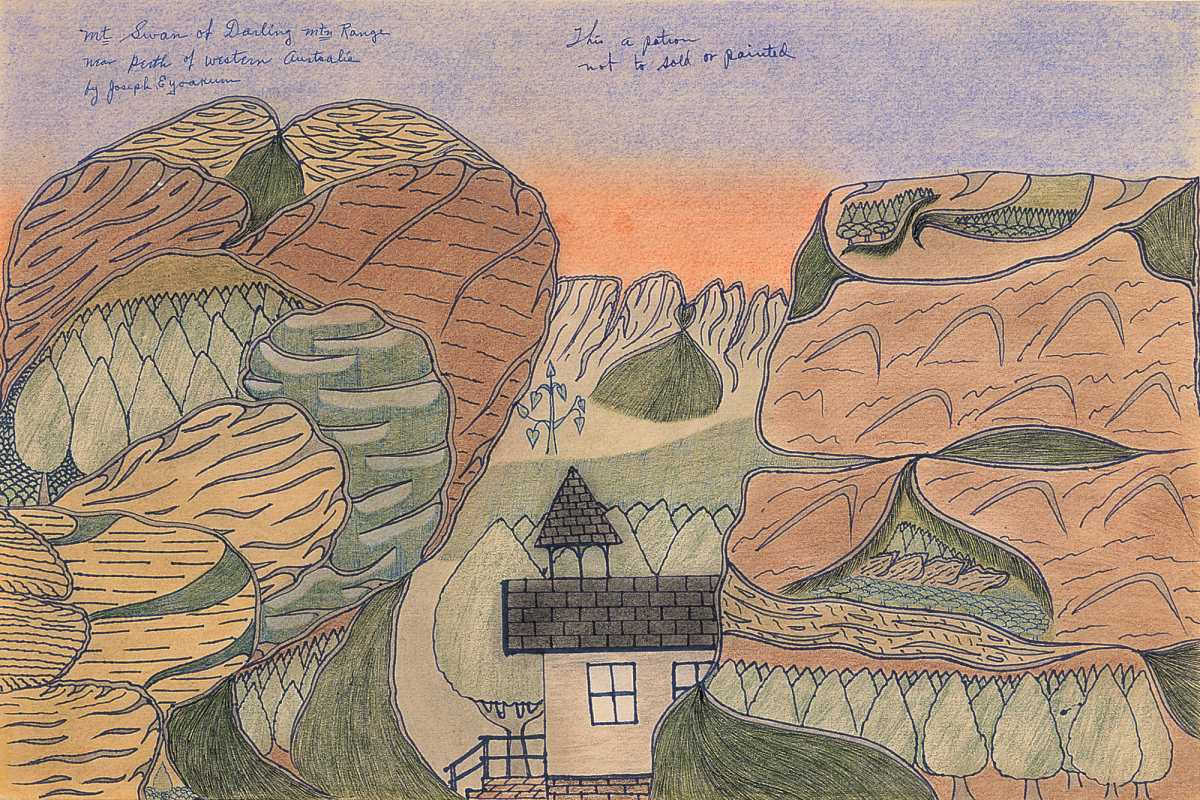
There is something deeply intimate about self-taught artists—those who come to art not through institutions, though through instinct, necessity, and an unrelenting inner drive to make something visible. The work carries a different kind of weight. It is not polished for approval or filtered through theory before it arrives; it is lived, and that presence is felt almost immediately in Self-Made: A Century of Inventing Artists at the American Folk Art Museum. There is a closeness to it all, a human immediacy that feels grounding rather than performative, and at times a certain grit that lends the work its honesty.
The museum itself supports that feeling. There is an intimacy to the space that allows the work to sit with you rather than declare itself from a distance, and the exhibition unfolds as a kind of collective self-portrait—expansive, contradictory, and quietly revealing. The collection spans drawing, painting, sculpture, and fragments of lived experience rendered through notebooks, photographs, and memory, and what emerges is not simply a survey of artists, though something closer to a reflection of America when it is not being overly arranged. In a climate where identity is often boxed and debated, there is something refreshing, even quietly reassuring, about a presentation that resists narrowing the frame.
The exhibition engages directly with the complexity of the term “self-taught,” acknowledging that it has never been neutral. It has been shaped by institutions, by collectors, and by the communities that both supported and, at times, distanced these artists . That awareness adds depth to the viewing experience, gently shifting the narrative away from sentimentality and toward something more expansive. The category begins to open, revealing itself as constructed rather than fixed, and allowing for a more nuanced understanding of artistic authorship.
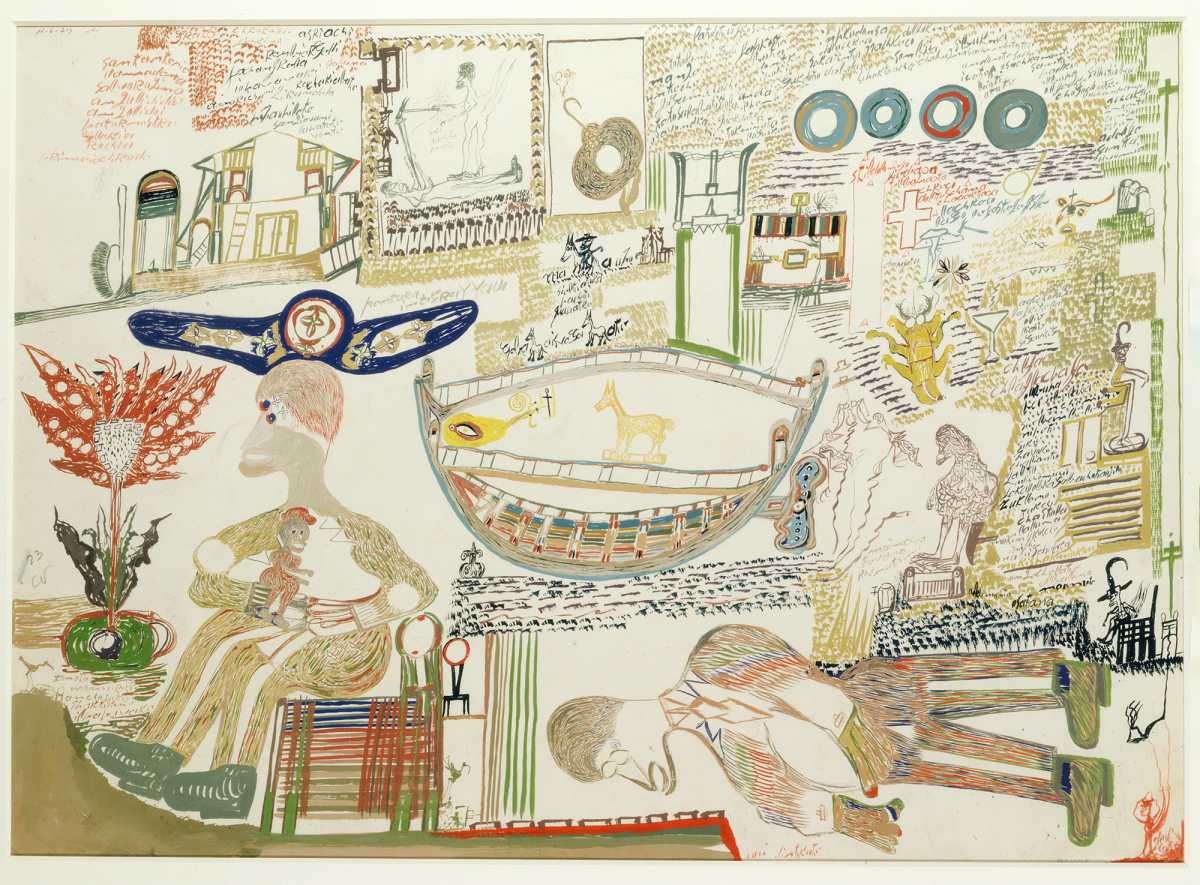 “Untitled,” on display at the American Folk Art Museum.Photo courtesy of the American Folk Art Museum
What does it mean to make yourself an artist when no one has formally granted you that space? That question moves through the exhibition with a quiet persistence. Self-portraits, alter egos, and autobiographical works feel less like stylistic choices and more like acts of authorship and presence. Artists such as Henry Darger, Bill Traylor, and Sister Gertrude Morgan do not wait to be placed into a narrative; they construct their own, often in environments that offered limited recognition for that kind of expression.
The work itself carries an immediacy that is difficult to replicate. There is little distance between life and object, and that closeness appears in the line, in repetition, and in the persistence of certain images. Knowledge here is formed through experience—through labor, memory, faith, isolation, and community—and the conditions in which the work was made often remain present within it. Domestic spaces, workshops, and even sites of confinement become part of the story, shaping both the form and the urgency of what is being expressed.
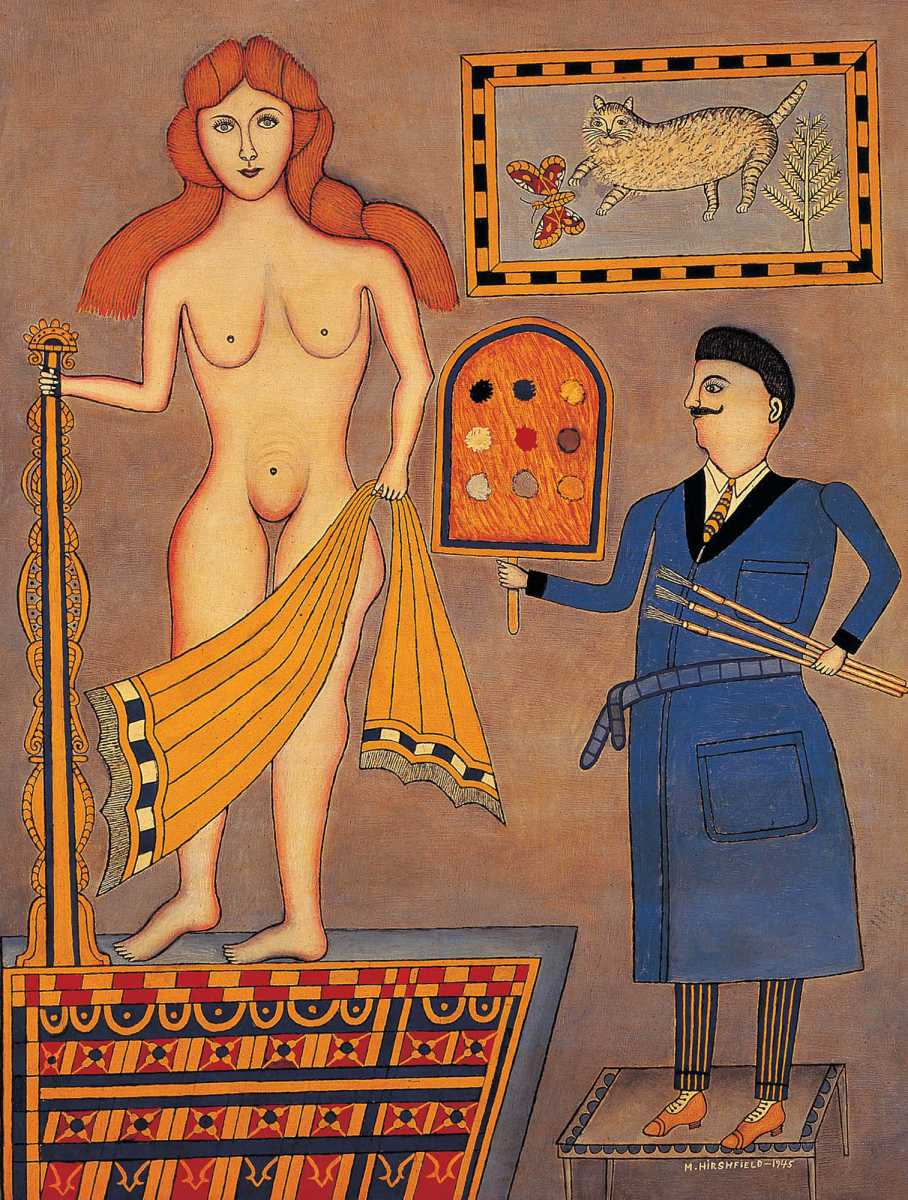 Oil on canvas painting by Morris Hirshfield, (1872–1946), 1945. “The Artist and His Model”Photo courtesy of the American Folk Art Museum
The range of voices adds another layer of depth. Artists such as Martín Ramírez and Adolf Wölfli expand the conversation beyond a singular national identity, offering a broader reflection on the human impulse to create and define oneself. The exhibition resists a singular narrative and instead allows for a multiplicity of perspectives to exist side by side, which feels both honest and necessary.
There is beauty here, though it arrives in a way that feels unforced. It does not seek perfection or polish itself for easy consumption; instead, it holds a kind of raw clarity that feels grounded and sincere. The hand is present in every mark, each decision carrying a sense of intention that feels deeply personal and, in many cases, quietly profound.
What the exhibition ultimately offers is not a conclusion, though an opening. The idea that “folk” or “self-made” has never been fixed begins to settle in, revealing itself as an evolving reflection of who is seen, who is heard, and how those definitions continue to shift . The work functions as both mirror and method, reflecting a range of lived experiences while gently challenging the frameworks that have historically shaped them.