
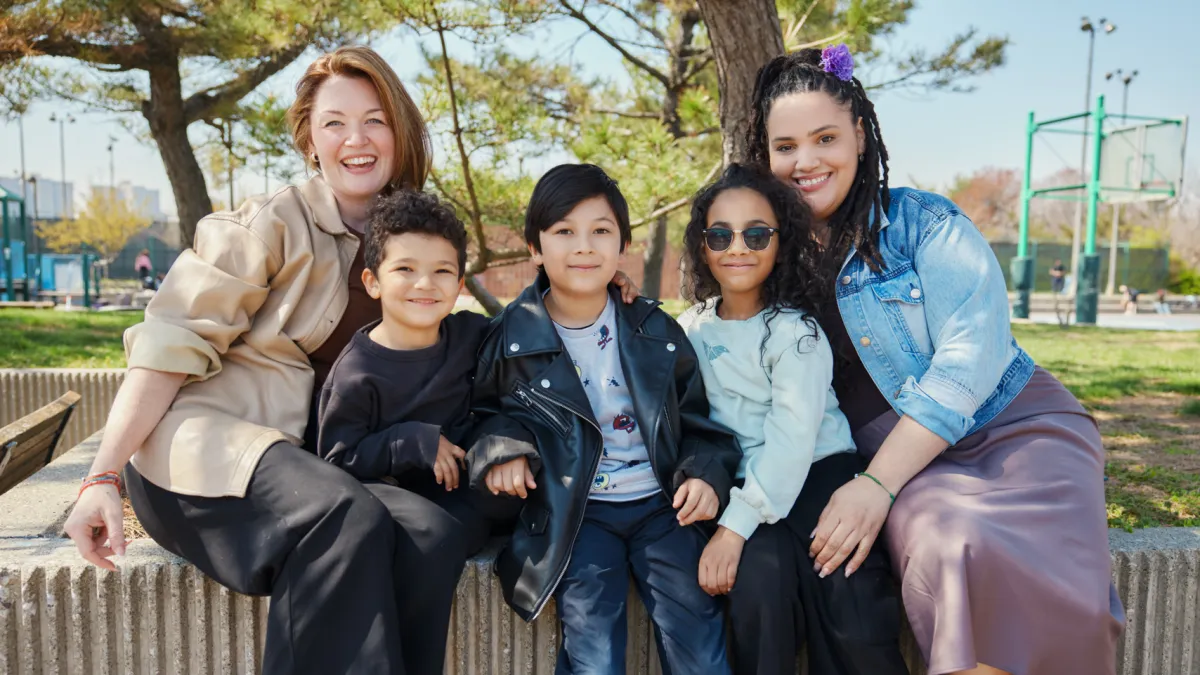
When Bernie Sinclaire’s ex-boyfriend moved out of their Manhattan apartment, she vowed never to rely on a man for financial security again. But as a single mother of two paying for rent, bills and childcare, she knew that to live the life she wanted she needed someone to share the load.
“I knew that in order to rise above poverty and avoid being stuck like I was as a child in my a single mother’s home, I would need to secure housing where I could comfortably pay the rent or the mortgage, and I would need a two-income household in order to do that,” she says. “It’s not, like, a man-hating thing, it’s just that women need stability in order to flourish.”
For years Sinclaire, 38, had dreamed of starting a “mommune” — moving in with another single mother to live communally — but her plans had always fallen through. So when she reconnected with her friend Anabelle Gonzalez, 39, who was recently divorced and raising her daughter by herself in a studio apartment around the corner in Washington Heights, she suggested they move in together.
US newsletter
A balanced, fair and fact-checked take on global news and culture for our US readers.
Sign up with one click
“I called her, and I was like, ‘Move in with me; let’s just do it.’ Anabelle wasn’t ready, and we both cried at the other end of the phone, and then about three months later she moved in,” she says.
Sinclaire and Gonzalez, both teachers at an all-girls school in the Bronx, are part of a growing number of single parents turning to unconventional living arrangements to afford soaring rent and childcare costs, and to provide emotional support.
In recent years, mommunes have cropped up everywhere from Jacksonville, Florida to Kansas City, Missouri, with single mothers living communally to help ease the stresses of parenting. The unique set-up is less common — or less publicised — in big cities such as New York where space costs a premium.
In a city where the average monthly rent for a two-bedroom apartment in Manhattan is $6,500 according to RentHop, getting by even without small children is no easy feat. But single mothers are the socio-economic group most vulnerable to falling into poverty. In New York, 86 per cent of single mothers with young children cannot cover the cost of basic needs, according to a 2023 report from the Center for Women’s Welfare.
For Gonzalez and Sinclaire, the benefits of pooling financial, physical and emotional resources have been immense.
Initially Gonzalez and her seven-year-old daughter Sophia moved in with Sinclaire and her two sons, Marcos, nine, and Nicolas, four, in their two-bedroom flat. Six months later, in December 2024, they signed a lease for a three-bedroom, two-bathroom, 1,200 sq ft apartment a block from the Hudson River in Hamilton Heights, a more affluent area of Manhattan. The building includes a gym, a playroom and laundry facilities.
“Every time we come home we think it’s a joke, we’re like, ‘What a blessing’,” Sinclaire says, sipping a frothy cappuccino Gonzalez just made her.
The flat itself is an explosion of colour, featuring a large open-plan kitchen and living room decorated with an enormous pink and orange shaggy rug. Sinclaire has applied bright wallpaper, installed light fittings and painted a window arch to make the rented home their own. There is a cat called Toulouse, a handmade puppet called Bob and a stuffed axolotl — a type of salamander — called, well, Axolotl, which they bought on their mommune holiday to Mexico last year.
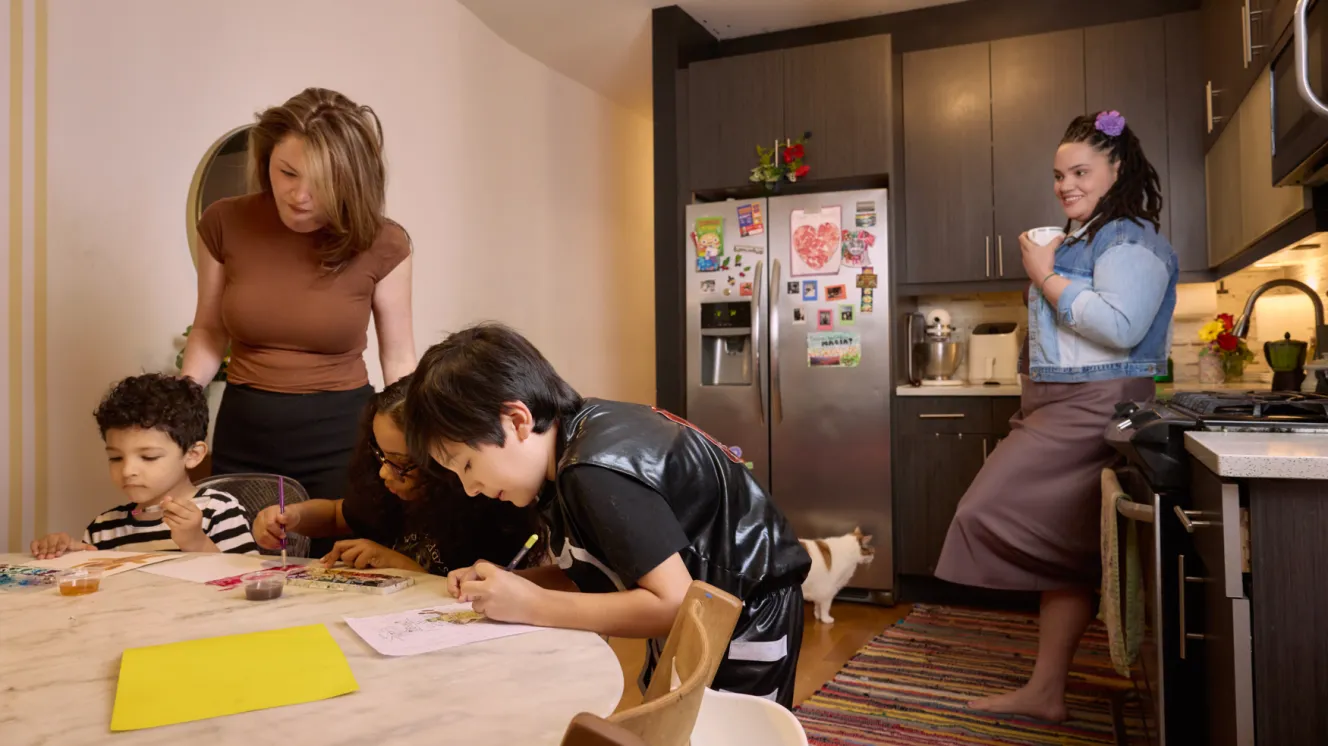 The two mothers say cohabiting makes household tasks far easierJohn Munro for the times
The children, who refer to themselves as the “kidsmune”, have space in their bedroom for a Barbie dreamhouse and a WWE wrestling ring. When asked what his favourite thing about the mommune is, the youngest, Nicolas, says: “We can play together.”
“Before, I was just in soldier mode — single motherhood is just pushing through from day to day,” says Gonzalez. “I would take a deep breath at the end of the day when I was in bed, and just say, ‘OK, Sophia’s good,’ and then wake up and do it again.”
Within eight months of starting the mommune, Sinclaire was promoted at work after feeling a new lease of energy and ability to focus. The amount she can save each month has increased to $1,325. She also won a paid fellowship from Barnard College to study women’s role in the American Revolution.
Sinclaire began posting about their communal life on Instagram in August. Last month one of her posts went viral. She went from 165 followers to more than 30,000. She has been inundated with requests from single parents, prompting her and Gonzalez to start developing a not-for-profit app to help like-minded single mothers who want to start their own mommunes connect.
While widely seen as the norm in the western world, the nuclear family is a relatively modern construct that became more common in the US as couples moved away from their extended families for work during industrialisation. Historically, however, children had many caregivers.
“Our species evolved as what I call a co-operative breeder … species where ‘alloparents’ — group members other than the parents — help to care for and provision offspring,” says the anthropologist Sarah Blaffer Hrdy, professor emerita at the University of California, Davis.
“I think extended families were the norm throughout most of history,” she adds. “Concepts like the nuclear family and privacy have so much to answer for in terms of the psychological distress of children and the loneliness of mothers, and so we just shouldn’t expect a mother to do this all by herself.”
Sinclaire questioned the idyll of the nuclear family when she was 13 and her Italian father walked out on her family, abandoning her American-born mother with five children. They went from living a beautiful life in Venice — where her father was the provider and her mother stayed at home with the children — to living in a hotel in Baltimore.
“My mother was 27 with five kids, had never had a job, never graduated high school and my father just ran off with another woman,” Sinclaire says. “[For years] I watched her continuously have to struggle between independence or romantic partnership in order to get by, and I never wanted to have to make those choices. Women need a village, women need community, and so do children. The mommune is not an antithesis to the nuclear family, it’s more an extension of it.”
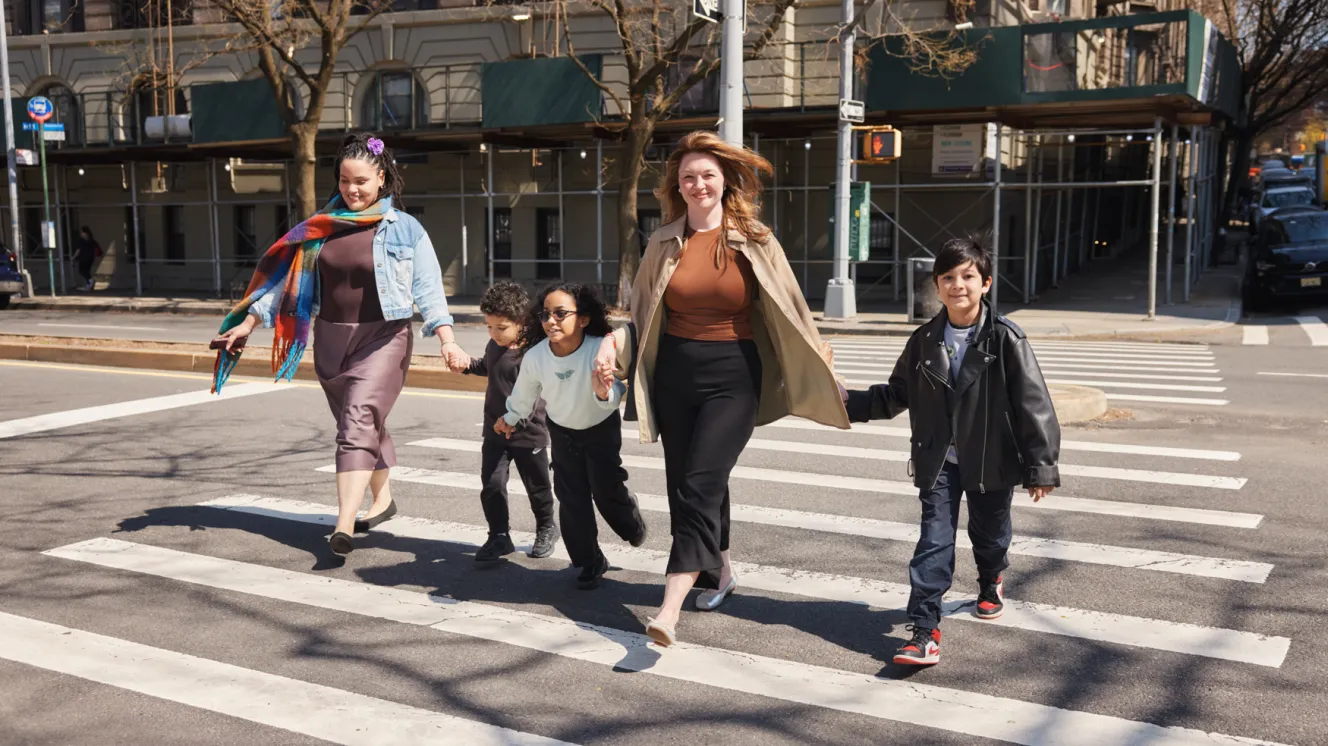 The mommune is likely to become more widespread as living costs place pressure on single mumsJohn Munro for the times
Having more than one caregiver in the home generally leads to better outcomes for children, experts say.
“Kids are demanding and generally you need more than one income to help raise kids because they’re expensive,” says Christina Gibson-Davis, sociology professor at the Sanford School of Public Policy at Duke University. She adds: “So it just strikes me that they’re [the mommune] creating a new form of family to meet these very real needs of child-rearing.”
The division of labour in the mommune centres on the different strengths Sinclaire and Gonzalez have. Sinclaire takes care of the interior design, the car and the admin, while Gonzalez manages more of the cleaning and the emotional temperature of the flat. They share the cooking and help each other with childcare, although they have no set rota. Nobody ever has to ask the other to pick up milk; if someone sees it’s running out, they simply buy more.
“I feel like sometimes in hetero[sexual] relationships, when you have kids, I always felt like I was keeping a running list of all the stuff that I was doing and all the stuff they weren’t doing. The mommune’s not like that,” Sinclaire says.
Sinclaire and Gonzalez are aware that as the children grow up they will need their own bedrooms. Eventually they say they will need a bigger place, but right now they are taking things one day at a time. Neither parent is actively dating at the moment but they say if they were, they would not bring anyone back to the mommune.
But what happens if one of them finds a new partner and wants to live with them? “I can’t imagine that, but I also can’t predict the future,” Sinclaire says. “And the point of the mommune is certainly not like ‘sign here in blood’.”
Gonzalez, who was raised in Williamsburg, Brooklyn, says the changes she has experienced since she moved into the mommune are immense. “We were walking in our old neighbourhood and I said, ‘Oh my god, I’m breathing differently,’” she says.
“I knew the mommune would be a step towards a more holistic life, but I never imagined that it would feel as supportive as it has been. It’s not just the money, but it’s also that sense of self — you can just breathe easier.”