
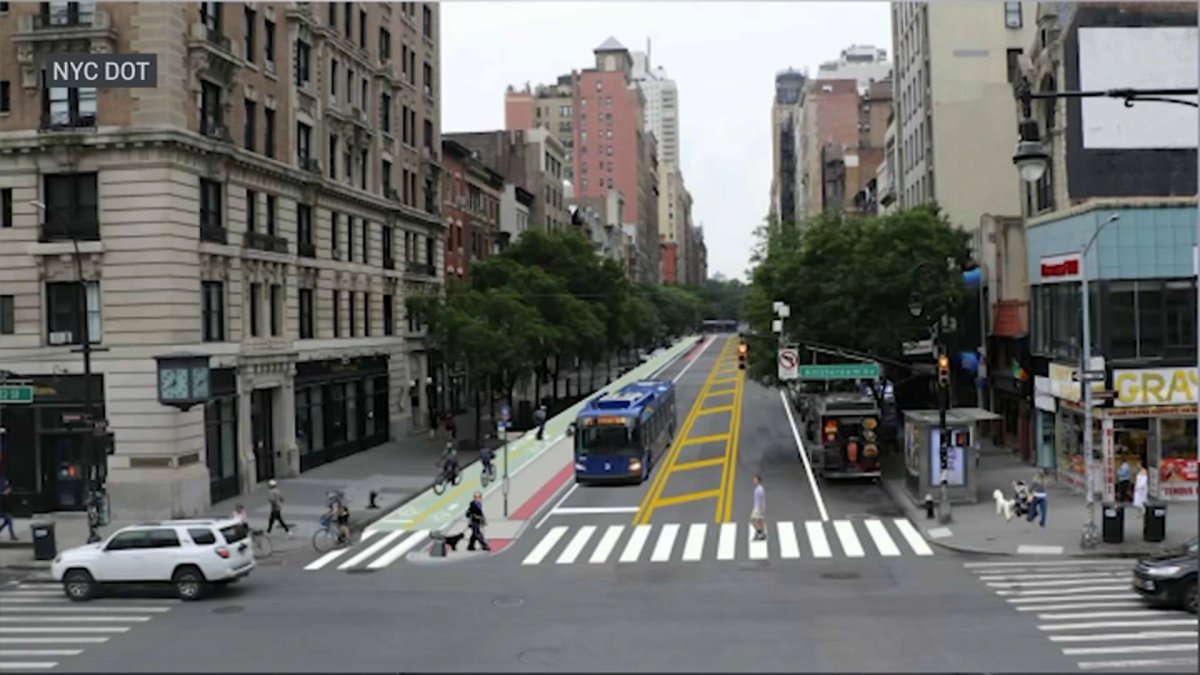
A proposed redesign of a busy Manhattan street is drawing both praise and concern, as city officials push forward with a plan to overhaul traffic, add protected bike lanes and reconfigure curb space.
The New York City Department of Transportation plan, which received overwhelming community board approval, would transform 72nd Street between Central Park and the Hudson River Parkway.
Supporters say it will improve safety and create a long-sought cycling connection, while some business owners worry it could hurt deliveries and customer access. Among those concerned is Lester Wasserman, a fourth-generation owner of Tip Top Shoes, a store that has operated on the Upper West Side for 85 years.
“This was done in the shadows,” Wasserman said, fearing the redesign would force the business to take a step back.
Under the proposal, four lanes of moving traffic would be reduced to two. A two-way protected bike lane would be installed along the north side of 72nd Street, along with dedicated bus boarding islands. The plan also includes designated areas for parking, loading and curb access on the south side of the street and near the bus lane.
Wasserman said the changes could make it harder for customers to visit and for businesses to receive deliveries.
“It’s awful. I don’t know how people are gonna park and come see us. I don’t know how the people are going to deliver boxes to us,” said Wasserman. “Logistically how does it make any sense?”
Concerns about curb access come as double parking is already a common sight along the corridor, complicating traffic flow and deliveries. But advocates for the redesign say the current street layout prioritizes cars over pedestrians and cyclists.
“There is very much a bias toward the automobile in a space that is really dominated by pedestrians,” said Carl Mahaney, director of Streetopia, an Upper West Side street redesign initiative that has pushed for changes for years.
Mahaney said the goal is to make the street safer and more efficient for all users, including businesses.
“They don’t want to see the businesses go under. The don’t want to see the street remain clogged with double parking and cyclists riding in between it all,” Mahaney said.
City officials say safety improvements are a key driver behind the redesign.
“It’s going to provide the first protected cycling connection river to river in this part of Manhattan,” said DOT Commissioner Mike Flynn, insisting the redesign will benefit everyone. “What we found with protected bike lane designs like this, is that they reduce serious injuries and fatalities by 29% for all users, whether you’re a pedestrian driver or cyclist.”
Despite the data, some business owners remain skeptical about how the changes will play out once construction begins, as they wait for the other shoe to drop.
“It’s gonna stifle and shut down everything we’ve worked for all these years to build. I really don’t get it,” Wasserman said.
With community board approval secured, the project is expected to move forward, with construction slated to begin in late spring or early summer. A similar redesign is also planned for 72nd Street on the Upper East Side, though details and approval for that project are still pending.
This story was originally reported for broadcast by NBC New York. AI tools helped convert the story to a digital article, and an NBC New York journalist edited the article for publication.