
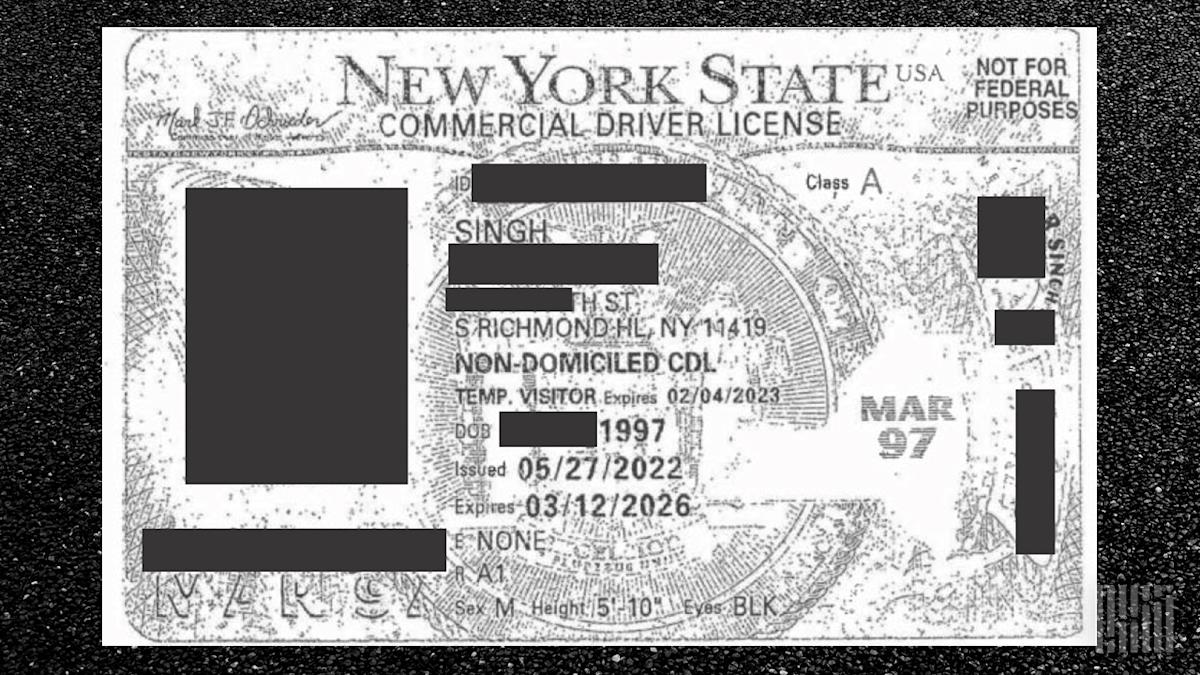
I personally am inclined to believe the audit findings, Secretary Duffy and Administrator Barrs. In a litigation case of my own, we have a theft case where a load was picked up by one of these drivers. Neither the load nor the driver was ever seen again. In the photo above, you see the “Temporary Visitor” expiration date expires 2/4/2023, while the Non-Domiciled CDL remained valid until 3/12/2026. That means this driver held a CDL without a valid work authorization issued by NY for at least 3 years. Here’s the other issue here, a Temporary Visitor is a B-1/B-2 Visa, which typically means they’re not allowed to work at all. So the validity of this license is in complete question, but at the end of the day, the CDL holder picked up a load, and neither he nor the load was ever seen again. These licensing standard issues have consequences for the public, for shippers, and for insurance companies.
I have covered California, North Carolina, Pennsylvania, Minnesota, Washington, South Dakota, Colorado, and now New York in this column. The state denials all sound the same. The audit findings all tell the same story. At some point, denial stops being a legal strategy and starts being a liability multiplier.
What does this actually mean for the people in this industry who have to operate in the real world while state and federal officials fight this out?
If you are a fleet based in New York or operating significant mileage in the Northeast corridor and you have non-domiciled drivers on your payroll holding New York-issued credentials, the time to audit your driver qualification files was yesterday. Under federal regulations, a carrier that dispatches a driver operating on a license issued in violation of federal requirements assumes significant exposure. That exposure exists regardless of whether the carrier knew the license was noncompliant. The burden is on you to verify that your drivers are legally qualified to operate the equipment they are driving. If FMCSA’s audit findings are applied to the broader population of New York’s 32,606 non-domiciled CDL holders, and the 53 percent sample noncompliance rate holds, you may be looking at roughly 17,000 to 18,000 drivers in New York whose credentials may be deficient under federal standards. Those are not small numbers in a state that feeds the country’s largest freight market.
Your driver qualification file obligations do not change because the state made a DMV programming error. Federal motor carrier safety regulations under 49 CFR Part 391 require you to verify that every driver you employ is properly licensed for the vehicle they operate. A CDL that was issued without proper lawful status verification may not constitute proper licensure for interstate commerce purposes. That is the logical extension of what the FMCSA and the D.C. Circuit have said in this context: that a CDL issued in violation of federal requirements is a noncompliant credential, and that a carrier dispatching a driver on a noncompliant credential has exposure. If you have non-domiciled CDL holders on your payroll in New York, check their SAVE verification status, check their license issuance and expiration dates against their visa and work authorization documentation, and document what you find. Do not wait for FMCSA to finish sorting this out.
For domestic New York CDL holders, meaning the American citizens and lawful permanent residents who obtained their credentials through the standard process and have nothing to do with the non-domiciled issue, the funding withholding does not directly affect the validity of their credentials. Your CDL remains valid on its face. If New York refuses to comply and Duffy exercises the full nuclear option, things change dramatically.
The nuclear option is decertification under 49 U.S.C. Section 31312 and 49 CFR Part 384, Subpart E, specifically Section 384.405. Under that authority, FMCSA has the power to find a state in substantial noncompliance with federal CDL program requirements and prohibit the state from performing any CLP or CDL transactions. The regulation is explicit. Any state found in substantial noncompliance shall not issue any commercial learner’s permit or commercial driver’s license, shall not renew any CLP or CDL, shall not transfer any CDL, and shall not upgrade any CDL. Not just non-domiciled credentials. Every single one.
I wrote about this in January when Duffy was floating decertification against California. The same analysis applies here and in some ways it is more acute, because New York is not just a big trucking state. New York is the gateway through which an enormous share of Northeast corridor freight moves. The New York City metro is the largest consumer market in the country. The port complex at New York and New Jersey is among the busiest on the East Coast. Long Island, the Hudson Valley, the distribution networks feeding New England, all of it runs on New York-licensed commercial drivers.
Federal Bureau of Labor Statistics data puts the number of heavy and tractor-trailer truck drivers employed in New York at roughly 68,000 to 75,000, with median wages around $60,520. When you add in all CDL holders, including bus drivers, hazmat operators, straight truck drivers, and construction and specialized equipment operators, New York’s total CDL population is substantially larger. Based on proportional estimates using California’s known figures and New York’s share of total national employment, a reasonable estimate puts New York’s total CDL-holding population in the range of 300,000 to 400,000. That is a working estimate based on available data, not a number FMCSA or New York has publicly disclosed for the current period, but it is grounded in the known workforce proportions and aligns with what has been reported in related contexts.
Under full decertification, here is what would actually happen.
Every driver in New York’s CDL pipeline would freeze. New drivers in CDL school completing their training would have no pathway to receiving their credential until decertification is lifted and the state demonstrates corrective compliance to FMCSA’s satisfaction. The existing CDLs already on the street, the ones held by 300,000-plus drivers who obtained them legitimately, would technically remain valid until their printed expiration dates under the plain language of the decertification authority, which prohibits new transactions but does not void existing credentials on day one. It gets complicated for every fleet operating in interstate commerce.
Other states are not legally obligated to recognize CDLs issued by a state that FMCSA has placed in substantial noncompliance. The Commercial Driver’s License Information System, which is the national database backbone that enables interstate CDL verification, could flag New York credentials as issued by a noncompliant jurisdiction. Enforcement agencies and border states could decline to accept New York CDLs at weigh stations and during roadside inspections. Carriers in other states dispatching drivers with New York credentials could face scrutiny over whether those credentials are valid for interstate purposes during the noncompliance period.
The supply chain consequences of full decertification in New York mean freight moving through the Northeast corridor would face driver qualification uncertainty across a massive geography. LTL operations serving New York City, drayage at the Port of New York and New Jersey, temperature-controlled food distribution across the five boroughs and Long Island, bulk fuel delivery, construction material hauling, school transportation, all of it touches New York-licensed CDL holders. When I wrote about California’s potential decertification, I noted that California had more than 700,000 CDL holders and 138,000 truck drivers serving the ports of Los Angeles and Long Beach. New York’s numbers are smaller but the geographic concentration and the density of the freight market it serves make the disruption risk proportionally serious.
There is also an insurance and liability dimension that fleet owners and risk managers need to carefully consider. If you are dispatching a driver whose New York CDL is in a legally uncertain status due to a state decertification proceeding, and that driver is involved in a serious crash, your liability exposure in that case has just expanded in ways your insurance carrier may not have priced. The plaintiffs’ bar is very good at finding the weakest point in a carrier’s driver qualification process, and a driver qualification file showing a credential from a state that FMCSA had publicly identified as substantially noncompliant is not a comfortable exhibit in a wrongful death case.
For non-domiciled drivers specifically, regardless of whether your CDL is a domestic issue or a New York non-domiciled credential, if you are operating today and you have any uncertainty about whether your license issuance fully complied with federal documentation requirements, the time to understand your situation is now. You can contact your carrier’s compliance department, contact an attorney familiar with motor carrier safety regulations, or contact the New York DMV directly to request documentation of how your credential was issued and what documents were on file. You have the right to understand the status of your credential. If you have been driving on a license that New York is forced to revoke as part of a corrective action plan, you have 30 days from any revocation notice to take corrective steps before your livelihood is affected. Do not wait to be notified. Get in front of it.
For fleets hiring in New York or the broader Northeast, begin the process of verifying non-domiciled CDL holders in your fleet right now. Pull their licenses. Look at the issuance and expiration dates. Compare the expiration date to the work authorization or visa documentation in your driver qualification file. If you see a credential that expires years beyond the lawful presence documentation, that is a flag requiring immediate follow-up. Check whether your carrier insurance policy has any exclusions or notification requirements for operating drivers whose credentials are under regulatory review. Some policies require immediate notification of known regulatory deficiencies in driver qualification files. Failing to notify your insurer of a known credential issue could affect your coverage position in a claim.
The New York action today is not a surprise. This is the fifth or sixth time in less than a year that Duffy and Barrs have had to stand at a podium and announce that an American state failed over half of a federal CDL audit. California failed 25 percent. North Carolina failed 54 percent. New York failed 53 percent. Pennsylvania, Minnesota, Washington, South Dakota, and Colorado have all faced actions. Tennessee proactively identified problems and acted before FMCSA had to come knocking. The question is no longer whether there is a pattern. The question is whether the architecture that produces the pattern can actually be fixed by the current enforcement mechanism.
The Commercial Motor Vehicle Safety Act of 1986 established the federal CDL framework, on the theory that uniform national standards administered through a federal-state partnership would ensure consistent licensing integrity across all 50 states. Congress provided federal funding to states for highway safety programs in exchange for compliance with those standards. The enforcement mechanism for noncompliance is funding withholding and, at the extreme end, decertification. That structure has been in place for 40 years. What the 2025 audit cycle has revealed is that multiple major states were operating CDL programs in material noncompliance with federal requirements that existed long before this administration or any of the specific regulatory actions currently being litigated. They were not doing it on purpose, in most cases. They were doing it because DMV programming was never corrected, because staff training was inadequate, because quality control was absent, and because the audit mechanism that was supposed to catch these failures was not catching them at the frequency needed to produce compliance.
What would a nationalized CDL licensing standard actually look like if Congress decided to move in that direction?
At its most complete, a federal CDL authority would involve the creation of a credentialing body within FMCSA or as a separate federal agency that directly controls the issuance transaction for all commercial driver’s licenses. States could still conduct skills tests and knowledge tests through approved testing administrators operating under federal certification standards, similar to how the TSA manages security screening at airports through a centralized federal workforce rather than delegating it to individual airport authorities. The actual credential, however, would be issued by the federal entity, with expiration dates calculated by a federal system, lawful status verification run through a federal query at the moment of issuance, and the resulting credential recorded directly in CDLIS without any intermediate state data entry. The DMV programming error that produced the New York 8-year default would be physically impossible under this model because state systems would not generate CDL expiration dates. The federal issuance system would.
A lighter-touch version would preserve state administration of testing and application intake but require a federal pre-approval query before any CDL transaction can be finalized. The state collects the application and the documentation, runs the tests, verifies the skills, but cannot print a license until a federal system returns a compliance clearance. The clearance would confirm SAVE verification for non-domiciled applicants, confirm that the expiration date generated by the state system matches federal requirements, confirm clean CDLIS and NDR status, and generate a federal issuance record. This stops short of full nationalization but inserts a hard federal checkpoint at the exact moment every audit has identified as the failure point. It does not require building a new federal credentialing infrastructure from scratch. It requires connecting existing federal systems to existing state systems with a compliance gate in between.
Federalism is a real doctrine with real legal weight, and states have jurisdictional authority over driver licensing that does not evaporate because Congress decides to tighten oversight. The Tenth Amendment and related doctrines would prompt immediate constitutional litigation from states like New York and California, which have demonstrated they will sue the federal government over CDL policy at the slightest opportunity. Building a federal CDL issuance infrastructure, even the lighter pre-approval model, would cost money, require new federal IT contracts, and likely face years of procurement and implementation delays. A federal bureaucracy handling CDL issuance could introduce bottlenecks into the qualification pipeline for millions of domestic applicants who have nothing to do with the non-domiciled compliance problem. The motor carrier associations and many carrier fleets would be appropriately concerned about anything that makes it harder or slower to onboard qualified domestic drivers in a market that is already running 60,000 to 80,000 drivers short of demand.
There is also a political reality that sits behind the structural debate. The current enforcement campaign is driven by a specific administration with specific policy priorities, and the funding-withholding mechanism is a blunt instrument that punishes the broader highway infrastructure budget of the noncompliant state rather than surgically targeting the CDL program itself. California lost $200 million. New York just lost $73 million. Those are dollars that were supposed to fund road repairs, bridge maintenance, and safety infrastructure that has nothing to do with CDL issuance. Punishing a state’s infrastructure budget to enforce a licensing compliance obligation is a mechanism that was designed as a last resort, not a routine enforcement tool. When it becomes routine, as it now appears to be, the question of whether the underlying system design is adequate becomes harder to avoid.
What the states keep demonstrating is that they cannot be trusted to run CDL programs without hard federal verification at the transaction level. That is not an ideological statement. It is an empirical one, based on audit findings across at least nine states in a single year. The 1986 Act delegated issuance authority to states, assuming they would follow federal requirements. The audit program is proving that the assumption was wrong for a significant portion of the country, not in isolated cases but systematically, in ways that required DMV programming changes or staff training changes that multiple states never made.
What is stopping us from fixing this at the structural level is the same thing that prevents many structural reforms in this country. Political will, constitutional turf battles, implementation cost, and the inertia of a 40-year system that most people in positions of authority have never seriously questioned, because the compliance failures were not visible until someone actually started auditing.
They are visible now. They have produced fatal crashes. They have put tens of thousands of drivers in credential limbo. They have cost states hundreds of millions of dollars in withheld federal funding. And the audits are not done. Duffy’s nationwide review is still ongoing. The next press conference is coming.
Here is what you need to do right now, regardless of how the political fight resolves.
If you operate a fleet in New York or have New York-licensed drivers on your payroll, audit your driver qualification files today. Separate your non-domiciled credential holders and verify their documentation against federal requirements. Document that verification and date-stamp it. Create a paper trail that shows your organization took the federal compliance determination seriously and acted on it promptly. That paper trail matters in litigation and it matters in a regulatory enforcement action.
If you are a driver holding a New York CDL and you are unsure whether your credential was issued under compliant procedures, reach out to the New York DMV and request the records associated with your license issuance. Ask specifically which documents were on file and what the basis for your expiration date was. You have the right to that information and you need to understand your situation before you find out about a problem at a weigh station in another state.
If you are a carrier insurance underwriter, account executive, or risk manager working the commercial transportation book in the Northeast, you should be having active conversations with your underwriting team about what happens to your insured’s coverage position if a driver with a flagged New York credential is involved in a loss while the state is under an FMCSA compliance action. That question should have an answer before a claim forces the issue.
If you are a New York fleet owner running legally, paying your insurance, training your drivers, doing everything right, understand that you are facing operational uncertainty right now because your state’s DMV programmed its computers incorrectly and then refused to fix it when the federal government pointed it out. That is not your fault. The consequences of the standoff your governor has chosen to have will land, at least in part, on you and on the drivers you employ. That is worth knowing and worth expressing to the people who represent you in Albany.
The $73 million is gone. New York has 30 days from the date of the enforcement action to respond. If Hochul’s team continues to characterize this as a political stunt and refuses to conduct the comprehensive audit and revocations FMCSA requires, decertification is the next step. Barrs said it explicitly in the announcement. Duffy has said it publicly. It is not a threat being made to the press. It is the regulatory endpoint of the noncompliance determination process, as set forth in the Code of Federal Regulations, and this administration has repeatedly and credibly demonstrated that it will exercise the authority the statute gives it.
I have been saying for the better part of a year that the non-domiciled CDL enforcement campaign, whatever one thinks about its policy dimensions, is exposing something that needed to be exposed: a CDL credentialing architecture that puts too much trust in state-level execution without adequate federal verification at the transaction level. New York is the latest and, in some ways, most troubling example because of the geographic and economic concentration of what it affects. This is not going to resolve itself quietly. Fleets, drivers, and compliance professionals in the Northeast need to be watching this closely and acting now on the parts of it they can control.
The nuclear option is on the table if New York continues down the path it has chosen.
The post New York to lose $73 million playing licensing games with the Duffy appeared first on FreightWaves.