
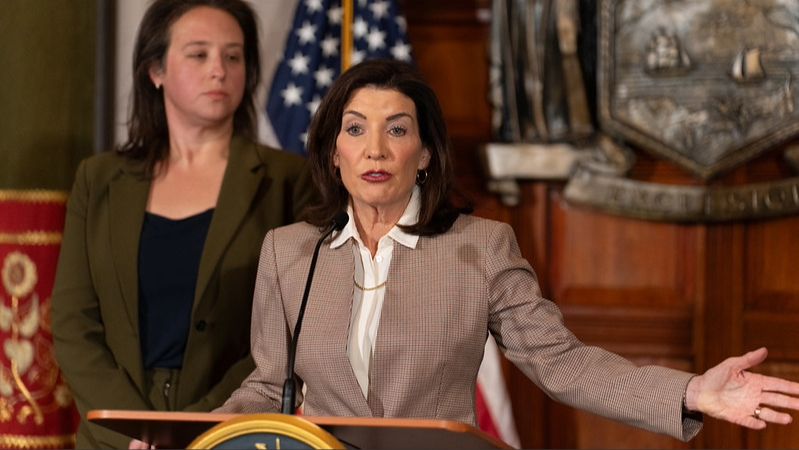
After a tense Monday and Tuesday in Albany, New York’s state budget negotiations over the past two days have felt like a train delayed at the station for an hour — but now, one by one, the wheels are starting to move.
That sense was clear when Gov. Kathy Hochul, a Democrat, announced at the top of a press availability following an unrelated event that there has been progress toward reaching a deal with the Democrat-led Legislature on an immigrant protection package that has been brewing since the beginning of the legislative session. The push grew in urgency after the Trump administration’s immigration crackdown in Minneapolis resulted in the deaths of Renée Good and Alex Pretti.
Hochul — who typically does not provide concrete updates on closed-door budget negotiations — told reporters she is announcing a revised proposal following weeks of discussions with state lawmakers, a process that has run parallel to budget talks and at times overlapped with them.
The governor characterized the announcement as an update on where she stands, stressing that she has yet to reach an official deal with legislative leaders and that negotiations were still ongoing. She said she is expanding upon her existing proposals from earlier this year to ban formal agreements between local governments and ICE, known as 287(g) agreements, as well as to provide legal recourse for individuals who feel their constitutional rights have been violated by ICE and protect certain sensitive locations from ICE intrusion without a warrant.
“We’ve made some substantial progress in the last few days with our legislative leaders, and we’re building on a proposal that I first unveiled back on Jan. 30, as we called it, the ‘Local Cops, Local Crimes Act,’” Hochul said. “The crux of that proposal is very simple, literally stating that local cops should be focused on local crimes: keeping our streets safe, responding to emergencies, going after gun traffickers and violent offenders, and protecting the neighborhoods they know best.”
A key sticking point has been how state and local law enforcement interact with ICE, and Hochul appears to have ceded some ground, though some lawmakers and advocates still have significant concerns.
The expanded proposal would prohibit state and local law enforcement from coordinating with federal immigration enforcement on non-criminal offenses, and from asking, collecting or sharing information about immigration status unless it is legally required or relevant to a crime; from transferring custody of a person to immigration authorities unless the individual has been convicted of a crime; and from utilizing state, local or school resources — including employee time — for immigration enforcement.
Steadfast in her insistence that individuals who have committed serious or violent crimes should not receive protection, Hochul said simple immigration offenses such as illegal entry, reentry or failure to register with immigration authorities would not be covered by the proposed changes.
“That is not the class of individuals that we want to have our local law enforcement or state or local employees assisting in the apprehension of if those are the only suspected offenses,” she said.
The governor’s updated pitch would also expand the sensitive locations protected from warrantless ICE intervention, as proposed by Hochul in January, to those owned and operated by state and local governments, such as schools and libraries, with an opt-in for privately owned “sensitive locations.” Significantly, the proposal would prohibit ICE agents from wearing face coverings, a priority for some state lawmakers and a cause championed by state Sen. Pat Fahy.
A remaining sticking point appears to be that, under Hochul’s proposal, police would still be able to work with ICE if individuals are convicted of a covered crime or if there is probable cause that the individual committed a violent or otherwise serious offense.
In addition to debate over what crimes would be covered, some lawmakers and advocacy groups have expressed concern about leaving probable cause open to interpretation.
“We know how easy it is for law enforcement to claim probable cause to detain someone. Relying on a probable cause standard means the governor’s proposal will allow police to turn a person who is simply accused of a crime over to ICE — an inept, violent and lawless agency,” said New York Civil Liberties Union Senior Policy Counsel Zach Ahma.
Assembly Speaker Carl Heastie told reporters the probable cause issue sums up concerns among members in the lower chamber.
“The conference and a lot of members are still not really settled about probable cause, but happy in other places where the governor has moved,” he said.
Hochul acknowledged the concern.
“Any community can go as far as they want in protecting their residents from ICE,” she said. “We’re establishing a floor. Any community that doesn’t want to have any engagement with ICE, they don’t have to. We’re talking about communities that do engage with ICE. We’re putting some changes in place that we will expect them to adhere to.”
The governor and lawmakers have stressed the need to pass a protection package, saying such measures are needed to address situations unfolding every day. Hochul was unable to say whether it would be possible to reach a final agreement and sign a package into law before the rest of the state budget is finalized. Lawmakers were conferencing the proposal as Hochul spoke.
“I’m announcing where I am right now,” she said. “I’m looking forward to the feedback from their conferences.”
The announcement came as both houses passed a fourth budget extender to bridge the gap until Monday, as the state budget is now more than two weeks late.
Heastie reported Thursday that all major issues have shown some movement, but at least a few significant items under each remained unresolved Monday.
Deputy Senate Majority Leader Mike Gianaris told Spectrum News 1 he believes more forward momentum is on the horizon.
“I think next week will be one of significant progress across the board,” he said.
On Hochul’s push to alter the state’s climate law amid shifting federal policy and a lawsuit she argues is forcing the state’s hand in dialing back emissions-reduction policy, Gianaris said the gears are turning.
“It is moving along,” he said. “We’re having conversations about timelines and how to measure air quality and all of the technical aspects of doing this. We’re getting there slowly but surely.”
He said it was “too soon to tell” whether that would include fully implementing Hochul’s desired change to the accounting methodology used to track progress in lowering emissions — a key concern for many progressive lawmakers who are otherwise open to adjusting the timeline.
Senate Majority Leader Andrea Stewart-Cousins told reporters Wednesday that Hochul’s proposal to change environmental quality review regulations to spur housing development and lower costs was closest to a deal.
Hochul has signaled concern, holding multiple events this week to push against the measures being watered down by lawmakers wary of the proposal’s scope.
The governor hosted mayors and local officials from Central and Western New York on Thursday to discuss the plan. They sought to convince reporters that for projects on previously disturbed land with no environmental threat, local review procedures are sufficient.
“Take a look at how thorough our boards are at reviewing these projects — absolutely yes. Absolutely yes, we are able to clear the thresholds we need to without this additional delay,” said Ithaca Mayor Robert Cantelmo.
Hochul’s push to make changes to car insurance policy in a bid to lower rates by weeding out fraud and abuse remains a major sticking point, though incremental progress has been made.