
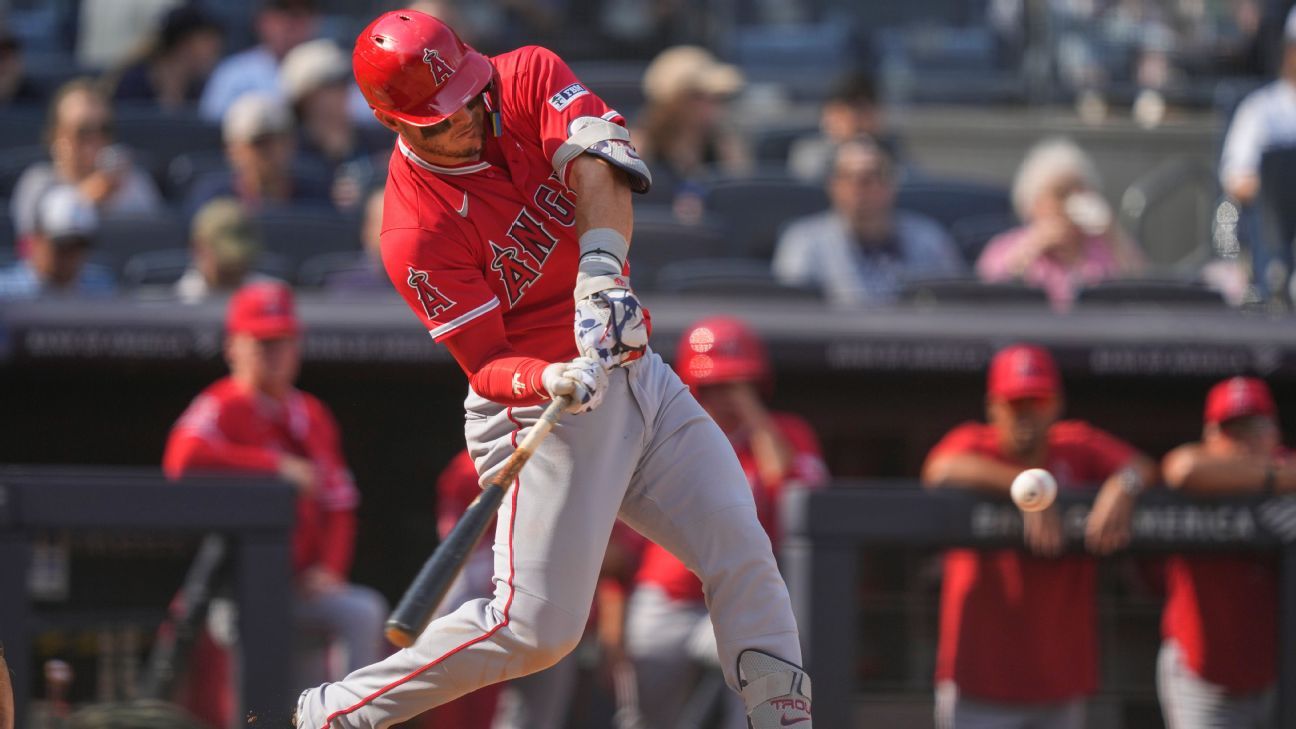
The silence that descended upon the Bronx on Thursday evening was not born of confusion, but of singular, undeniable awe. With one violent rotation of his hips and a perfectly timed swing, Mike Trout drove a 2-2 slider from relief pitcher Angel Chivilli halfway up the left-field bleachers, etching his name into the annals of major league history.
The towering 446-foot drive marked the fifth home run for the Los Angeles Angels superstar in just four days at Yankee Stadium, a feat that defied the conventional geometry of the ballpark and reinforced his status as the premier slugger of his generation. For the gathered crowd in New York, the spectacle was less about the final score—an 11-4 Angels victory—and more about witnessing a player operating at the absolute zenith of his physical and cognitive powers.
This performance represents a critical juncture in the 2026 season. As the Angels solidify their offensive identity, Trout’s ability to dominate in one of the most pressurized venues in professional sports provides more than just momentum it offers a blueprint for consistency. In the competitive landscape of the American League, where small margins determine playoff eligibility, the tactical advantage of having a player who can neutralize a stadium’s home-field advantage is profound. Economically, the impact of such displays extends beyond the diamond, driving ticket demand, merchandise sales, and the valuation of the Angels’ franchise, which maintains a brand equity valued in the billions of shillings.
The Anatomy of an Elite Slugger
Trout’s achievement is not merely a product of raw strength but a triumph of analytical discipline. His ability to identify pitch spin, velocity, and trajectory within milliseconds has become the hallmark of his career, yet this series showcased an evolution in his approach. By adjusting his timing against the high-velocity, high-movement profile of the Yankees pitching staff, Trout demonstrated an adaptability that younger hitters often lack.
Data compiled during the four-game set reveals the technical precision behind the headlines:
Total series output: 6 hits in 16 at-bats.Five home runs, establishing a new record for a single visitor series in the current Yankee Stadium.Nine total runs batted in (RBIs), accounting for the bulk of the team’s offensive production.Consecutive homer streak: He homered in five straight appearances at the venue, dating back to previous visits.Historical Context and Elite Company
To understand the gravity of Trout’s accomplishment, one must look at the historical precedent. Until Thursday, the list of players to record five home runs in a single series against the New York Yankees was restricted to a trio of legendary hitters who redefined the sport in their respective eras. By matching this output, Trout solidified his trajectory toward the pantheon of baseball’s all-time greatest performers.
The historical record is as follows:
Jimmie Foxx (1933): A titan of the pre-war era who utilized immense power to intimidate pitching staffs across the American League.Darrell Evans (1985): An underrated slugger whose efficiency in the mid-80s remains a case study for longevity and precision.George Bell (1990): A powerhouse who brought a distinct, aggressive style to the batter’s box, frequently punishing errors in judgement by opposing pitchers.Mike Trout (2026): The modern standard-bearer who combines contemporary biomechanical training with an intuitive sense for the strike zone.
Each of these figures brought a unique tactical approach to the game, yet all shared a common trait: the ability to force an opposing manager to manage the game around them. When Trout drew an intentional walk in his final plate appearance on Thursday, it was an admission of defeat by the Yankees, who chose to surrender a free base rather than risk a sixth round-tripper. That tactical concession allowed Jo Adell to capitalize with a grand slam, highlighting the ripple effect that elite individual performance has on team-wide success.
The Human and Managerial Perspective
In the locker room, the sentiment among the Los Angeles squad is one of normalization. Los Angeles manager Kurt Suzuki, speaking to reporters after the game, emphasized that Trout’s performance is consistent with the standard he sets in daily practice. This narrative of sustained excellence is crucial it prevents the complacency that often plagues high-performing teams.
Jo Adell, who benefited from the intentional walk to Trout, offered a candid assessment of what it means to share a lineup with a generational talent. He described the experience as a singular opportunity to witness the peak of professional athletic achievement. For younger players in the league, Trout serves as both a mentor and a benchmark, setting the bar for what is possible through diligent preparation and mental fortitude.
Beyond the professional sports context, this story resonates with the global audience of informed citizens who appreciate the intersection of talent, pressure, and legacy. Much like top-tier athletes in rugby or cricket who command the global stage, Trout’s mastery of his discipline serves as a reminder that excellence is rarely accidental. It is the result of years of refinement, physical conditioning, and the relentless pursuit of improvement.
As the Angels move forward in their 2026 campaign, the challenge will be to maintain this high-performance output across a grueling 162-game schedule. The statistical anomaly of this series will eventually fade into the record books, but the mental edge that Trout has established over his opponents will likely persist. The question that remains is not whether Trout can hit another home run, but rather how the rest of the league will adjust their defensive architectures to contain a player who has proven that even the most formidable home-field advantages can be neutralized.