
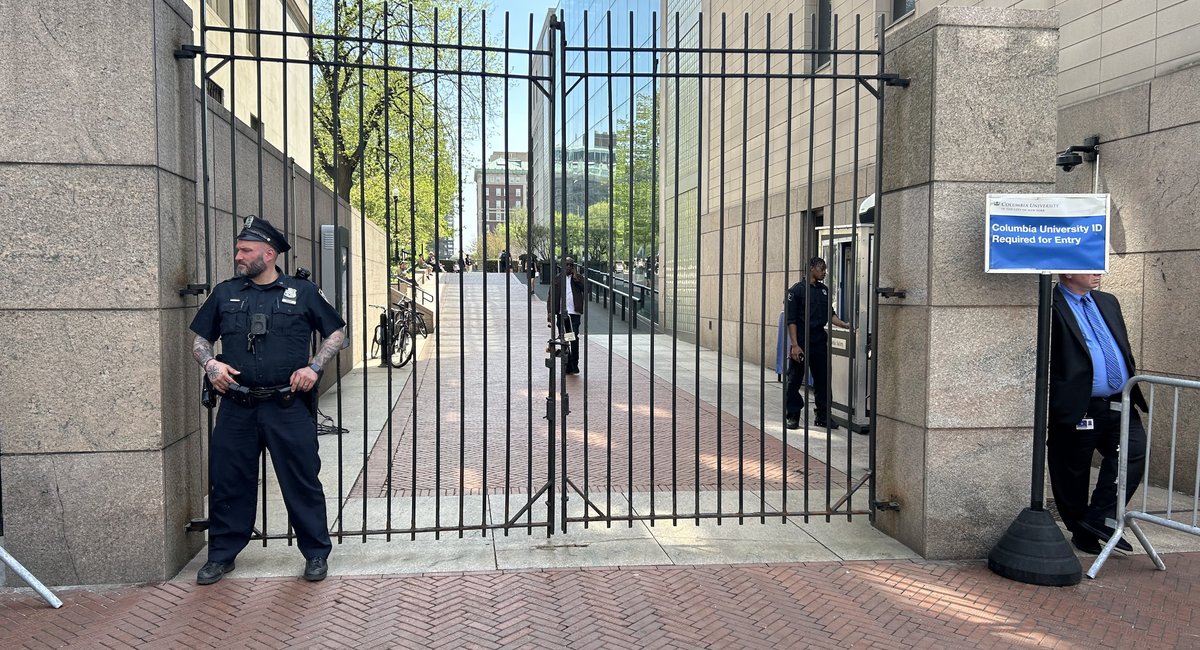
Columbia University’s gates are still locked to the public two years after pro-Palestinian demonstrations upended campus life — and neighbors of the Ivy League school are fed up.
Columbia’s Morningside campus is bounded by 114th and 120th streets, Broadway and Amsterdam Avenue. With its gates closed, residents looking to walk crosstown face significantly longer trips. And local business owners said at a small rally Thursday that foot traffic has plummeted.
“It has been a big inconvenience for the neighborhood and it has not made anything safer,” neighbor Gussie Kappner said, noting most residents have to circumnavigate the campus if they want to get from Amsterdam to Broadway or vice versa.
A Columbia spokesperson said the university is evaluating access and has implemented a program allowing locals to apply for permission to walk through the Ivy League gates.
The elite university has long had a tense relationship with the surrounding community. Local community board member Victor Edwards warned the closures fuel decades-old resentment over the university’s expansion. Plans to construct a gym for Columbia in Harlem contributed to historic protests at the university in 1968.
“Once again, here we go,” Edwards said.
Columbia University Law School student Michael Gross said many students support reopening the campus to the public.
“I think it’s a no-brainer for the vast majority of students [who] are trying to be a part of this neighborhood,” he said.
Richard Lipsky, a lobbyist who represents the Morton Williams supermarket on Broadway, said the store’s foot traffic has decreased 20% since the campus gates closed.
“From a business standpoint, a small business standpoint, it’s a big problem, too,” he said.
Kappner noted that navigating the closures is especially inconvenient for seniors and residents with disabilities. The 1 train is on Broadway and a medical center is on Amsterdam Avenue.
“We understand the desire to return to an open campus,” Columbia spokesperson Millie Wert said in a statement. “Our priority is ensuring the safety and security of our University community. Any changes to campus access will be carefully considered with input from our Campus Safety Advisory Committee, which includes students, faculty and staff.”
Under the access plan, residents who live between West 103rd and 135th streets can apply for permission to cross through campus. Nearly 1,000 community members have been approved through the plan in the last year.
Students, staff and neighbors at the rally to reopen the campus cast the fight over access as part of a larger debate over academic freedom and the role of elite universities in American life.
“Don’t our leaders understand that that is exactly what the enemies of higher education want?” math professor Michael Thaddeus said. “It’s a capitulation to those who want to chase universities out of the public sphere.”
The Trump administration withheld $400 million in research funding from the university last year, alleging Columbia had not done enough to combat antisemitism following Hamas’ Oct. 7, 2023 attacks in Israel. Pro-Palestinian protesters set up an encampment in the heart of campus amid Israel’s war in Gaza and eventually occupied a building, resulting in a clash with the NYPD.
University leaders and the NYPD alleged that outside agitators unaffiliated with Columbia exacerbated tensions.
The university and federal government reached a settlement last summer that included increased oversight in return for the research money. Critics accused Columbia of caving and called it a defeat for academic freedom. Acting Columbia President Claire Shipman has rejected that critique.
A lawsuit brought by local residents seeking to force Columbia to reopen the gates to the public is ongoing. The suit argues Columbia is violating an agreement with the city that required a section of 116th Street called College Walk to remain accessible even though it is part of the campus.
“Though not ideal, at this time, limiting access to College Walk is an important component of the University’s efforts to ensure that the Morningside Campus remains a safe and welcome place for Columbia Affiliates to pursue the University’s academic mission,” Columbia attorney Joseph Greenaway wrote in a filing last month.