
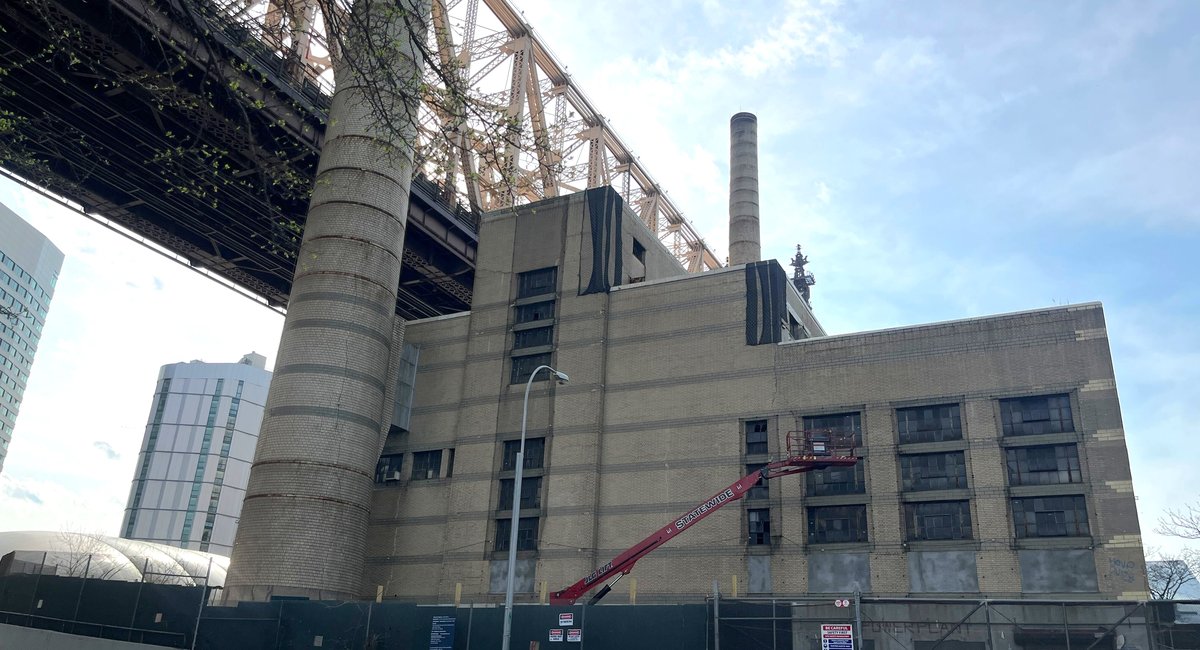
Roosevelt Island residents are demanding answers about why the city is demolishing a decommissioned steam plant on an emergency basis.
More than 100 people attended a raucous town hall with housing and buildings officials Wednesday night, to discuss the planned destruction of the Roosevelt Island Steam Plant. They said the Department of Buildings issued an emergency order to demolish the building, but that officials had refused to elaborate on the nature of the emergency or adequately address health concerns.
At one point in the town hall at the Chapel of the Good Shepherd, residents broke out in chants of “report, report” and “give us the truth!”
“I thought that we were going to get answers, so I genuinely was like, ‘OK, great. … I will renew my lease in my building, all will be well. But we heard crickets,” said Lani McGuire, a resident raised on the Island and Marine Corps veteran. “We heard literally just them ignoring questions. It was disrespectful. … It was frightening.”
The Roosevelt Island Steam Plant was built in 1939. It was designed by the Starrett and van Vleck architectural firm, which designed the New York Stock Exchange and Bloomingdale’s. The plant powered hospitals on the island until it was decommissioned in 2013.
The buildings department issued the emergency order on July 8, 2024, citing cracked and deteriorating masonry on the steam plant’s 210-foot-tall smokestacks.
Housing officials said workers are currently preparing the site and removing large oil tanks. They said asbestos abatement will be done in the building prior to demolition, and that they will protect residents from inhaling toxic particles by using misting systems during the process.
But with Main Street serving as the island’s primary commercial and residential thoroughfare, many residents worry there will be no avoiding toxic materials being hauled away.
“Who will be held legally and financially liable for the long-term health impacts on the families and daycares downwind of the demolition?” McGuire asked.
Residents questioned whether the building actually represented an emergency. Several cited the repurposing of the Domino Sugar Factory on the Williamsburg waterfront. The historic and formerly vacant building has been turned into an office tower.
“Roosevelt Island deserves better than a demolition-by-neglect strategy. We deserve a thoughtful process that protects health, preserves our voice, and explores adaptive reuse,” reads a petition on GoFundMe campaign seeking donations for a legal challenge to the demolition.
Zora Boyadzhieva, a member of the Architectural Community Alliance of Roosevelt Island and resident of 11 years, was among those demanding an environmental report from the city’s Department of Housing Preservation and Development. But an HPD official said at the town hall that the agency does not have to release such a report until after the building has been demolished.
“After 135 days, we don’t have the reports, and we are very worried. We’re worried that they’re going to start to demolish the building tomorrow,” Boyadzhieva said. “And of course, when you don’t get simple answers, don’t get simple documents for that long, you start to imagine things that are scary.”
Some residents suspected the building would be knocked down to make way for a new apartment building on the island, which has more parks and playgrounds than grocery stores.
“People are concerned about the island being overcrowded, about the infrastructure not being updated for a long, long time,” Boyadzhieva said.
Residents said the island with a population of around 11,000 people doesn’t have the infrastructure to support a major housing development.
The demolition is estimated to cost nearly $8 million, according to HPD.
“Our number one priority is the safety of our fellow New Yorkers. DOB issued orders to demolish the steam plant and smokestacks after the structures were found to be in severe disrepair, presenting a clear hazard to members of the public,” DOB spokesperson David Maggiotto wrote in an email. “This course of action was taken after a detailed review by our structural engineers, who determined that failing to take action would result in the further deterioration of the building, eventually risking structural collapse.”