
This column originally appeared in On The Way, a weekly newsletter covering everything you need to know about NYC-area transportation.
Sign up to get the full version, which includes answers to reader questions, trivia, service changes and more, in your inbox every Thursday.
Long before New York City Mayor Zohran Mamdani pushed for fast and free buses, the city of Albany had the Freewheeler.
Mamdani’s allies at the state Capitol are pushing for a new pilot program to study the effects of eliminating the bus fare in parts of the city.
Back in the 1970s, they could’ve just looked out the window.
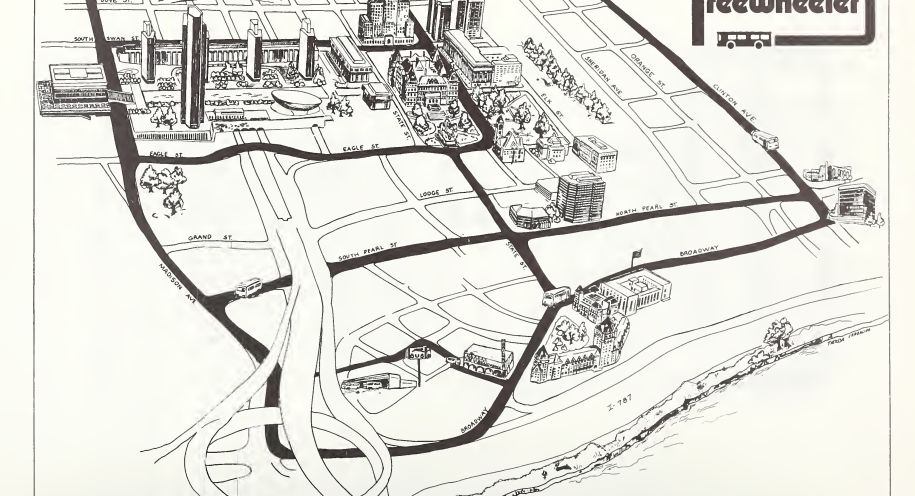
More than a decade before Mamdani was even born, the streets of Downtown Albany were filled with free buses. They whizzed by the Capitol and other government offices on a regular basis, all thanks to a $326,000 grant from the U.S. Department of Transportation to study how eliminating bus fare affects ridership.
The Freewheeler buses — yes, that’s what they were called — ran during daytime, off-peak hours on routes running through Albany’s central business district from 1978 through 1980. (During peak hours, the regular fare was 40 cents.)
Ridership went through the roof. Three times as many people rode the bus during off-peak hours during the work week when fares were eliminated — a jump from 1,070 daily average riders before the pilot program took effect to 3,040, according to a 1981 federal study. On Saturdays, it was a fivefold increase, from 270 to 1,340.
The study showed the free buses didn’t bring more people to Downtown Albany. Instead, people simply shifted their travel habits.
Workers and residents who had been accustomed to hiking up Downtown Albany’s steep State Street hill hopped on the bus instead. Downtown residents made fewer trips by car, though not by much — about 353 fewer car miles per day, not enough to make a meaningful reduction in emissions, according to the report.
Courtesy U.S. Department of Transportation
But still, Downtown Albany businesses reported an uptick in business during the pilot program. Sales-tax receipts within the central business district were up 4.9% compared to the two years before the program went into effect.
These days, Democrats in the state Legislature are trying to convince Gov. Kathy Hochul to support a similar free bus pilot program for New York City in the state budget, which is now more than two weeks late. They see it as a key first step toward achieving Mamdani’s broader vision of free buses across the five boroughs.
Hochul hasn’t committed to supporting another free bus program. And she’s hearing opposition from a key ally: MTA Chair and CEO Janno Lieber.
“We’re really pushing affordability,” Lieber told Gothamist in an interview at the Capitol last month. “We don’t necessarily think that free buses is the right way to do it. The overwhelming majority of New Yorkers are actually riding the subway or a combination of bus and subway and they wouldn’t get the benefit of any free bus — let alone a free bus pilot.”
If lawmakers are successful, it would be New York City’s second free bus pilot in the last three years.
A pilot program pushed by then-Assemblymember Mamdani in the 2023 state budget made one bus route in each of New York City’s five boroughs free to ride for a year. Lieber said the program caused confusion as the MTA worked to crack down on fare evasion.
Much like the Albany program 48 years ago, the 2023 free bus experiment led to an increase in ridership — though few were new riders, according to the MTA.
Like the New York City pilot, Albany’s Freewheeler buses didn’t last.
“When the funding support dried, so did the service,” said Carm Basile, a former CEO of the Capital District Transportation Authority who started as a transportation planner in 1981.
NYC transportation news this week
The cost of getting fans to the World Cup. New Jersey Gov. Mikie Sherrill said on the debut broadcast of WNYC’s “Ask Governor Sherrill” last night that FIFA should put up money to help cash-strapped NJ Transit move the hordes of spectators from Penn Station to the Meadowlands. Meanwhile, the NJ Transit board yesterday approved a resolution allowing its CEO, Kris Kolluri, to unilaterally set prices for World Cup-related train rides, which could cost $100 for a round trip from Penn Station.
72nd Street renovation. The Mamdani administration is proposing a new bike lane on 72nd Street that would connect to Central Park, giving cyclists a new link between the East and Hudson rivers.
Grand Army Plaza renovation. The mayor also wants to ban cars from the southern edge of Brooklyn’s Grand Army Plaza, which would connect the Soldiers’ and Sailors’ Memorial Arch directly to Prospect Park.
If not free buses, then faster ones. The mayor’s office said it’s planning bus lane improvements on 45 major corridors across the five boroughs, with the goal of speeding up bus trips by 20%.
Grand Central slashing. Family and friends of Anthony Griffin, the man police shot and killed at the Grand Central subway station Saturday, said he had no history of violence and that the NYPD’s description of a man slashing older people with a machete doesn’t sound like the person they knew.
Big honking digging machines. Crews have begun assembling the $25 million-apiece, single-use boring machines that will dig out the first new set of Hudson River train tunnels in more than a century.
Curious Commuter
Have a question for us? Use this form to submit yours and we may answer it in a future newsletter!
Question from Jennifer in Brooklyn
How does the MTA deep clean the floors, steps, walls and platforms of the subway? Why can’t they do it more often? I’m genuinely perplexed as to why our subway is so filthy and other subways are immaculate by comparison.
Answer
The MTA reports there are two ways stations are cleaned – there’s “regular cleaning by station crews, as well as periodic intensive mobile washing that includes deep cleaning technology,” according to MTA spokesperson Kayla Shults. Agency officials take exception with the question, and are often quick to respond to these types of concerns by noting that unlike many subway stations in other countries that shut down overnight, the MTA runs 24 hours. Still, the stations are noticeably shabby. The MTA’s in-house deep cleaners rely on trucks equipped with pumps that power hoses used by crews to clean the platforms. It’s a labor-intensive operation, and the agency did not say how often those trucks are deployed.
During his final three years in office, Gov. Andrew Cuomo hired outside companies to clean many stations across the city. He also shut down the entire subway system overnight during the COVID-19 pandemic in 2020 and 2021 in order to clean subway cars and push out homeless people.