
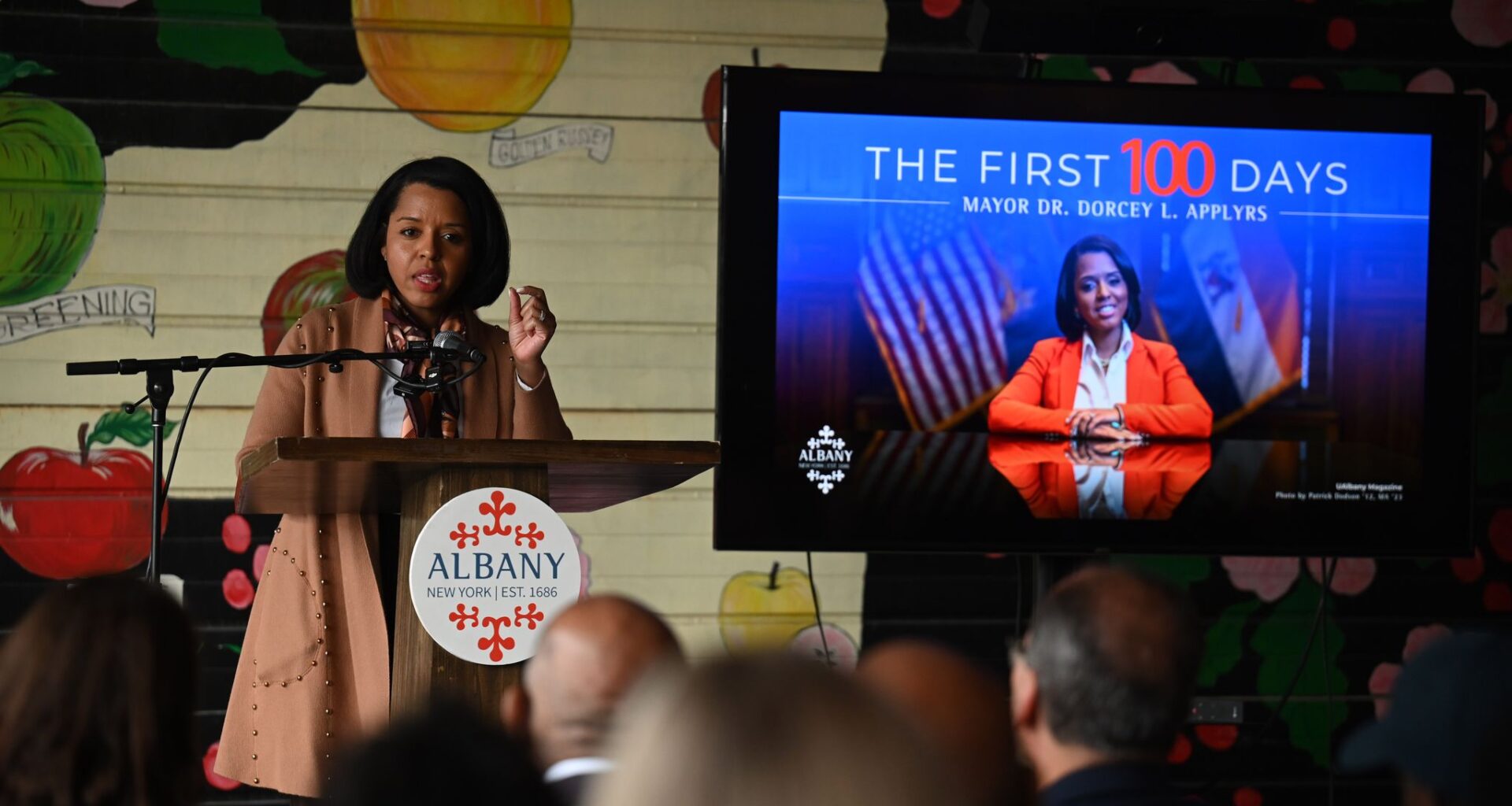
Albany Mayor Dorcey Applyrs, pictured marking her first 100 days in office on Monday at Nine Pin Cider Works in Albany, said, “I am rebuilding the city’s financial approach in real time, using current data, realistic revenue assumptions, and clear cost controls.”
Will Waldron/Times Union
Albany has big fiscal problems, as you may have heard. The city faces a $15 million gap for its 2025 budget and the shortfall could grow significantly this year.

Article continues below this ad
Well, Mayor Dorcey Applyrs and other city officials hope the state comes to the rescue. And to be sure, such a bailout will almost certainly happen; nobody expects Assembly Speaker Carl Heastie and other state Democrats to let Albany’s new mayor twist in the wind.
“I’m optimistic,” said state Sen. Pat Fahy, a Democrat from Albany. “There’s a recognition that the capital city can’t be allowed to fall apart.”
The current thinking is that Albany will receive a $35 million package, including $20 million already budgeted by Gov. Kathy Hochul, plus an additional $15 million.
Make the Times Union a Preferred Source on Google to see more of our journalism when you search.
Add Preferred Source
To be clear, that won’t be enough to fully rescue the city, given that the initial $20 million is accounted for in the 2026 budget. The looming gap, now pegged at $22 million, exists nevertheless.
Article continues below this ad
Will the city receive more? Should it?
You can argue that the budget problems are a problem of the city’s own making, at least in their severity. That they seem to have caught the mayor and so many other officials off guard suggests nobody was minding the store. Seriously, much of the budget hole should not have been a surprise.
According to the mayor’s office, $8.7 million of the 2025 budget gap resulted from expiring federal aid and grants, reduced speed-camera collections, and less-than-anticipated revenues from the tax agreements handed to developers.
That part of the gap, then, was either predetermined or entirely predictable, and it’s inexcusable that the 2025 budget was built on such a flimsy foundation. To me, at least, a reasonable conclusion is that former Mayor Kathy Sheehan didn’t want to spike taxes in her final year or when an ally — that would be Applyrs — was running to succeed her.
Article continues below this ad
As Common Council member Deirdre Brodie noted, budgetary warning signs were increasingly obvious late last year. And yet Applyrs, who has said the gravity of the problem was not evident until recent weeks, nevertheless started her administration by giving out raises, creating new jobs and hiring a pricey lobbying firm.
“Families don’t buy TVs when they don’t know if they can afford groceries,” Brodie said. “I think city leaders need to hold themselves to the same standard.”
Applyrs promises that the mistakes of past budgets won’t be repeated.
“I will not make decisions based on assumptions that no longer reflect reality,” she said. “I am rebuilding the city’s financial approach in real time, using current data, realistic revenue assumptions, and clear cost controls.”
Article continues below this ad
Meanwhile, the mayor will be looking for as much state help as possible.
Of course, when arguing for increased state financial help, Albany officials note that much of the city is state-owned and tax-exempt. That puts the city in a continual revenue squeeze, they argue, that isn’t of its own making. The problem is exacerbated by Albany generally receiving less direct state funding, on a per-capita basis, than other cities.
But it’s also true that the value of taxable property in Albany is unusually high for an upstate city, boosted by the presence of state government and untaxable assets such as the University at Albany.
Article continues below this ad
According to the state comptroller’s office, the taxable value of Albany property in 2025 was $7.5 billion.
Syracuse, by contrast, is 50 percent larger by population but has a lower taxable value, $6.9 billion. Troy has half of Albany’s population and a taxable value of $2.8 billion, significantly less on a per-capita basis.
By that measurement, Albany is in a privileged position, not a disadvantaged one. It’s a benefit to be the capital, not a drawback.
That isn’t an argument against more state aid or a bailout, but let’s concede that the case is more complicated than city officials care to admit.
Article continues below this ad
And that’s before we consider the $400 million in economic development money that Hochul has directed to Albany for economic revitalization, an acknowledgement of the city’s struggles and the importance to New York of a livelier capital.
Other cities would kill for such a gift, figuratively speaking, but, weirdly, the money makes it more likely that the state will rescue Albany. In a way, Albany has the state over a barrel.
There’s no way Hochul’s administration can spend, as planned, $150 million to revamp the New York State Museum while a city fiscal crisis is forcing the closure, say, of the nearby Lincoln Park swimming pool.
The state can’t hand checks to developers for downtown apartments and other projects, no matter how valid and good for the city’s future, while services are being slashed in the South End or Arbor Hill.
Article continues below this ad
The optics would be terrible. The morality would be questionable. And nobody, by the way, seems to be talking about shifting any of the $400 million to address budget gaps.
And so, here’s a prediction that Albany will receive much, if not all, of the bailout it seeks. But that shouldn’t preclude a detailed examination, perhaps from the state comptroller, of how the city got into this mess.
To paraphrase the cool kids, the math isn’t mathing.
Article continues below this ad