
As I amble through The Venetian Las Vegas hotel and casino complex, I try to block out the cacophony of fake Venetian gondoliers belting out, “Oh Solo Mio” against beeps and boops of slot machines in the distance. And then I am struck by something: that every 200 feet or so, I walk by a steakhouse. And not just any generic sanctuary of steak but spots with boldface names scrawled across them, like José Andrés, Emeril Lagasse, and Wolfgang Puck. It turns out there are six steakhouses ensconced within The Venetian. At first it seems like beef overkill to me. But as I explore the rest of Las Vegas, I realize the near ubiquity of steakhouses here is not an anomaly.
I have always considered New York City, with its bevy of century-old basilicas of bovine meat, to be the steakhouse capital of the country. Maybe even the planet. But in Las Vegas, you can’t toss a ribeye bone without hitting a sign announcing prime roasted beef could be consumed there.
Case in point: Both cities have at least 100 steakhouses, but Las Vegas has a population of 650,000 people and 40 million visitors each year to New York City’s 8.5 million denizens and 65 million annual visitors.
If I had any doubt about the answer to the age-old question, “where’s the beef?” I now know where to find it: Las Vegas is the place to blow a few hundred bucks to tuck into a sizzling porterhouse or a thick tomahawk while sipping on a dirty Martini or a full-bodied Rioja. But I’m not satisfied with stopping there.
Steakhouses originated in London as taverns for the working class. In the United States, they began appearing in the 19th century, also catering to a blue collar clientele. By the 1970s, the stalwarts of steak had become a symbol of old, passe dining. But these days, steakhouses are booming. It appears, we’re all currently living through a golden age of the steakhouse.
And so, I wanted to see how these restaurants evolved from working-class hangouts to symbols of extravagance, and why Las Vegas is particularly primed for pairing up with these meat meccas.
Classic steakhouses in Las Vegas
I begin at Golden Steer, the oldest steakhouse in Las Vegas (it opened in 1958), and reportedly a haunt for iconic figures like Marilyn Monroe, Muhammad Ali, Frank Sinatra, James Dean, Elvis Presley, and Nat King Cole. Golden Steer is old-school Vegas to the core. I sit at the bar, my face illuminated by the ubiquitous slot machines built into the counter, nursing a dirty Martini.
Las Vegas’ steakhouse roots, says Amanda Signorelli, co-owner of Golden Steer, “goes back to our foundation as a cowboy outpost in the desert. What really cemented steakhouses as central to our culture is how this city evolved into a destination for abundance and celebration.”
I look around the room at the Golden Steer, witnessing exactly that: Diners dig gooey marrow out of bones the size of dinosaur femurs while others cut into thick hunks of beef, and waiters toss Caesar salads tableside. Golden Steer is reversing the trend of New York City restaurants opening up outposts in Las Vegas by exporting their own restaurant to the Big Apple: In late fall 2025, the steakhouse will fire up its burners in Greenwich Village.
The classics of Las Vegas are not going to challenge your expectations of what a steakhouse can do. They’re generally homegrown restaurants located off the Strip. Some standout examples include Oscar’s Steakhouse, named for former Las Vegas mayor, Oscar Goodman, in Downtown Las Vegas and Hugo’s Cellar, also downtown, where the old-school vibe begins with the restaurant’s website that looks like it hasn’t been updated since the late 1990s. The one geographical exception, however, is the The Steak House at Circus Circus. The dark wood and hunter green walls with red tufted leather booths set the tone for a classic steak experience, as tuxedo-clad waiters march through the dining room delivering medium-rare rib-eyes and porterhouses.
Related: For a Truly Great Salad, You Should Go to a Steakhouse
“Steakhouses date to the earliest days of Las Vegas hospitality, when what would become the Strip began emerging in the early 1940s,” says Johnathan Wright, restaurant critic for the Las Vegas Review-Journal. “Beef had long been a food of celebration and luxury, and steakhouses, with their wide appeal, added to the guest experience at hotels and casinos. As the culture of dining, entertainment and gaming grew in Vegas, steakhouses became more lavish, as well as a way to reward important players with comped food and drink, a practice that continues today. The history of the steakhouse in Vegas is entwined with showroom dining and dining has always been entertainment in Vegas, and that includes steakhouses.”
“A great steakhouse dinner has become a timeless experience in Las Vegas,” says Kate Wik, CMO of the Las Vegas Convention and Visitors Authority. For decades steakhouses have been woven into the fabric of Las Vegas history and culture. Today, top chefs from around the world continue that tradition, drawn to Las Vegas as a place to push boundaries, entertain guests from every corner of the globe, and deliver it all with that unmistakable Vegas flair — from the iconic Golden Steer to modern standouts like PRIME at Bellagio, Peter Luger Steak House at Caesars Palace, SW Steakhouse at Wynn, and Barry’s Downtown Prime at Circa Resort.”
Lavish and modern Las Vegas steakhouses
Lagasse brought a sprinkling of New Orleans to Las Vegas when he opened Delmonico Steakhouse in 1999 in The Venetian. Housed in a lush high-ceilinged room amid a capacity gaggle of diners feasting on red meat, I feast my way through a house-aged, bone-in rib-eye and wonder how a steakhouse in such a beef-heavy town manages to stay open for a quarter of a century.
When I ask Lagasse, he boils it down to not resting on one’s laurels: “I think a big driving force behind our success is that we never stop evolving, we are always striving to be better than the day before,” he says. “We honor the great American steakhouse, but we do it our way with a distinctive nod to New Orleans. Big flavors, warm hospitality, and real care for every guest, that’s what sets us apart.”
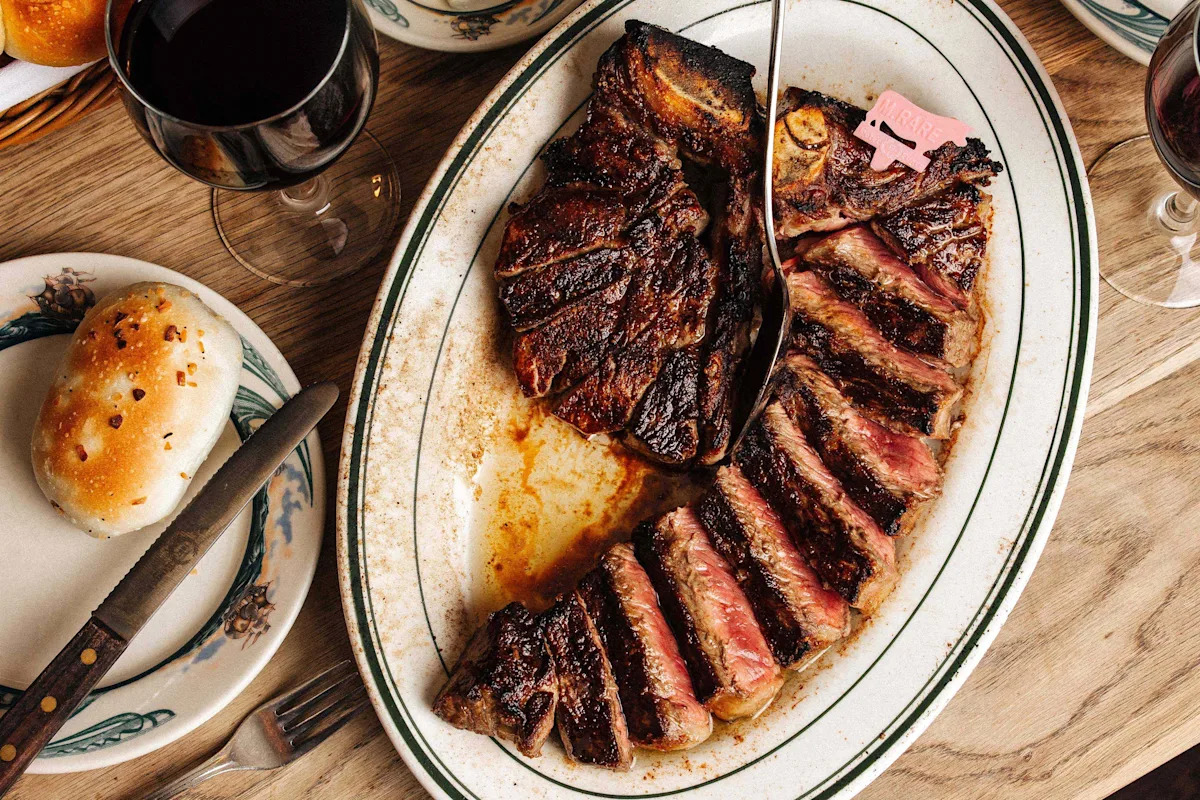
The same might be said for the venerable Brooklyn beef institution Peter Luger Steak House. It revealed a serious Vegas glow-up when it opened in Caesars Palace in late 2023, making exhausting strides to create a classic steakhouse vibe with hardwood floors, high vaulted ceilings, brick archways, and bronze chandeliers. The menu isn’t much different from the original in Brooklyn — and that’s the point — but the high-roller atmosphere is.
Related: A Highly Opinionated Guide to Las Vegas’ Best Restaurants and Bars
“We’ve gone through extraordinary pains to make sure that the Vegas restaurant is true to the original,” says Daniel Turtel, Peter Luger’s vice president. “We’re aging on-site with the same beef and even the same bacteria and mold as the meatbox in Brooklyn. We’ve been using beef tallow in our fryers since before it was trendy, and will keep doing so long after the next trend gives beef tallow the boot.”
The new guard
There’s a new batch of steak-serving restaurants in Las Vegas and they reflect the current boom in beef-centric dining, often blending a classic American steakhouse vibe with an outside culinary element to it. Bazaar Meat by José Andrés, for example, brings an Iberian zing to the restaurant: alongside classic cuts of beef, you can also graze on jamón ibérico, suckling pig, and “vaca vieja,” or “old cow,” representing the Spanish practice of consuming older cows that are less tender but much more flavorful. From Spain to Korea, Cote, an import from New York City, recently opened its doors, serving Korean-accented steak.
The latest steakhouse to open in Las Vegas is Boa, about a 10-minute walk from Delmonico and Bazaar Meat. Boa is the quintessential Las Vegas steakhouse of the 2020s, with a modern design that intentionally separates it from the classics. The menu does, too. Here you can feast on an enormous 15-day dry-aged tomahawk, variations on the theme of A5 wagyu, and prettied up signature dishes — like caviar cones, wagyu cigars, and lamb lollipops — that will appeal to social media-loving diners.
In Eric Wareheim’s just-released book, Steak House, he waxes on about why he loves the atmosphere of a steakhouse, likening it to a big, comforting hug, “The wizardry of a good steakhouse is that you get that hug without even having anyone’s arms wrapped around you. It’s a vibe hug and it’s intoxicating.”
After five days of eating at steakhouses, I exit Las Vegas feeling like I have just been given hundreds of hugs.
Read the original article on Food & Wine