
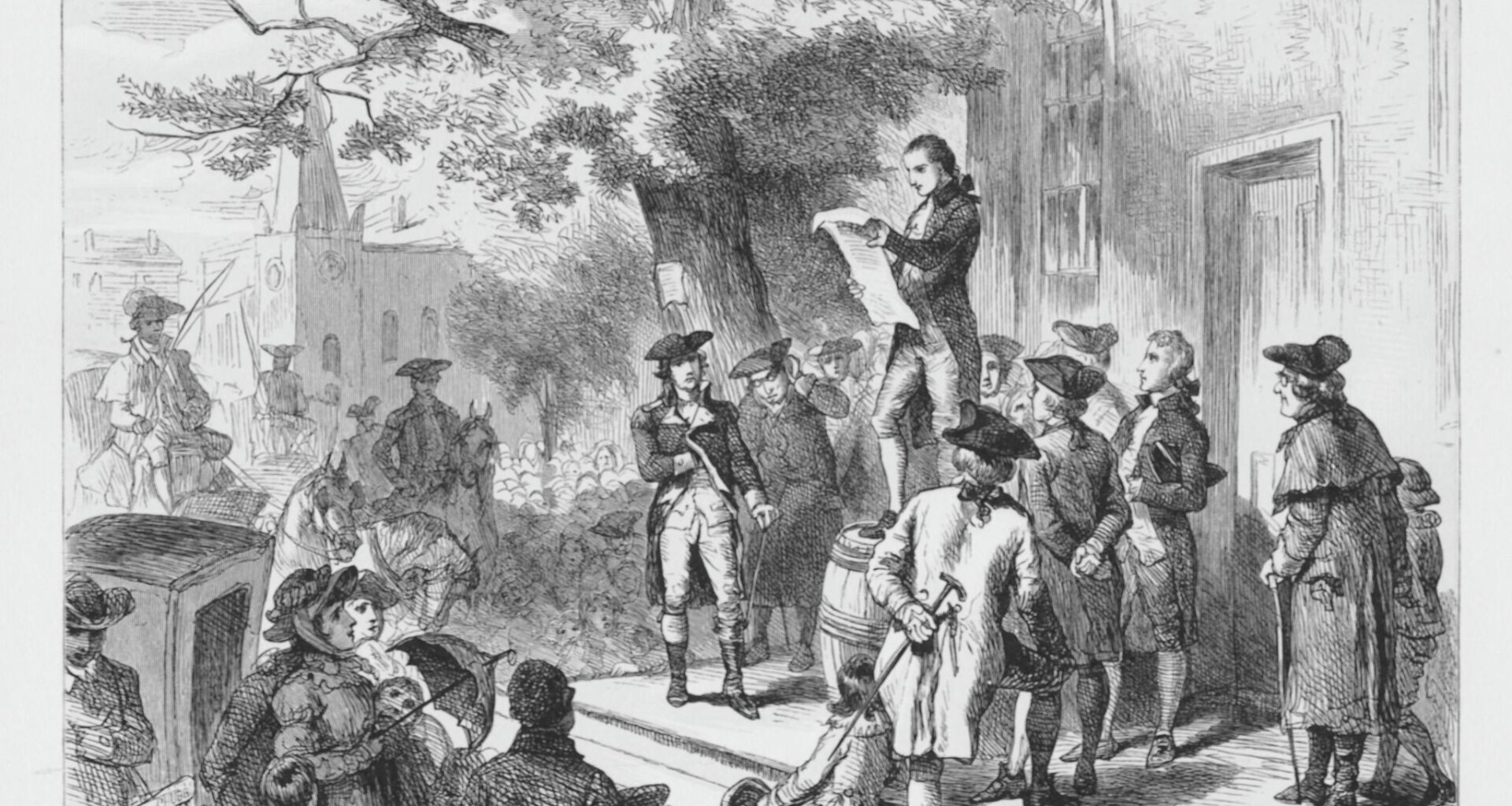
This undated engraving shows residents of Kingston listening as Robert Benson, secretary of the convention, reads the state constitution publicly for the first time.
Archive Photos/Getty Images
April 20 is New York’s birthday. It should be a time for statewide celebration.

On April 20, 1777, the Convention of Representatives of the State of New York, an ad hoc revolutionary group elected the previous summer, completed work on New York’s first constitution in Kingston. The document declared that the convention, acting “in the name and by the authority of the good people of this State, doth ordain, proclaim, and declare that no authority shall on any pretense whatever be exercised over the people … of this State, but such as shall be derived from and granted by them.”
Article continues below this ad
In effect, the constitution transformed the English colony of New York, governed by a king, into the state of New York, governed by officials elected by its people.
Studying the document, and the process that created it, reveals several strategies that New York could use today.
Courage. The convention kicked off in New York City, then moved to White Plains, then to Kingston to keep out of reach of British military forces. Getting caught would have meant imprisonment or possibly executions. The constitution writers-on-the run showed a steadfast commitment to the cause of liberty.
Make the Times Union a Preferred Source on Google to see more of our journalism when you search.
Add Preferred Source
Inventiveness. The writers had little to go on – the other colonies-becoming-states were working on their own constitutions, and the U.S. Constitution was a decade in the future. They drew on a few European and American colonial political writers for ideas such as natural rights and government by consent of the governed. And they drew on their own experiences with colonial government.
Article continues below this ad
Compromise. The constitution writers were fast. They drafted a document from scratch and finished it in about three months – approximately as long as the current state Legislature struggles every year to even pass a state budget by the legally established deadline, April 1 (a deadline it usually misses). The founders talked things through, put bickering aside and compromised. That’s a good model for today, when political impasse is all too common.
Brevity. The new constitution was around 5,000 words long, about a tenth of the length of the current state constitution. It laid out the parameters of state government and defined the role of the governor, the Legislature and the courts. The writers left the details to the Legislature.
The document was far from perfect. Slavery, established in the 17th century, was left intact. Freedom of religion was protected, but not other civil rights. Voting was limited to men who met minimum property holding qualifications.
These deficiencies were slowly addressed in subsequent years. A Bill of Rights was added by legislation in 1787. A law to gradually abolish slavery passed in 1799. Property qualifications for male voters were phased out in the 19th century; women finally got voting rights in 1917.
Article continues below this ad
After finishing the constitution, its writers quickly arranged for elections. The first Legislature assembled in Kingston in September. The new governor, George Clinton, was also a general in the patriot army. The government got down to work, quickly passing laws to raise revenues for the war effort and deal with the loyalists, who supported the British.
A British military force sailed up from New York City (which the British occupied) and burned Kingston on Oct. 16. The new state officials, warned about the coming attack, rowed across the Hudson and reestablished the capital at Poughkeepsie.
Patriot troops at Saratoga stopped a British invasion from the north on Oct. 17. New York state was here to stay.
The first state constitution proved to be a solid foundation to launch what would soon be called the Empire State. During the period from 1777 to 1821 period, settlement pushed westward, the Erie Canal was initiated and New York began on the road that would make it the nation’s most populous and important state.
Article continues below this ad
Many New Yorkers know little of the statesmen who started New York or of the enduring principles established in its founding document. New York history gets scant attention in the schools. This year could be an exception and set a precedent for the future.
As we prepare to celebrate America 250, we should also look back to our own state’s origins for models of inventiveness, courage and compromise for the public good.
Bruce W. Dearstyne, a historian, is the editor of “Revolutionary New York: 250 Years of Social Change.”
Article continues below this ad