
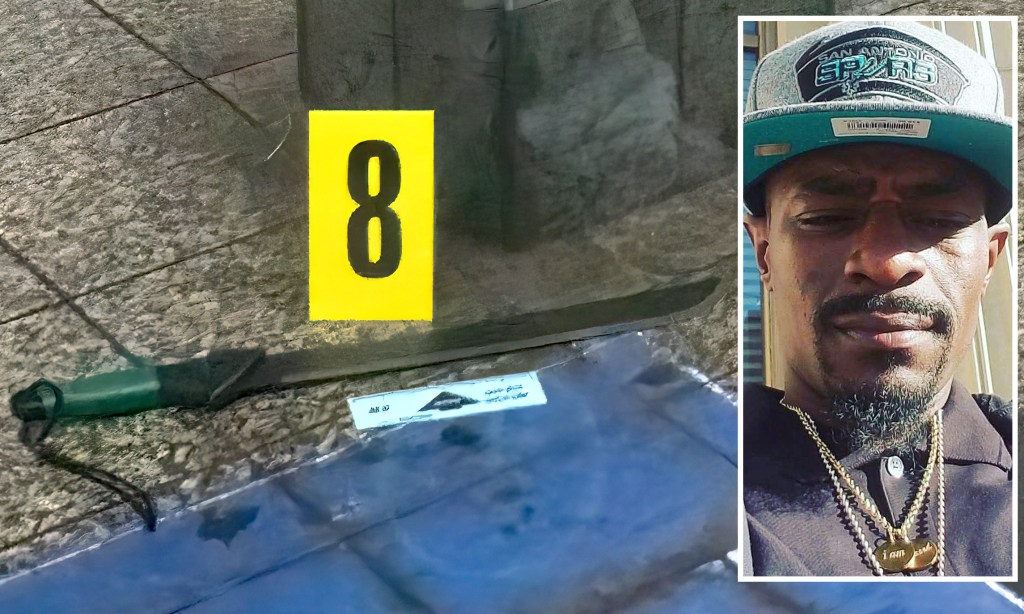
Before he cut a bloody swath through the subway station at Grand Central Terminal with a machete, Bronx-born battle rapper Anthony Griffin had been binge drinking for days without sleeping — a habit he formed while mourning the death of his mother years ago, his friends and family said.
Griffin, who was known in battle rap circles as Fox 5, was shot dead by cops April 11 after refusing to drop the machete they say he used to slash three elderly strangers in the busy Manhattan subway station. During the attacks Griffin shouted that he was ‘Lucifer,’ police said.
The violent attack marked a tragic and final chapter in Griffin’s downward spiral following his mother’s death in 2021. Her passing had a profound effect in him, friends say, and left him without a place to live, and he was forced to enter the city’s shelter system in 2022.
While Griffin had no documented history of mental issues with the NYPD and had not been formally diagnosed with a mental illness, his family said that in recent years Griffin seemed depressed. He struggled with alcohol abuse and insomnia. Looking for some kind of solace he reportedly became deeply interested in religion.
“It was just him and his mom. The closest sibling he had was me. So when his moms passed away, it affected him,” said Griffin’s cousin, Nate Baker.
“He was just sad. He wasn’t mad and angry. He was just drinking more. Wasn’t sleeping, you know, wasn’t resting properly.”
“He was always up, and I kind of understood, because I know how it feels when you lose somebody close, especially your mother,” the cousin continued. “So I was like, ‘Damn, I can’t tell him how to mourn.’ But I told him, ‘You gotta stop drinking. You gotta get rest. Anthony, you know you gotta rest.’”
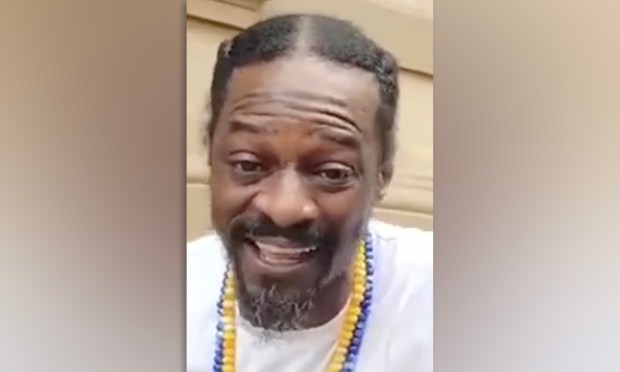
Courtesy of Terrell Blair
Anthony Griffin, 44, performed under the stage name “Fox 5.” (Courtesy of Terrell Blair)
In one of their last conversations Griffin confided in Baker that he had started having seizures due to his drinking habit.
“I was worried about him. He said he caught like, 13 seizures,” Baker said. “That was the last conversation. I gave him some money to wash his clothes. He just got a phone. Me and him just started talking again, because he got a number.”
A musical turn
Baker, who said his relationship with Griffin was akin to “Batman and Robin” grew up with him in the south Bronx in the 1980s.
“He was always into music. We was always watching Video Music Box, Friday Night Videos with Bobby Simmons. He started writing raps around maybe 19, mid 90s, I would say. He started writing and he just started getting better and better and better,” Baker said. “[When he was rapping] that’s only the only time when the Fox come out. And then it’s like, ‘Whoa.’”
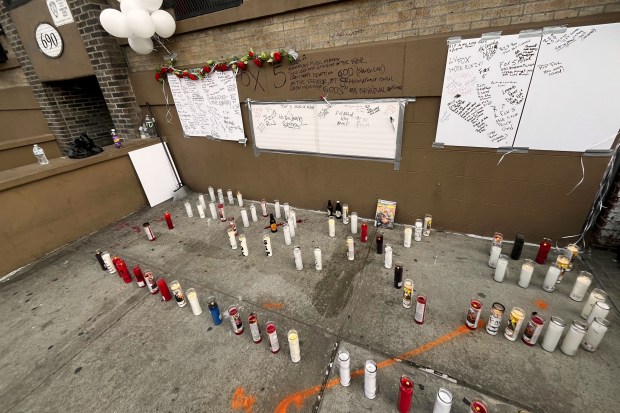
Julian Roberts-Grmela / New York Daily News
A memorial for Anthony Griffin is pictured on Sunday outside the Mott Haven building he grew up in. (Julian Roberts-Grmela / New York Daily News)
Griffin gained notoriety in the late 90s and early 2000s, when he found a niche as a battle rapper, known for his incisive lyrics, social commentary and sense of humor.
Numerous friends and family members, in interviews with the News, described Griffin as a peaceful man, known for his devotion to God as much as his spitfire lyrics. They said they’d seen no sign of the kind of violence that exploded that Saturday at Grand Central.
“He was so funny. You’d be in stitches. You be around him, you will laugh. I swear to God, there’s no one like him,” Baker said.
But the music industry changed, and Griffin never caught a break. He took a hiatus from battle rapping and changed his rap name to Gawdflow around 2010.
After stepping back from the battle-rap scene, Griffin immersed himself in religion.
“I went within,” he said in an interview around 2022. “I was just relearning myself and realigning myself with my creator,” he said in the interview. “Hip Hop needs salvation. I’m here to do the job.”
He had recently gotten an apartment in Queens through the housing lottery, his childhood friend Inaz said, and began riding the subway every day from Queens to the Bronx, panhandling and preaching through his freestyle rap lyrics.
The last time Inaz saw Griffin in November, “he hugged me so tight he fixed my back,” Inaz said. “You could tell that he was definitely suffering from some mental health issues, because, you know, sometimes he would start rambling.”
“As he got older, he got real preachy to the point where it kind of lost people,” Baker told the New York Times.
Deadly confrontation
On the morning of April 11, Griffin entered the subway at the Mt. Vernon station, near his apartment in Queens, around 9:30 a.m., according to police.
Before leaving his apartment, Griffin grabbed the machete his friend told News12 he had started carrying “for protection.”
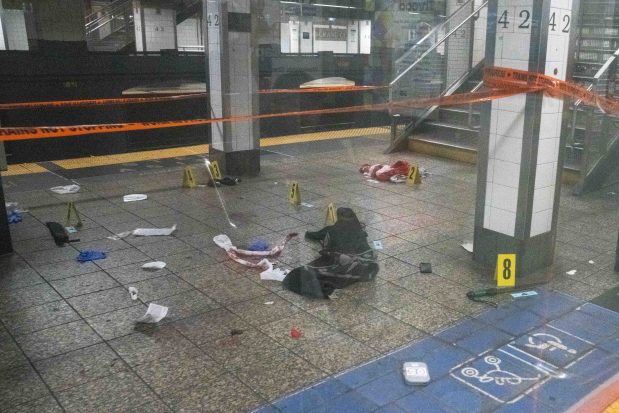
Theodore Parisienne / New York Daily News
The scene on the subway platform after cops shot and killed a man who slashed three elderly commuters on the uptown 4/5/6 subway platform inside Grand Central Terminal on E. 42nd St. near Park Ave. in Manhattan on Saturday, April 11, 2026. (Theodore Parisienne / New York Daily News)
Baker believes he was on his way back up to the Bronx.
But instead of taking his usual train ride, Griffin got off the 7 train at Grand Central Station, where he slashed an 84-year-old man on the platform on the head and face, police said. Griffin then moved upstairs to the Nos. 4/5/6 platform, where he attacked a 65-year-old man and a 70-year-old woman, slashing the man’s face and causing an open skull fracture and chopping at the woman’s shoulder, police said.
Two uniformed NYPD Transit detectives ordered Griffin 20 times to drop his weapon but he refused, NYPD Commissioner Jessica Tisch said.
The cops then offered to help him if he dropped the blade but he advanced on the cops instead, his knife extended, while screaming that he was “Lucifer,” Tisch said.
The cops opened fire, hitting Griffin twice, then performed CPR on him before medics took him to Bellevue Hospital, where he died.
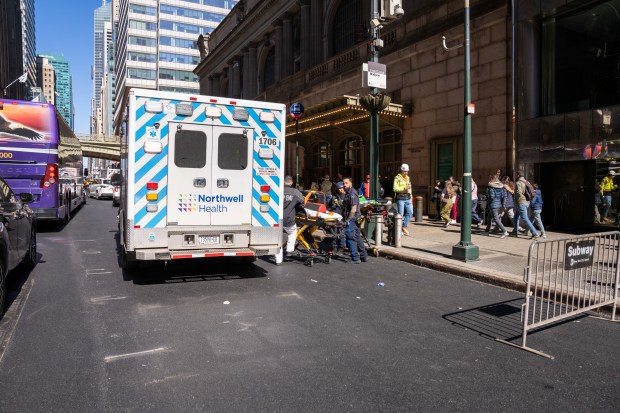
Theodore Parisienne / New York Daily News
An ambulance is pictured outside Grand Central Terminal after cops shot and killed a man who slashed three elderly commuters on the uptown 4/5/6 subway platform inside Grand Central Terminal on E. 42nd St. near Park Ave. in Manhattan on Saturday, April 11, 2026. (Theodore Parisienne / New York Daily News)
“It’s unbelievable,” Baker said. “It’s like I’m in a bad dream. I would never expect him to go out this way, violently. Nobody can believe that story. Everyone is like, ‘He did what to old people?’”
Griffin’s family said they were perplexed hearing what his final words were.
“He was a Christian man. He never called himself Lucifer,” Griffin’s cousin, Dashawn Cunningham said. “He wasn’t the devil.”