
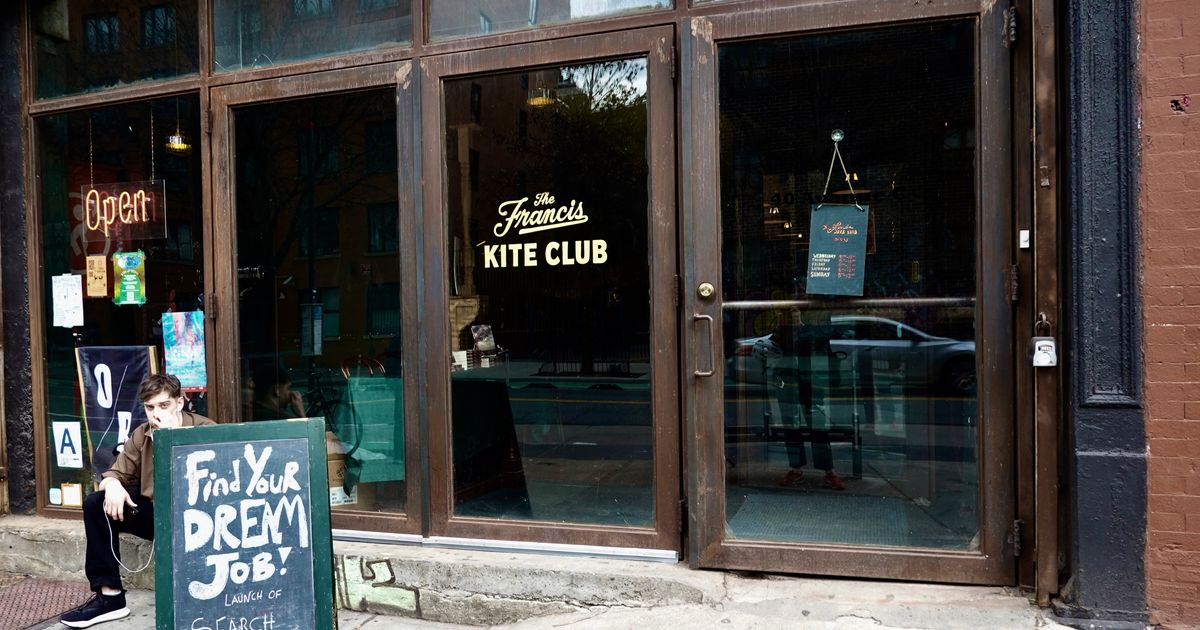
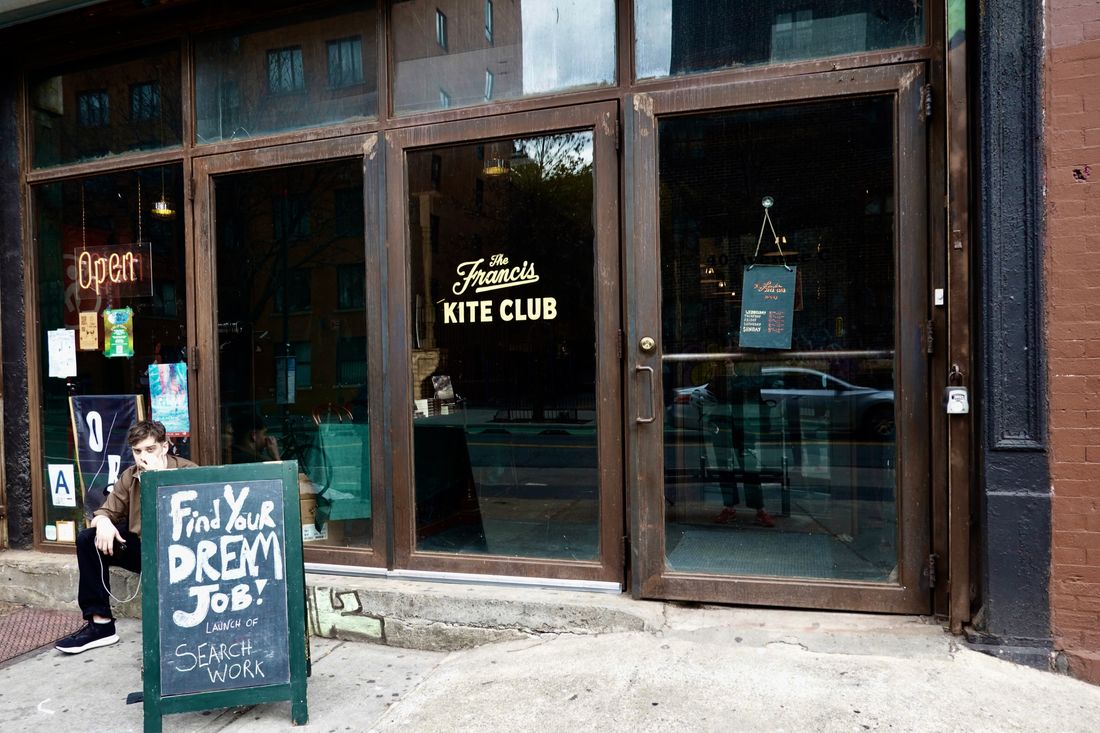
A packed house at the Francis Kite Club for a reading of Search Work, a new release from a publisher who works in the back of the bar.
Photo: Adriane Quinlan
On a Wednesday in April, a chalkboard outside the Francis Kite Club on Avenue C read, “Find Your Dream Job!” Inside, on a low stage near the center of the room, in jeans and a loose yellow sweatshirt, Rachel Meade Smith was introducing a collection of essays, Search Work, as a 21st-century record of the maddening search for “meaningful, sustainable, and humane work.” Her editor at the small indie OR Books, Olivia Heffernan, pointed out the copies for sale to the audience filling out the bar’s dark-green banquettes and rows of folding chairs, then made an invitation: “Feel free to come check out our office,” she said, pointing to an arched door at the back of the bar.
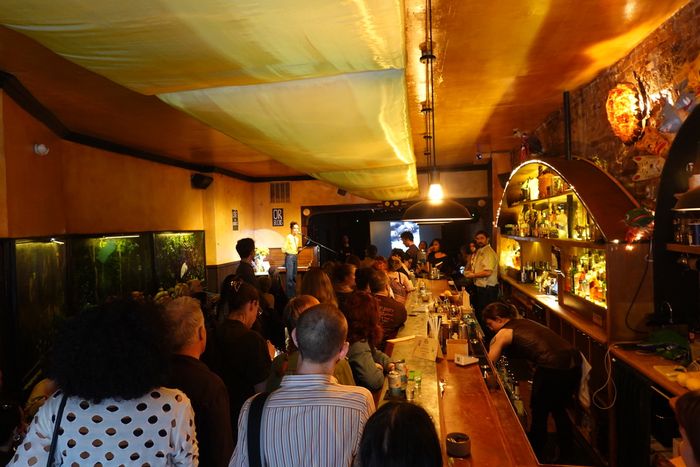
The scene at the Francis Kite Club for the release of Search Work.
Photo: Adriane Quinlan
For $1,700 per month, OR Books rents the Francis Kite Club’s green room from Monday through Wednesday, from about 10 a.m. to 6 p.m. On Thursdays, OR hands it over to Lux, a feminist magazine, which pays $250 for the day. Bartenders arrive at 5 p.m. Wednesday through Sunday, creating a built-in happy hour for the assembled workers. The bar-office also hosts events like the Search Work launch along with fundraisers and parties — a perk that makes use of a sound system brought in by Kyp Malone, who’s part of the collective of artsy friends who co-own the bar. Chelsea Manning has DJ’d a party for Lux. Slavoj Žižek and Norman Finkelstein have appeared for OR Books. The relationship is “symbiotic,” per Joey Daniel, who handles audiobooks for OR. “I’ve signed off on beer deliveries,” says Lux founder and editor-in-chief Sarah Leonard. “And sometimes we get books delivered on a Saturday, and they’re here to receive it for us,” adds Heffernan. Editors dump out half-drunk cocktails and tidy up so they can spread out over the banquettes in front with their laptops and manuscripts. Bartenders borrow books. “It’s like a sitcom back here, and always delightful,” says Leonard.
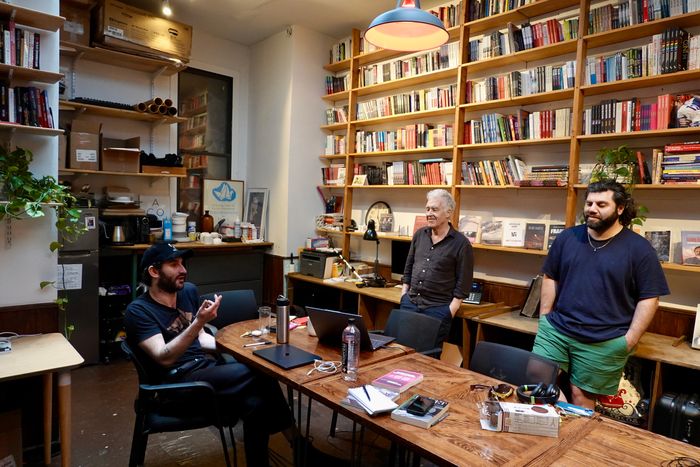
Sean Goldring, the bar manager, chats with Colin Robinson, the co-founder of OR Books, and Joey Daniel, who oversees audiobooks and multimedia.
Photo: Adriane Quinlan
“We’re in a bar, but it doesn’t cross my mind,” says Daniel, who later accepts a free white wine from Sean Goldring, the bar manager. The real benefit is not the bar itself but rather the feeling of the room: casual, grubby, a place for play and for the play of ideas. Smith, whose book was launching that night, remembered back to her first meeting in the room: how she had wanted OR to publish her book, how she had been nervous before arriving, and how almost immediately she had felt like “we were just peers having a real conversation,” she says. “I didn’t have to impress them.”
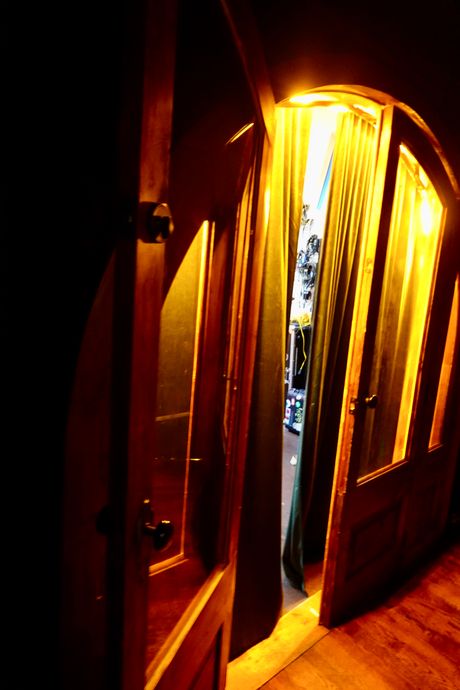
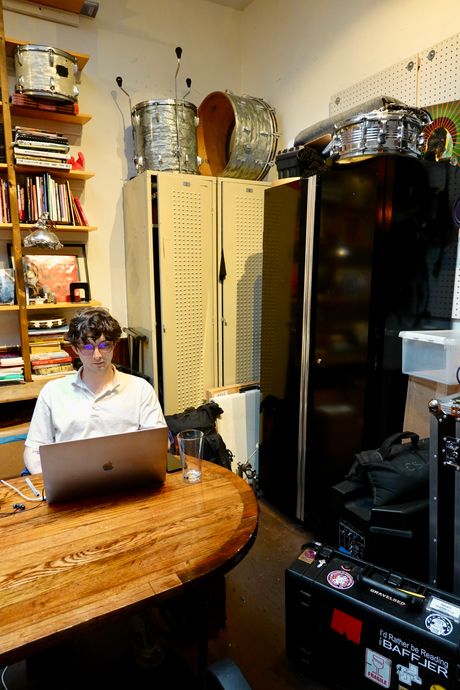
Through the arched door, editor Sam Russek works below a drum kit and a shelf of back issues of Lux Magazine. From left: Photo: Adriane QuinlanPhoto: Adriane Quinlan
Through the arched door, editor Sam Russek works below a drum kit and a shelf of back issues of Lux Magazine. From top: Photo: Adriane QuinlanPhoto: A… more
Through the arched door, editor Sam Russek works below a drum kit and a shelf of back issues of Lux Magazine. From top: Photo: Adriane QuinlanPhoto: Adriane Quinlan
This is, of course, exactly the kind of thing that Colin Robinson, who runs OR Books, wants to hear about his operation — a small publisher that prints on demand to reduce waste and backs authors no one else will touch. (One of last year’s best sellers was a collection from the late Palestinian poet Refaat Alareer.) But if you ask Robinson how he ended up here, the story is purely financial: When their last landlord died, they needed a new gathering space, plus a place to host events, and he knew one of the owners of Francis Kite Club. “It’s just brutal economics,” he tells me. Office space is expensive, and the publishing industry has been downsizing for decades now, sometimes cutting staff, sometimes pushing workers to go hybrid. (Scholastic and Oxford University Press recently sold off iconic New York buildings, Macmillan left the Flatiron and consolidated, and Penguin Random House sublet 112,000 square feet at its headquarters.)
The time-share model also made sense in another way: Small magazines regularly throw events at their offices, effectively turning them into a bar for the night. (N+1 has had parties in an industrial Greenpoint loft with a balcony off a hallway for smokers; the Baffler has hosted in its more formal Manhattan office.) So why not, if you’re an exceedingly small magazine like Lux, have the office be the bar? Events they’ve thrown here have been key to helping build a subscription base. “The reason you’re reading Lux is to be in community with people, and the space does allow for that in a very powerful way,” says Leonard. (The perk of a bar in an office is so obvious that even JPMorgan is doing it.)
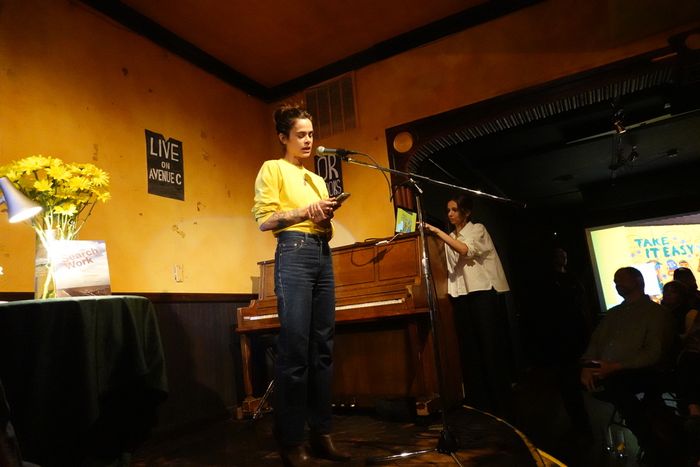
Smith (left) reads as Heffernan, her editor, makes an adjustment on a laptop.
Photo: Adriane Quinlan
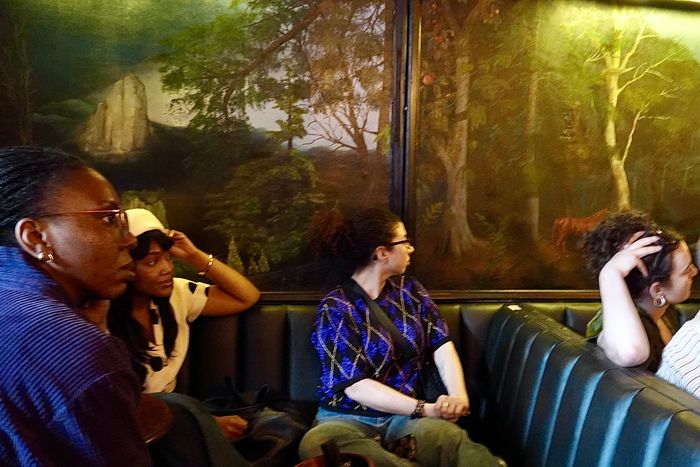
The audience for the Search Work reading took over green banquettes, backed by paintings by Nina Nichols.
Photo: Adriane Quinlan
And many bars are having just as hard a time making rent, making these kinds of arrangements a life raft for basically all parties involved. A start-up called Fluxo got off the ground in the city last year as a kind of Resy for hot desks at a place with a guaranteed level of Wi-Fi and free nonalcoholic drinks. A spot in Bushwick has free seltzer and stays open until 11 p.m. The most popular bar, says Matthew Kennedy of Fluxo, is off Grand Central. And owners have found, he adds, that workers who come for the free coffee sometimes stay to end the day with a beer.
If there’s a drawback to the arrangement at the Francis Kite Club, it’s the fact that the office OR Books walks into on Monday morning has spent the weekend as a greenroom for traveling bands and performance artists, actors and poets. “We find lots of clothes,” says Daniel, holding a sweatshirt he picked up that morning. Robinson and Heffernan have cleaned up pantyhose. “We found video and photo evidence that was crazier than we could have imagined,” Robinson says. But his deeper worries so far haven’t come to pass — no one steals the books that stretch on shelves up to the ceiling, representing 17 years of work. People are leaving books behind, almost as if they want them to be noticed. “Which in a way is even worse because we have too much in here,” he says, looking around at a stuffed-to-the-brim room — with merch over a fridge, a coffee counter over a filing cabinet of author contracts, and sound equipment spilling out of storage capped with a silver drum kit.
After the reading for Search Work, visitors wander in: an archivist at the Schomburg Center, a bartender who needed to put ice in the fridge, and the writers who had just read on the stage grabbing their bags for the long ride home. “You probably weren’t expecting anything as lavish and glossy as this,” Robinson says with a laugh. A little later on, someone walks in, perhaps seeing the chalkboard (“Find Your Dream Job!”). Could Robinson print their résumé ahead of an interview? “Fluent in Japanese,” he says, reading the file as it prints. “You’re overqualified.”
Sign Up for the Curbed Newsletter
A daily mix of stories about cities, city life, and our always evolving neighborhoods and skylines.
Vox Media, LLC Terms and Privacy Notice
Related