
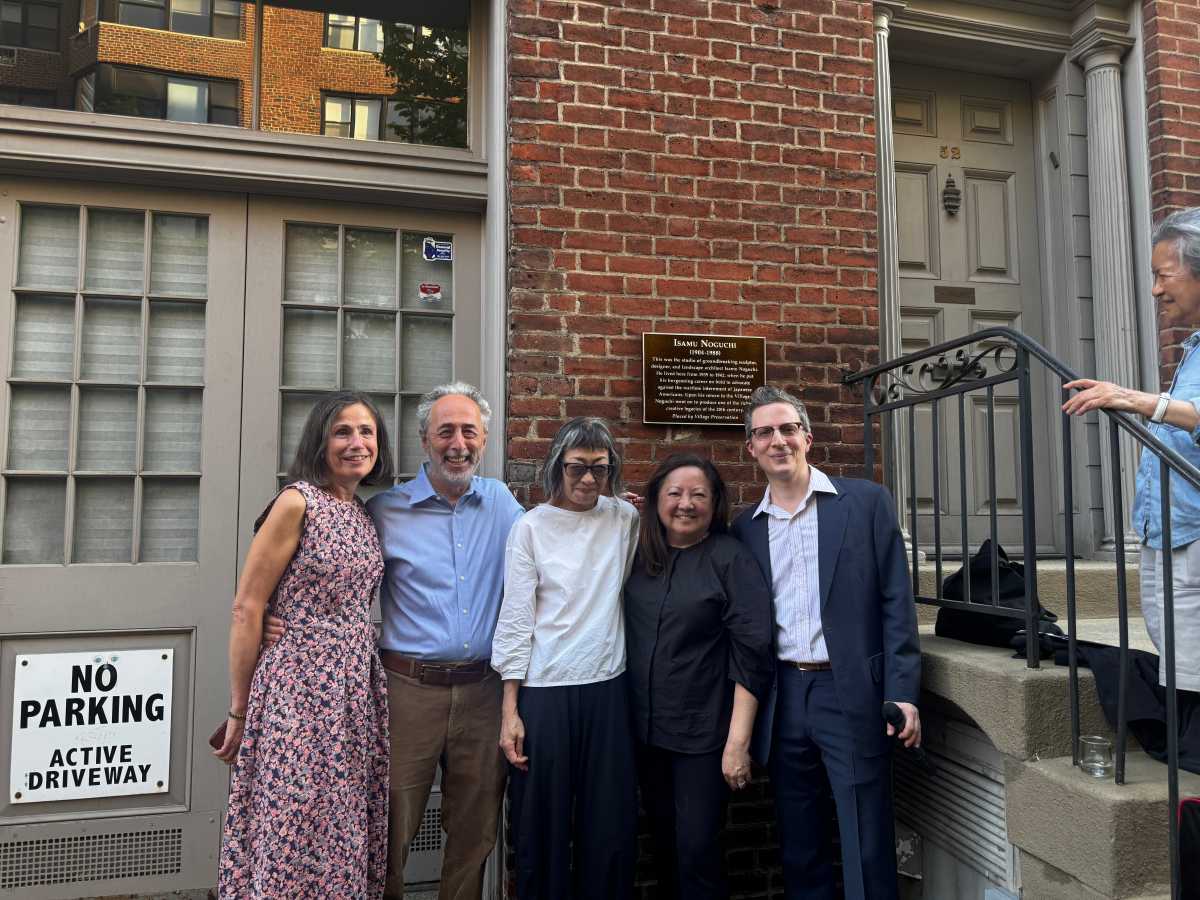
The plaque, placed at 52 West 10th St., is the 28th plaque placed by Village Preservation — a nonprofit that has documented, celebrated and fought to preserve the special architectural and cultural heritage of Greenwich Village, the East Village and NoHo.
“Isamu Noguchi understood New York not simply as a place, but as a site of continual experimentation where art, design and public space could intersect in new ways,” said Amy Hau, director of the Noguchi Museum. “Honoring his studio at 52 West 10th Street is a powerful reminder of the ideas that took shape here, and of the enduring impact of his vision on the cultural fabric of the city. We are thrilled to see this site recognized as part of his New York story.”
At the outset of his career, Noguchi lived and worked at 52 West 10th Street, rising to prominence and sparking a decades-long career.
He eventually founded the Queens-based Noguchi Museum, which currently houses a rotating collection of over 50 of his works, just three years before his death in 1988.
“As we trace Isamu Noguchi’s legacy across New York, sites like 52 West 10th Street offer a tangible connection to the places where his ideas took shape,” added Kate Wiener, curator at the Isamu Noguchi Foundation and Garden Museum. “This plaque ensures that his presence in the city remains visible, anchoring his work within the lived and layered history of downtown Manhattan.”
According to the nonprofit, Noguchi is one of the most significant and versatile artists of the 20th century, making contributions to fields of sculpture, landscape architecture, playground design, industrial design, set design and many others.
“We’re thrilled to honor Isamu Noguchi here in Greenwich Village, which provided such a fertile ground for launching and advancing his trailblazing career,” said Andrew Berman, executive director of Village Preservation.
Berman explained that Noguchi embodied two worthy Village traditions — expanding its creative horizons and taking a principled stance, even at considerable personal cost, against injustice.
Since 1980, the nonprofit has advocated for landmark designation of over 1,300 buildings and zoning protections for nearly 100 blocks.
The nonprofit places a special emphasis on civil rights and social justice history connected to its neighborhoods and to the contributions of women, people of color, immigrants and LGBTQ+ individuals that are often overlooked and undervalued.
According to Berman, the plaque celebrates not only Noguchi’s extraordinary artistic achievements, but also his advocacy on behalf of fellow Japanese-Americans.
“[The plaque] will fit in perfectly with the 28 other plaques we have installed honoring the remarkable legacy of some of the many trailblazers who called this neighborhood home,” Berman continued, “from Jane Jacobs to James Baldwin, Martha Graham to Charles Mingus.”
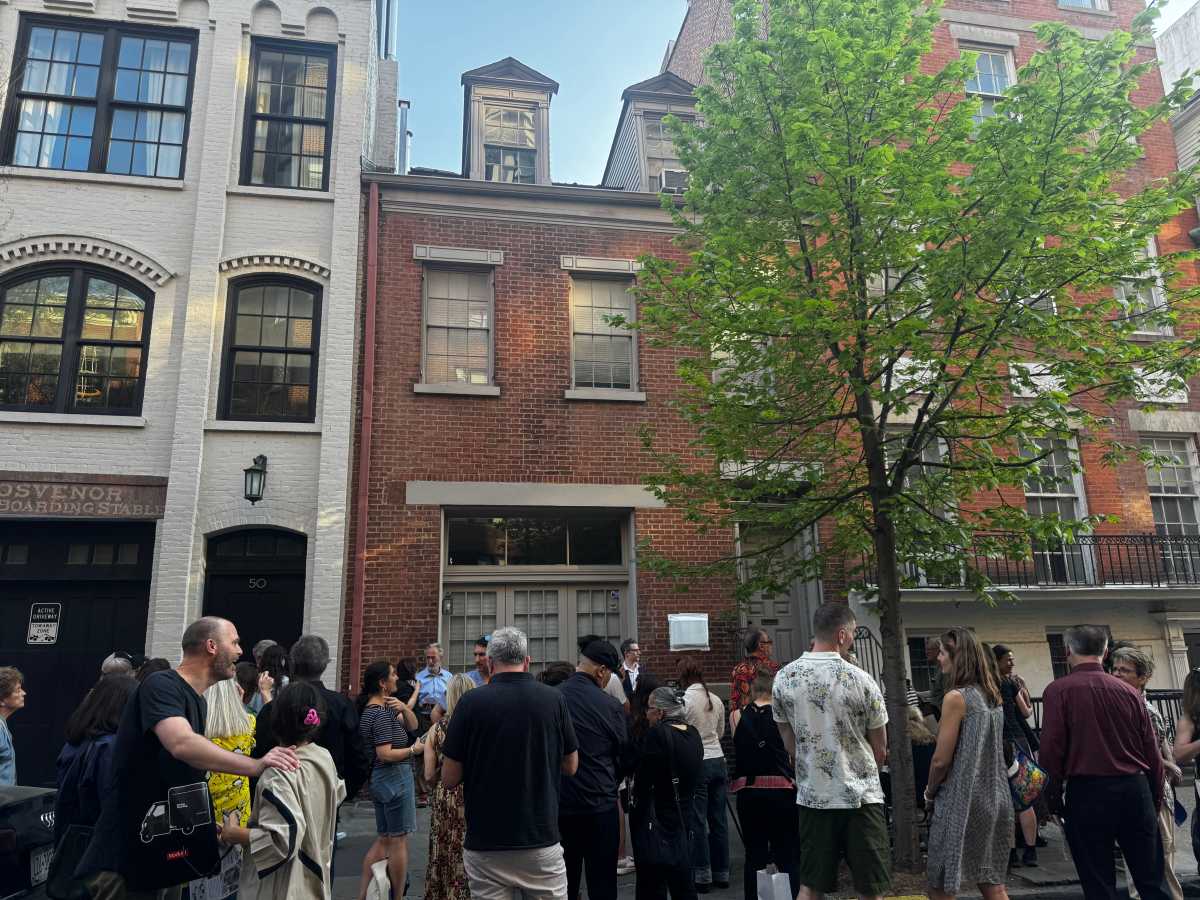 A crowd of people attended the unveiling of the Isamu Noguchi plaque on Thursday, which commemorated the artist’s contributions to New York City and across the world. Photo courtesy of Village Preservation
Noguchi first came to New York to study medicine, a news release from the nonprofit said. However, he soon changed course to pursue his artistic aspirations, which took him to Paris and back.
Upon his return to New York, Noguchi frequented bohemian haunts in the Village such as Romany Marie’s Café on Christopher Street, where he networked with artists and future collaborators, including Buckmister Fuller.
Noguchi’s career began to take off in 1940 after he was commissioned for a large-scale bas-relief for Rockefeller Center.
By then, the artist was living and working at 52 West 10th Street, which was his last documented address before he put his career on hold to protest the internment of Japanese-Americans in the western United States during WWII.
In 1942, Noguchi volunteered to enter the Colorado River Relocation Center concentration camp in Arizona, where he remained for six months, even though he was not required to do so.
His career resumed later that year on MacDougal Alley, where he created some of his most enduring sculptures between 1942 and 1949.
However, he eventually left the studio for travels and a one-year fellowship in India. The studio was demolished in 1952 to make way for an apartment building, which still stands at the end of the alley today.
At this point, Noguchi’s growing stature led to numerous fruitful collaborations, including a few with fellow Village residents such as architect Gordon Bunshaft, musician John Cage, choreographer Merce Cunningham, and founding mother of modern dance Martha Graham, with whom he forged a decades-long working relationship that resulted in over 20 productions.
The artist also found time to make a splash in the world of industrial design, producing items like the eponymous glass-topped coffee table and the Akari light sculptures that remain in production to this day.
By the end of his career, Noguchi’s work traveled far and found its way into major art museums, assembly lines, theaters and public spaces throughout the world, gracing dozens of cities, hundreds of art exhibits and thousands of homes.
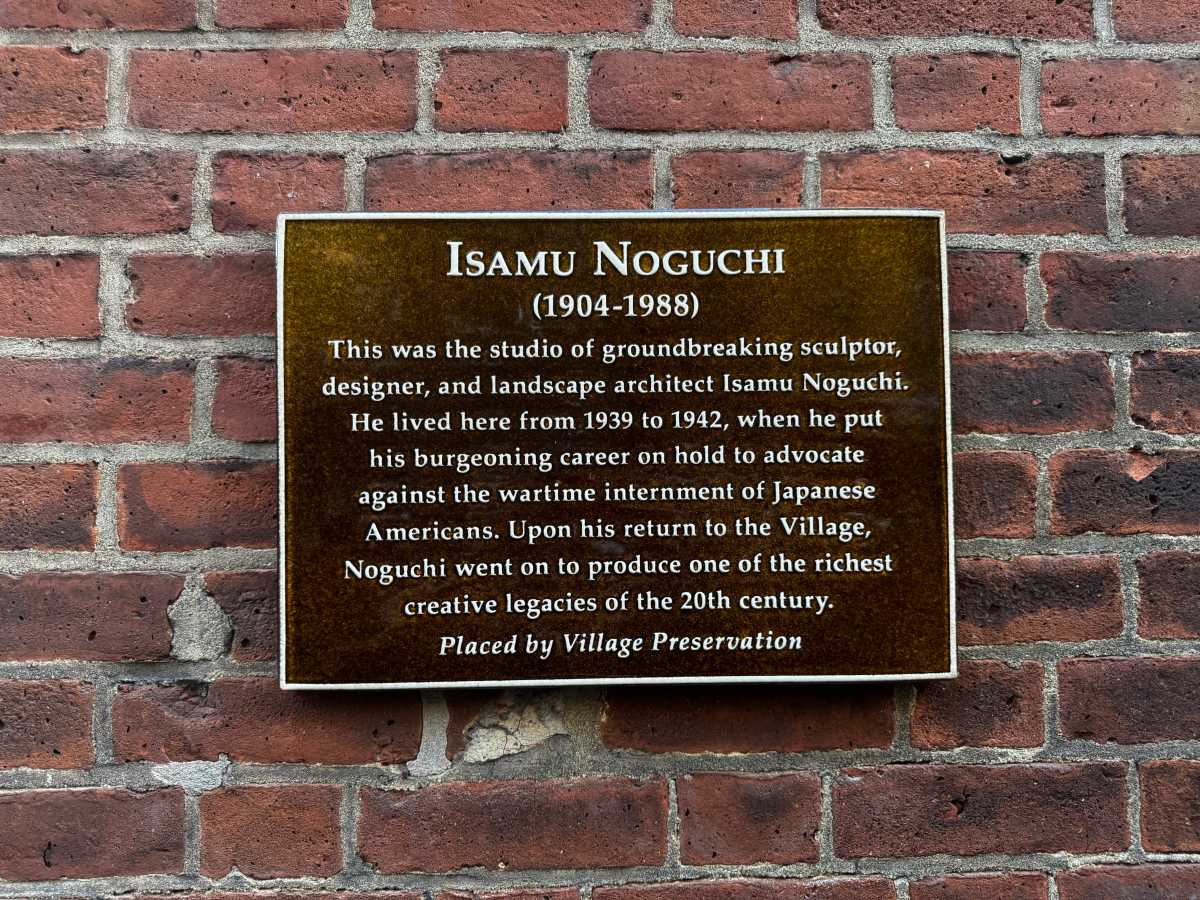 The Isamu Noguchi plaque is the 28th plaque placed by Village Preservation. Photo courtesy of Village Preservation