
Topline
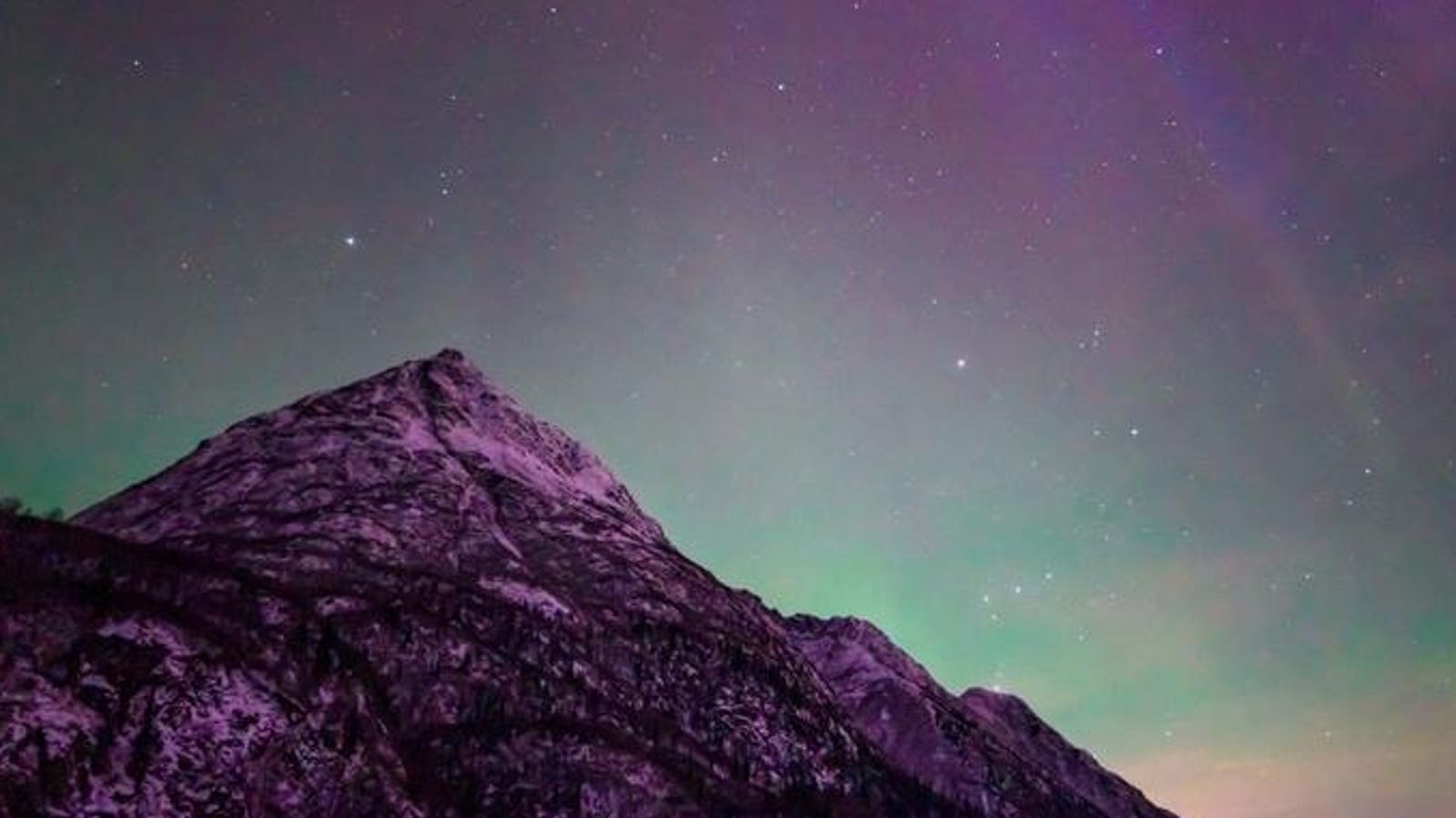
A strong geomagnetic storm could produce northern lights displays stretching as far south as New York on Saturday night, according to a forecast by the National Oceanic and Atmospheric Administration forecast.
NOAA says the northern lights could be visible as far south as New York on Saturday. (Photo by Hasan Akbas/Anadolu via Getty Images)
Anadolu via Getty ImagesKey Facts
NOAA projects Saturday’s northern lights display will have a Kp index of 6, a measure of strength on a scale of 0 to 9, indicating auroral activity that stretches “further from the poles” and is “quite bright and active.”
The strong aurora is expected to follow a moderate geomagnetic storm, measured at a level of G2 on a scale of G1 to G5, which NOAA projected would take place between Friday and Saturday.
High-speed solar winds are expected to eject from the sun and head toward Earth, which NOAA says typically increases the level of geomagnetic activity in the Earth’s atmosphere, producing visible northern lights displays.
The lights are expected to die down after the storm but may still be visible in some northern states and Alaska on Sunday night, as NOAA projects a Kp index of 3.67.
What States May See The Northern Lights On Saturday?
NOAA says the northern lights may be visible “over some northern and upper Midwest states from New York to Idaho.” NOAA typically publishes a map depicting the aurora’s projected “view line,” or the southernmost point at which it will be visible, but it says its maps are temporarily unavailable. In another release, the NOAA said the aurora “may be seen as low as New York to Wisconsin to Washington state.”
What’s The Best Way To See The Aurora Borealis?
NOAA recommends those hoping to catch the lights should travel as far north as possible and find a high vantage point that lacks light pollution. The lights are most visible when it is dark outside, and NOAA recommends looking within an hour or two of midnight, between 10 p.m. and 2 a.m. local time.
What’s The Best Way To Photograph The Northern Lights?
Travel photographers told National Geographic the ideal way to photograph the northern lights is by using a tripod to stabilize the image, a wide-angle lens and a lower shutter speed. Photographers using their iPhone should enable the camera’s night mode, turn off flash and shoot in the RAW format.
Key Background
The northern lights made regular appearances in the night skies over the United States between 2024 and 2025 as the sun experienced its “solar maximum,” or a period of heightened geomagnetic storms and other activity. NASA said the lights hit a 500-year peak, as the frequency of aurora displays exceeded scientists’ expectations. In some extreme cases, the auroras were visible as far south as Texas and Florida. A handful of geomagnetic storms in recent weeks have produced strong northern lights shows.
Further Reading
Where and when to see the northern lights in 2026 (Space.com)