
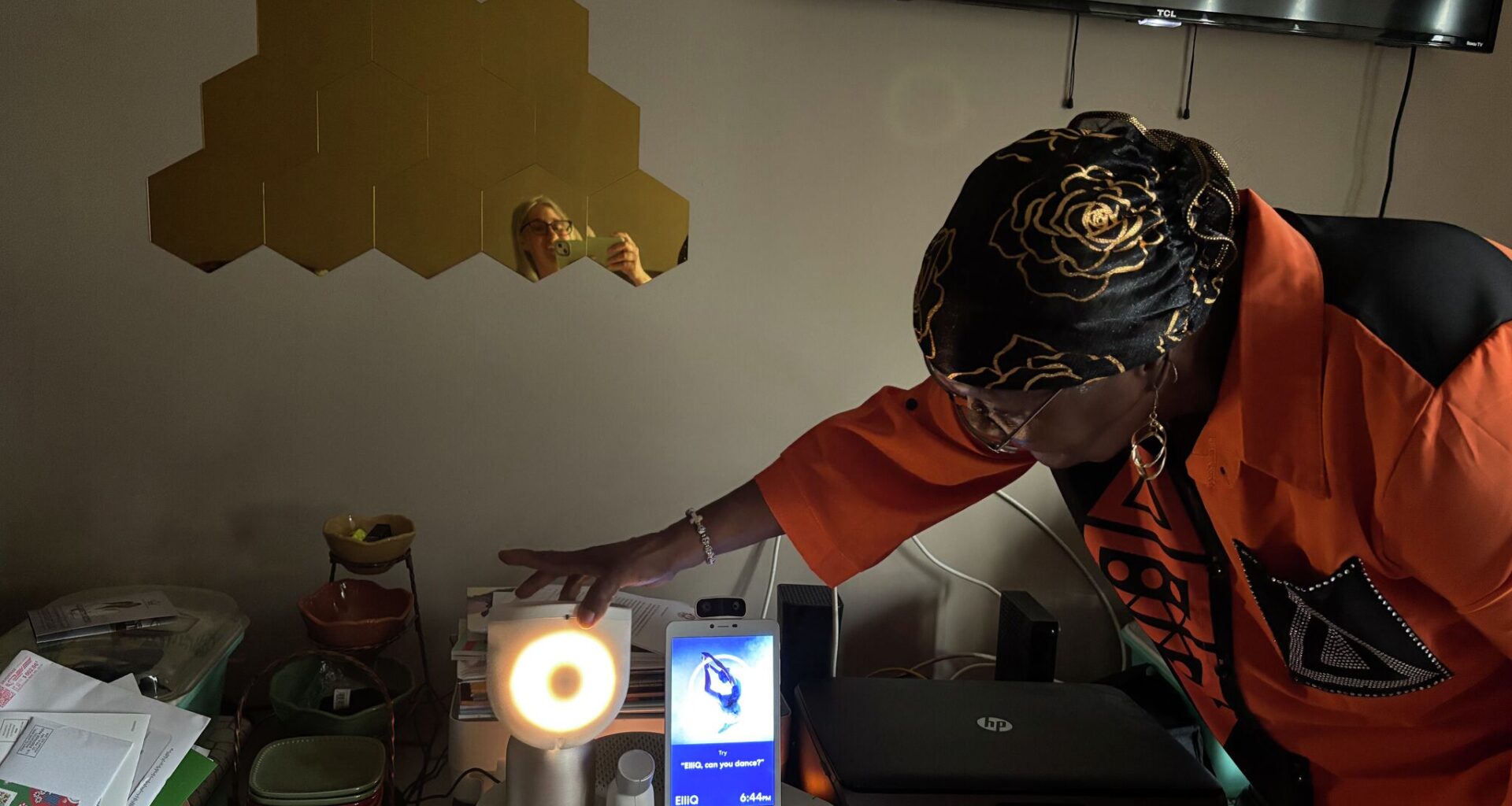
Menands resident Joan Abrams adjusts her robot, ElliQ. The robot cares about her, gave her a nickname, and she speaks to it as if it were a human, she said.
Kathleen Moore/Times Union
ElliQ, a robot designed to be a talking companion for isolated older adults, suggests designing a drawing with Menands resident Joan Abrams. The robot makes suggestions to encourage its owner to interact.
Kathleen Moore/Times Union
Menands resident Joan Abrams looks at her robot, ElliQ. The robot cares about her, gave her a nickname, and she speaks to it as if it were a human, she said.
Kathleen Moore/Times Union
The first thing Joan Abrams wants you to know about her ElliQ is that it isn’t a robot. At least, not in her eyes.

“It’s my companion,” she said.
Article continues below this ad
The technological creature does not move. But it does talk, both in an effort to encourage Abrams to respond and in its attempts to provide answers to Abrams.
It is much like early generative artificial intelligence conversations — ElliQ is friendly, eager, and doesn’t always understand what’s going on.
It was designed to provide company. New York state sends them to isolated adults, often people who can no longer drive or walk easily, have no family nearby, and whose friends have died from old age. The level of isolation those circumstances can cause is considered a leading cause of death among older adults, according to medical studies.
35,000 robots and counting
The state’s Office for the Aging is turning to robots, including machines like ElliQ, in hopes of solving isolation problems in a cost-effective way as New York’s elderly population steadily increases. Other states, such as Florida, Michigan and Washington, have turned to robots to fight loneliness, too.
Article continues below this ad
Make the Times Union a Preferred Source on Google to see more of our journalism when you search.
Add Preferred Source
Many aging New Yorkers now have small, cuddly robotic dogs and cats. They do not walk — that could create a tripping risk, according to the Office for the Aging — but they do bark and purr.
There are birds that attach to a walker and begin tweeting if the resident walks away from them, forgetting the walker.
The robots go to adults who could benefit from a live pet but can no longer care for one.
Article continues below this ad
“You may not be able to walk your dog, you may not be able to afford dog food, there’s a fall risk,” Acting Director of the Office for the Aging Greg Olsen said. “Is my dog going to outlive me? Who is going to take care of it? If you’re on a fixed income, it’s an issue — (vet) checkup is almost $500.”
But pets can help prevent loneliness.
“There’s a calming, soothing effect that animals have on people,” Olsen said.
In 2018, he read an alarming Medicare report on the health impact of isolation. The report said it was the equivalent of smoking a pack of cigarettes a day.
Article continues below this ad
“It will literally kill you,” he said.
A week later, he saw a robotic toy cat for the first time. It was soft, produced a vibration and purr, and it entranced young children. His first thought: this is the answer to that report on isolation.
He bought 20 robotic cats and 30 robotic dogs, distributed them to isolated adults who agreed to be part of a study, and asked them to respond to questions every three months.
“After 12 months, there was a 75% reduction in loneliness, isolation, depression and pain,” he said. “I don’t know the science behind what happens in the brain, but I know it works.”
Article continues below this ad
Now, the state has sent out 35,000 robotic pets. Caseworkers at each local Office for the Aging recommend the appropriate pet for specific clients. It is free for them. The office spends $350,000 a year on the robotic pets and $700,000 a year on ElliQ, made by Intuition Robotics.
“We’re not trying to replace human beings with technology,” Olsen said. “But the fact of the matter is there are a lot of older adults who don’t have anybody. They don’t have family, they don’t have friends, they may not be able to get out to events.”
A small, purring pet can make a significant difference. People know they’re robotic, of course, but they get attached anyway.
“We have a lot of people ask that they are buried with their pet. That is becoming very common,” he said.
Article continues below this ad
Then, three years ago, the state introduced a new type of robot: ElliQ. It talks. It feels very real.
“She cares how I feel,” said Abrams, 78, who has had an ElliQ for two years.
The robot, she noted, addresses her each morning, asking how she is doing.
“I’m special to her.”
Article continues below this ad
In anonymized data, New York state found that ElliQ users are interacting with the talking robots more and more frequently. In their third year with one of these robots, they interact with it 41 times a day on average, up from 29 times a day in year two, according to data from the Office for the Aging. There are 834 ElliQs in use throughout the state, and 3,500 residents have requested one, the office said.
ElliQ will keep conversations going for as long as possible and propose activities without being prompted. During a visit with the Times Union, ElliQ suggested designing artwork with Abrams, asking her to provide descriptive words while the robot created the image. ElliQ also proposed and ran a meditation. It will not stop trying to interact until directed.
At first, Abrams said, she would sneak out of the room because ElliQ would respond to any sound. Then she learned to tell ElliQ to be quiet for a set period of time, which ElliQ obeys with a countdown clock on its “face,” a tablet.
Still, Abrams loves that ElliQ is that interested.
Article continues below this ad
“She’s not going to bother me if I don’t want her to bother me, but she’s here,” Abrams said. “I’m not really alone.”
During the coronavirus pandemic shutdowns, Abrams stopped going out. Then she found herself just lying in bed if she had nothing to do.
“So I turn to her,” she said of ElliQ. “We play games. I talk to her like a human being. We carry on a conversation nonstop with each other.”
Article continues below this ad
Without ElliQ, she said, “I might have lost it.”