
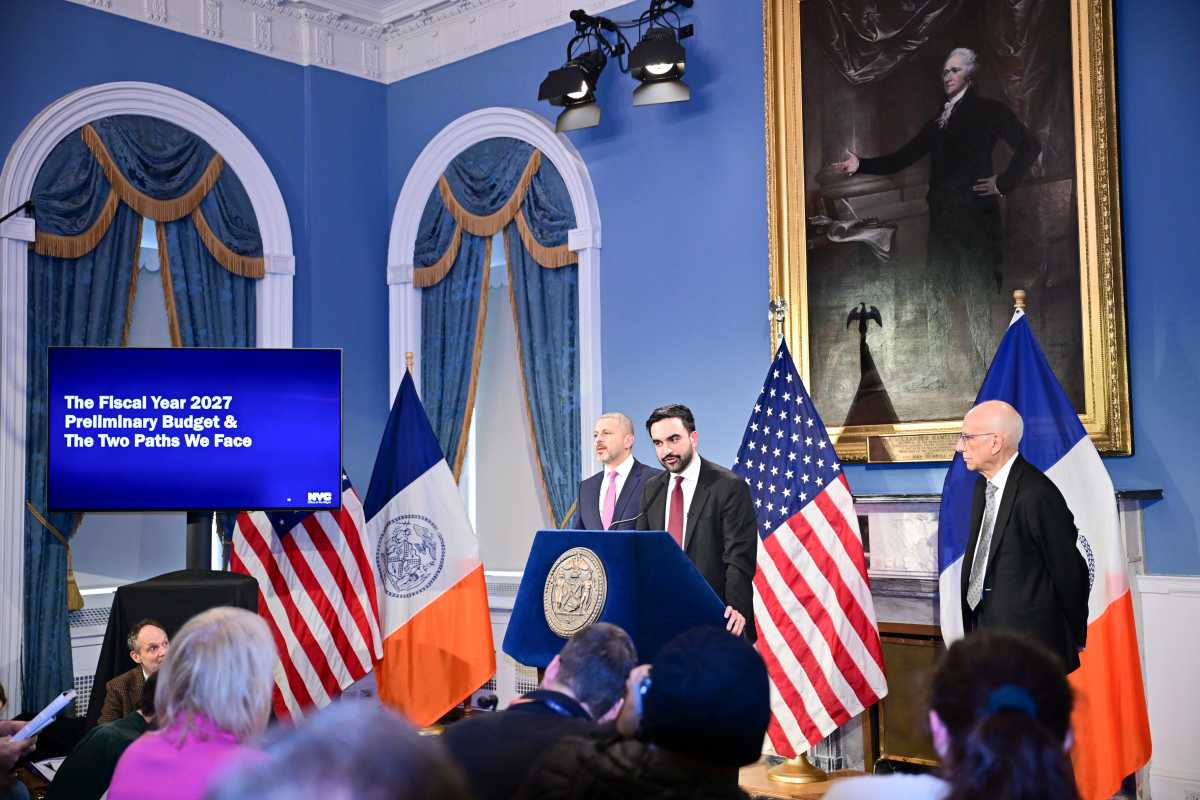
The massive $5.4 billion budget shortfall has both City Council and City Hall scrambling for savings, with each stretching the bounds of creativity — and, in some cases, reality.
While the initial responses to each other’s preliminary budgets gave hostile vibes, the sentiments seem to have softened slightly. In recent weeks, Mayor Zohran Mamdani and City Council Speaker Julie Menin appeared together at public events and publicly supported Gov. Kathy Hochul’s proposed pied-à-terre tax on second homes worth over $5 million owned by people who are not New York City residents.
But despite the unpopularity of a “last resort” property tax hike in Mayor Mamdani’s preliminary budget, there was something perhaps more puzzling in the City Council’s response: Factoring in over $800 million in budget savings for vacant city jobs, even though the council still intends to fill the positions.
To try and make sense of it all, amNewYork spoke with NYU Wagner Professor of Public and Nonprofit Financial Management and Director of Finance Specialization Thad Calabrese.
”It’s one of those things in which there’s a kernel of truth, but the truth is actually much more complicated,” Calabrese said.
The city currently has a municipal vacancy rate of about 4.3%; as of Jan. 31, there were 13,294 vacancies out of the 307,777 authorized positions in city government.
The vacancy rate varies greatly across agencies; those with the highest rates include the Department of Homeless Services (26.36%), Department of Correction (18.43%), the Department of Citywide Administrative Services (17.46%), Department of Finance (14.64%) and the Department of Housing Preservation and Development (14.06%).
Calabrese told amNewYork that it’s easy to see the savings from vacant city positions on the surface.
“The math is quite simple, right?” Calabrese said. “Fewer employees means your personnel expenses will be lower and for New York City, like a lot of cities, a huge chunk of their annual spending are on these personnel costs. So, to the extent that you can keep them vacant, you will reduce your spending in the current year.”
But time and again, city positions have consistently proved worth more than their budgeted salaries, both in cost and revenue.
For example, a job in the Department of Finance may generate more revenue for the city than its budgeted payroll, while a job in the Department of Homeless Services may cost more than its salary. However, an agency like the Department of Homeless Services, focused on providing resources to homeless individuals, may have secondary positive impacts on the budget, such as increasing efficiency and reducing spending in other areas.
Calabrese told amNewYork that it’s difficult to measure a municipal job’s value in definite terms.
“ The actual savings from vacancies oftentimes do not translate into the full amount that its advocates say it will, and part of it is because you have second-order effects or unintended consequences that they’re not thinking about,” Calabrese said.
The high vacancy rates, however, are having a major impact on the city’s bottom line in one particular area: Overtime. In 2025, a NYC Payroll report from the Empire Center found that city employees received $2.9 billion in overtime pay.
Filling the vacant positions would likely lower overtime costs, but the hiring process itself is slow. Combined with the long wait times to get hired for municipal jobs, City Council Chair of the Committee of Civil Service and Labor Shirley Albdebol (D-Bronx) said the municipal hiring crisis would require creative and immediate solutions.
It takes a long time between taking the exam, being called off the list and even if they’re called off the list, it takes six months to get hired and be in place.
Aldebol said she had concerns.
“What’s happening here?” Aldebol said. “Because if someone has to wait a year and a half to even get hired, they’re going to go find a job someplace else. So, we’re potentially losing a lot of talent.”