
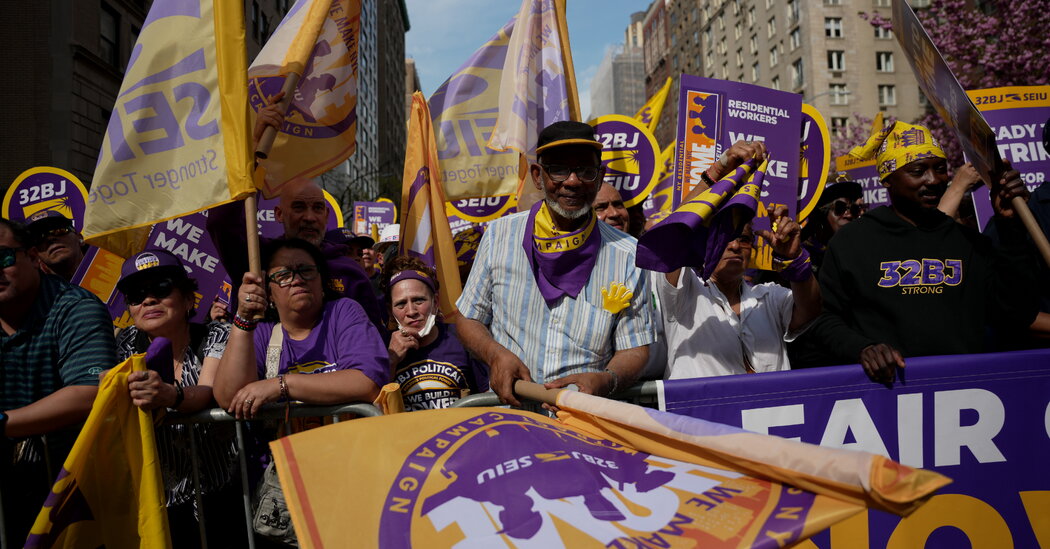
Thousands of doormen, superintendents and other apartment building workers in New York City voted on Wednesday to authorize a strike if their union cannot reach a deal with building owners in the coming days, a possibility that could leave residents to haul their own garbage and sort their own mail.
The workers, an essential part of the city’s economy and culture, voted by a show of hands while holding cards that read, “Yes, I am ready to strike,” at a raucous rally on Park Avenue on the Upper East Side. If the apartment building employees walk off their jobs, it would be their first strike in more than three decades. The strike could begin as soon as Tuesday.
Their plan includes picketing outside buildings around the city. The locations remained a “secret” on Wednesday, said a spokeswoman for the workers’ union, Local 32BJ of the Service Employees International Union.
The workers are demanding pay increases that would keep up with the rising cost of living in the city. Their union would not disclose the size of the raises it is seeking because it has not begun bargaining on pay matters. But the union says that the owners of the buildings want to pay new employees less and to shift some health care costs onto all the workers.
“That’s really what this fight is about — the health insurance,” said Charles Vega, 33, a doorman at a 60-unit cooperative apartment building at 87th Street and Park Avenue.
Several more bargaining sessions are scheduled before the workers’ contract expires on Monday night, but the two sides said that they were far from agreement on critical issues, including pay. Mr. Vega, who serves on the union’s bargaining committee, said that the talks with representatives of the owners had been tense. A recent session lasted only about 30 minutes, he said.
The negotiations highlight the growing divide between tenants of some of New York City’s most luxurious high-rise buildings and the uniformed laborers who protect and maintain them, as well as take out trash and take in laundry and food deliveries. But not all of the union’s members stand guard on Park Avenue. Many work in rental buildings and condominiums in less glamorous parts of the city, where they mow lawns and repair leaks.
Donald McCaffrey, 67, is one of six porters in a 36-unit building in Jackson Heights, Queens, that has no doorman. He said that the residents tell him that the staff members deserves higher pay and that they are worried about who will handle chores if the workers go on strike.
“They ask, ‘Why do I have to take the garbage down?’ ” Mr. McCaffrey said. “They don’t want to do it.”
Mayor Zohran Mamdani and other elected officials turned out Wednesday to extend their support to the workers. Mr. Mamdani mounted a makeshift stage on the blocked-off avenue and played to a crowd of workers who were waving yellow banners and signs that said, “Ready to strike for our health care.”
Mr. Mamdani declared that “New York City is a union town.” He said that his administration was committed to reducing income inequality. “The best tool that we have is increasing union density,” he said.
The roughly 34,000 residential building workers who belong to the union include doormen (who still are mostly male), porters, superintendents and managers in buildings where rents can run well above $5,000 a month. But many of those workers are struggling to support families on salaries of about $60,000 a year, said Manny Pastreich, the union’s president.
The building owners, who are represented in the negotiations by the Realty Advisory Board on Labor Relations, say they, too, are squeezed by inflation and must contend with Mr. Mamdani’s pledge to freeze rents for about one million rent-stabilized apartments.
The advisory board says that the building workers are among a small minority of employees in the United States who pay nothing toward their health insurance. The owners estimate that the cost of providing health care and other benefits amounts to about $50,000 a year per employee.
Howard Rothschild, chief executive of the advisory board, said in a statement that its members “remain committed to negotiating a fair contract that reflects the mounting pressures facing the industry, including the likelihood of zero-percent rent increases on stabilized units for years to come, increasing regulatory burdens and rising operating costs.”
In past years, bargaining sessions between the advisory board and 32BJ have dragged on, with agreements forged in the final hours before a contract was set to expire. In 2022, a deal was reached one day before a threatened strike. The last time the unionized building workers walked off their jobs was 35 years ago, in 1991, when a strike lasted 12 days.
Despite a long history of deals being reached at the last minute, building owners and managers have been preparing tenants across the city to share in the daily duties that the workers perform.
At a building in the Inwood section of Upper Manhattan, residents were informed that they would have to tote their trash to ground-floor bins and that volunteers would be required to haul the garbage to the curb between 6 a.m. and 7 a.m. three days a week. They also were warned that deliveries might be limited to emergencies, and that no one could move into or out of apartments during a strike.
“We respect 32BJ’s right to strike,” Mr. Rothschild said. “Our members are preparing for that possibility and taking prudent steps to ensure continuity of building operations, including hiring security.”
Mr. Pastreich, the union president, said that he could not predict whether an agreement could be reached before a walkout next week. “The tension of last days helps,” he said. “That’s when everyone focuses.”