
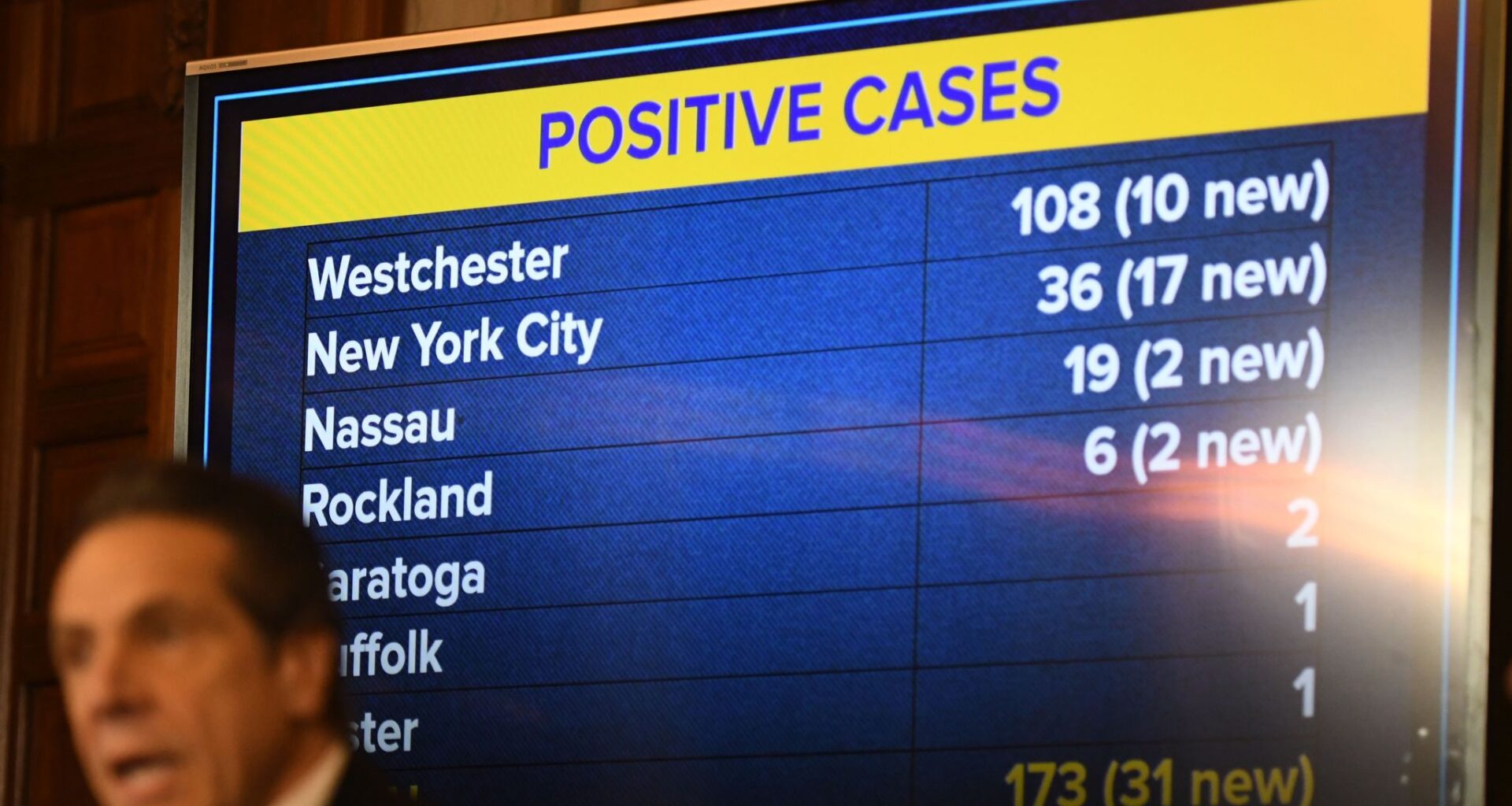
Then-Gov. Andrew M. Cuomo answers questions during a March 2020 news briefing about coronavirus. The Supreme Court on Monday declined to hear a case in which Cuomo and his administration were accused of causing the deaths of nursing home residents who had contracted COVID-19. (Will Waldron/Times Union)
Times Union
ALBANY — The U.S. Supreme Court on Monday declined to hear a case brought by plaintiffs who alleged former Gov. Andrew M. Cuomo and his administration were responsible for the deaths of their elderly parents who had contracted COVID-19 in the wake of a 2020 directive that required nursing homes to accept residents who had tested positive for the virus.

The Supreme Court’s decision will leave standing an order issued in November by the U.S. Court of Appeals for the Second Circuit that had dismissed the claims against Cuomo, former members of his administration and the Greater New York Hospital Association.
Article continues below this ad
An amended complaint that was filed in August 2023 in U.S. District Court in Brooklyn had alleged the nursing home directive led to violations of the rights of the plaintiffs’ deceased relatives under the Federal Nursing Home Reform Act of 1987. That law ensures that nursing home residents have the right to be free from cruel, inhumane, or degrading treatment. It also entitles them to safe and healthy living conditions.
The federal civil complaint also had alleged claims of deprivation of constitutional rights as well as wrongful death under New York law.
The circuit court’s dismissal of the case last fall also granted qualified immunity to Cuomo, his former secretary, Melissa DeRosa, and former state Department of Health Commissioner Howard A. Zucker. Qualified immunity shields government officials from lawsuits unless they knowingly violate a “clearly established” statutory or constitutional right.
Make the Times Union a Preferred Source on Google to see more of our journalism when you search.
Add Preferred Source
The litigation focused on a March 25, 2020, directive that had been issued by the state Department of Health instructing New York’s more than 600 nursing homes and adult care facilities to accept residents even if they had tested positive for COVID-19. Cuomo has defended that directive — although it was rescinded six weeks after it was issued — contending it followed federal guidance at the time and that the nursing facilities were not supposed to accept COVID-19 residents unless they could do so safely.
Article continues below this ad
But his critics have noted that the wording of New York’s guidance had included words such as “shall” and “must” that caused confusion and led many nursing home operators to believe they had no choice but to accept residents who were infected with the coronavirus — even if they could not be segregated. Many of those residents were individuals who were not considered sick enough to require hospitalization and were returned home — for many of them, that was a nursing home.
Michael S. Kasanoff, an attorney for the plaintiffs, criticized the decision and urged Congress to take action.
“As a result of the courts’ slavish devotion to the judicially created monstrosity known as qualified immunity, which is nowhere in the Constitution, government has free rein to do whatever it wants without accountability,” he said. “The courts literally prioritize government wrongdoers over the constitutional rights of the people. Congress needs to act to either abolish or significantly reform qualified immunity.”
The Times Union reported exclusively in June 2021 that the origin of the March 2020 memo to nursing homes stemmed from an urgent late-night call to Health Department officials from a top administrator at a Newburgh hospital. He informed them that a van had just dropped off more than 15 nursing home residents who had tested positive for COVID-19, and if more followed, it could create a critical shortage of beds.
Article continues below this ad
None of the nursing home residents clinically required hospitalization. Other nursing facility operators were also beginning to move residents infected with COVID-19 to hospitals out of fear they could spread the illness in the assisted-living facilities.
But Kasanoff has acknowledged that it was difficult to know with certainty how many patients who had tested positive for COVID-19 were sent to nursing homes, in part because testing had been limited during the early stages of the pandemic. He noted previously that the “plain language of the directives specifically prohibited testing.”
Zucker resigned in September 2021, a month after Cuomo resigned as governor. The former commissioner also faced scrutiny over the undercounting of nursing home deaths during the pandemic.
Cuomo declined to comment for this story.
Article continues below this ad
Richard Azzopardi, a former adviser to Cuomo when he was governor, said in a statement Monday that multiple investigations had “reached the same conclusion: there was no wrongdoing by (former) Gov. Cuomo or his administration. Today, the Supreme Court joins that list.”
‘Blanket immunity for causing harm’
Other lawsuits have pursued nursing homes for their role in the spread of COVID-19 through the vulnerable populations. Legal experts previously told the Times Union that cases filed against individual nursing homes, rather than Cuomo and other officials, could be more viable given the qualified immunity rules.
But attorneys for nursing home operators have asserted they have some immunity from civil lawsuits and criminal prosecutions regarding their handling of the pandemic due to a provision that was tucked into the state budget passed in April 2020. The immunity measure was later rolled back and eventually repealed in March 2021.
Article continues below this ad
State Attorney General Letitia James had previously called for that measure to be repealed in her office’s report on the handling of COVID-19 in nursing homes.
“While it is reasonable to provide some protections for health care workers making impossible health care decisions in good faith during an unprecedented public health crisis, it would never be appropriate just for nursing home owners to be given blanket immunity for causing harm to residents,” James said in a statement when the measure was repealed.
A year ago, the U.S. Department of Justice opened a criminal investigation of Cuomo that was supposed to focus on his public statements and actions during the pandemic, including allegations that the former governor and his top aides manipulated fatality data in 2020 to shift blame from the controversial directive that his critics have claimed caused thousands of nursing home deaths.
The investigation, which appears to have stalled and did not result in any charges or public grand jury activity, was opened by the U.S. Attorney’s Office in Washington, D.C. The case was opened when then-acting U.S. Attorney Ed Martin Jr. was in charge of the U.S. Attorney’s Office in Washington, D.C.
Article continues below this ad
Martin, a former Missouri Republican Party chairman, was later removed from that position but continued working for the Department of Justice. President Donald J. Trump rescinded Martin’s nomination for the job amid bipartisan backlash over Martin’s limited legal experience and his support for people who stormed the U.S. Capitol on Jan. 6, 2021.
Cuomo’s camp had claimed last year that the investigation was politically motivated to harm his campaign for New York City mayor. It also emerged not long after the Republican-led House Select Subcommittee on the Coronavirus Pandemic had concluded its yearlong investigation of Cuomo’s administration and referred the findings to the Justice Department.
‘Knowingly and willfully’
The referral by House Committee on Oversight and Government Reform Chairman James Comer, R-Kentucky, had been sent to then-U.S. Attorney General Pam Bondi, recommending Cuomo be charged with making false statements to Congress when he testified before the subcommittee. Comer had sent a similar referral to the Justice Department in October 2024 — weeks before President Donald J. Trump was elected to a second term — that received no response.
Article continues below this ad
Comer had accused Cuomo of “knowingly and willfully” making false statements to the Select Subcommittee on the Coronavirus Pandemic “about material aspects of New York’s COVID-19 nursing home disaster and the ensuing cover-up.”
The subcommittee’s investigation had revealed little new information about the policy decisions of Cuomo’s administration during the pandemic. Cuomo and Democrats on the subcommittee blamed Trump for any failures with New York’s pandemic response, while Republicans chastised the former governor for failing to be accountable for his mistakes.
But several Democrats on the subcommittee had noted that their investigation had also revealed instances of the governor or his aides giving inaccurate or conflicting testimony during interviews with the congressional panel.
U.S. Rep. Elise Stefanik, R-Schuylerville, who sat on the panel when Cuomo testified but was not a member of the subcommittee, had alleged that Cuomo’s assertions about his office not having a role in the drafting of the March 2020 directive were refuted by the testimony of Health Department officials. They included one of the people who had a direct role in writing the directive and who testified that the Executive Chamber had “absolutely” signed off on the guidance before it was issued.
Article continues below this ad
The former governor’s assertion — that he was unaware of the directive that had been issued to ease pressure on New York hospitals, as there were concerns they would become overwhelmed with patients — echoed public statements he made in April 2020, a month after it was issued, when he said during a news conference that he was not familiar with the advisory.
The 48-page report on the investigation later released by the House Select Subcommittee on the Coronavirus Pandemic outlined several instances in which Cuomo, as well as some of his former top aides, allegedly may have made false or misleading statements — during the pandemic or in their testimony to Congress — and also allegedly encouraged members of their administration to be untruthful.
The report also revealed testimony by former top aides to Cuomo who disputed his administration’s assertions that his office had no part in editing a controversial July 2020 report that had been attributed to the state Department of Health and sought to deflect blame for thousands of nursing home deaths from the March 2020 order — and instead shifting the responsibility to infected staff members.
Article continues below this ad