
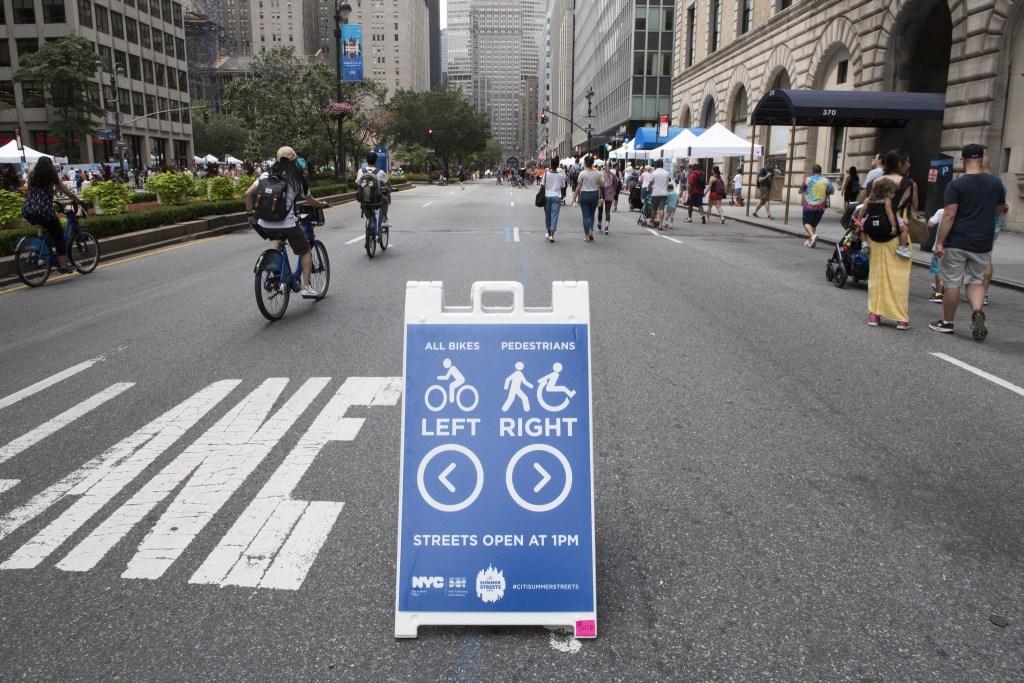
On Saturday, April 25, the New York City Department of Transportation will hold its annual Car-Free Earth Day on select blocks and pedestrian plazas across the five boroughs. Last year’s celebration included more than 50 locations with art installations, kids’ activities, and even a “Broadway Celebrates Earth Day” concert. The car-free festivities are a continuation of an experiment that began with the first Earth Day in April 1970.
Rethinking our streets has never been more critical, for both the health of the city and the planet. This is especially true in neighborhoods without safe places to play and be outside. Nowhere should New Yorkers be relegated to crumbling or crowded sidewalks, or forced to walk or bike alongside the noise and exhaust of speeding cars and trucks.
I urge the Mamdani administration to use Car-Free Earth Day as the start of an ambitious agenda, transforming our streets into public space 365 days a year, through 2029 and beyond. Celebrating can’t be limited to one day in April. Here’s what we can do:
Undo the previous administration’s nonsensical decision to allow cars in Forest Park and Silver Lake Park after years of being car-free. These closures go back as far as Mayor John Lindsay, whose ambitious vision for public space was stymied by his successor, Abe Beame, and the 1970’s fiscal crisis. Today we know that multimodal streets are an economic win.
Implement permanent closures in locations that are low-hanging fruit, such as Flushing Meadows Corona Park in Queens. Central Park and Prospect Park were only closed to cars in 2018, yet they are now embraced by New Yorkers as a year-round, everyday expectation. Other major parks should follow.
Fill the gaps and build out the multi-use corridors in the Greater Greenways plan, and move forward to better connect parks to their surrounding neighborhoods such as with the redesign of Grand Army Plaza in Brooklyn. The city has already identified these routes and projects — now it’s time to connect the dots.
Support Open Streets and pilot Low Traffic Neighborhoods. Take pandemic learnings and give non-city partners the financial and technical assistance they need to manage and operate these spaces effectively. Work with community boards and local stakeholders already advocating for safe streets in residential areas.
Recognize that car-free streets only flourish when residents have high-quality alternatives to driving. Use design and enforcement to make buses faster and more reliable. Expand participation in Fair Fares and explore how to bring the promise of free buses to fruition.
Expand the coverage and frequency of Summer Streets. Its popularity is undeniable — ask anyone who has ever run or biked around Grand Central on the Park Ave. Viaduct. Yet this glimpse of a world-class, car-free network is only five days a year, 40 hours total, covering about 22 miles of the city’s more than 6,000 miles of streets. As 29 elected officials just wrote to Transportation Commissioner Mike Flynn, it’s time to make Summer Streets bigger, better, and more connected.
Chase has a master in city planning from MIT and has worked in transportation in New York City for 15 years. These opinions are her own.