
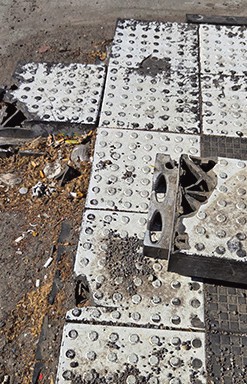

Bus stop along 21st Street with broken pieces of the “islands.”
Like so many situations that are labeled as “political,” the current concerns generated by the Department of Transportation (DOT) plans to change a bus stop on Queens Blvd. at 39th Place has prompted vocal opposition. Protesters came out in significant numbers on Friday, April 10th to highlight their concerns about the planned relocation of the bus stop for the Q32 and Q60 buses which they believe will be unsafe for local seniors and parents with young children. The current stop is located outside of the Sunnyside Community Services (SCS) pre-K entrance on Queens Blvd. The plan is to move the stop “one block away across the other side of 39th Street” which is a busy two-way street. In response, DOT claims that the relocation will make it safer for people to wait for the bus. The change is part of a coordinated plan with the MTA’s Queens Bus Network of 2025 calling for changes along Queens Blvd. The plan proposes “bus boarding islands” that would allow people to safely wait for buses while helping buses to move in and out of traffic more smoothly and shortening the length of the crossing on 39th Street. Because of a manhole near the current stop, it would not be suitable for the planned modification; therefore, requiring the bus stop move to another location.

After our winter storms and floods, pieces of the modular, heavy-duty vinyl pieces have broken off and have been unattended and in need of repair.
Local leaders opposed to the changes include SCS Executive Director Judy Zangwill who has deemed the plan to be “very unsafe” because it is located in a heavily trafficked area between Queens Blvd. and Northern Blvd. State Senator Michael Gianaris has expressed his pledge of support for the position taken by the local residents who are opposed to the change; and he expressed a commitment to urging MTA to “let go” of the relocation plans. Michael Mallon, Deputy Queens Borough President for External Affairs and Special Initiatives, is aligned with the concern that moving the stop across 39th Street would make it difficult for seniors and parents with young children to navigate. He characterized it as “a tragedy waiting to happen.”
It is unclear how the issue of a planned change will be resolved; however, it is very clear that the Sunnyside community is on a battleground to defend their right to a sense of self-determination in the face of bureaucratic decision-making that negates the lived experience of daily life in their community. The spectrum of needs that include mobility issues, access to local services, and challenges of increasingly high levels of traffic, together create a picture that begs the question: “Why are we changing something that works and already addresses these needs?” Perhaps those opposing the redesign are feeling the pressure of change for the sake of change that does not provide improvement or enhanced ease.
I can speak from my experience with similar modifications that have been made in Long Island City along our busy 21st Street. If I am correct in assuming that we have been given the “islands” that are proposed for Sunnyside, I can share that there is some greater ease in boarding the buses; however, after our winter storms and floods, pieces of the modular, heavy-duty vinyl pieces have broken off and have been unattended and in need of repair. These modular pieces are fitted together like a puzzle and there are areas where they have become dislodged creating a tripping hazard. In addition, we have also experienced bus stop changes in places where the result has created more difficulty than convenience. For more years than I can count, it was always very easy to depart the subway stop at 23rd & Ely and go directly upstairs to the bus stop that was right there. With this change and several others related to buses and trains, this is no longer the case as my husband and I discovered shortly after the changes were made. I can attest to the fact that the longer walk for my husband who has mobility issues was very challenging. In advance of the changes in Long Island City, my husband and I were not aware of any pushback or demonstrations. We got our notice in pamphlets and MTA workers standing at bus stops after the change was scheduled to take place. Maybe we should have done what Sunnyside is now doing in the hope that it would amplify our collective voice and our concerns, but alas this did not happen so we are left with another dose of what I have previously referred to as “bureaucratic bungling.”
I am choosing to take the long view and I see the Sunnyside community outcry as an important effort to foster consideration of community needs and concerns based on their familiarity with the area and the fact that, unlike DOT and MTA, they actually LIVE there. The battleground is not one where weapons are drawn or where a struggle for conquest and domination preside, but one of principles, values, and a simple form of agency and sovereignty that remains the undisputed ‘property’ of citizens, voters, and community residents. It seems that bureaucracies have assumed far too much power in determining how people live their lives. There appears to be a concerted effort to create more stress in the lives of communities that already have too much. So, in closing, I turn to an adage that illustrates how instead of the proverbial dog wagging its tail, the tail is wagging the dog and I will leave you, the reader, to determine your view of the bus stop battleground situation, but from where I sit, the bureaucracy is the tail trying to tell the dog what to do.