
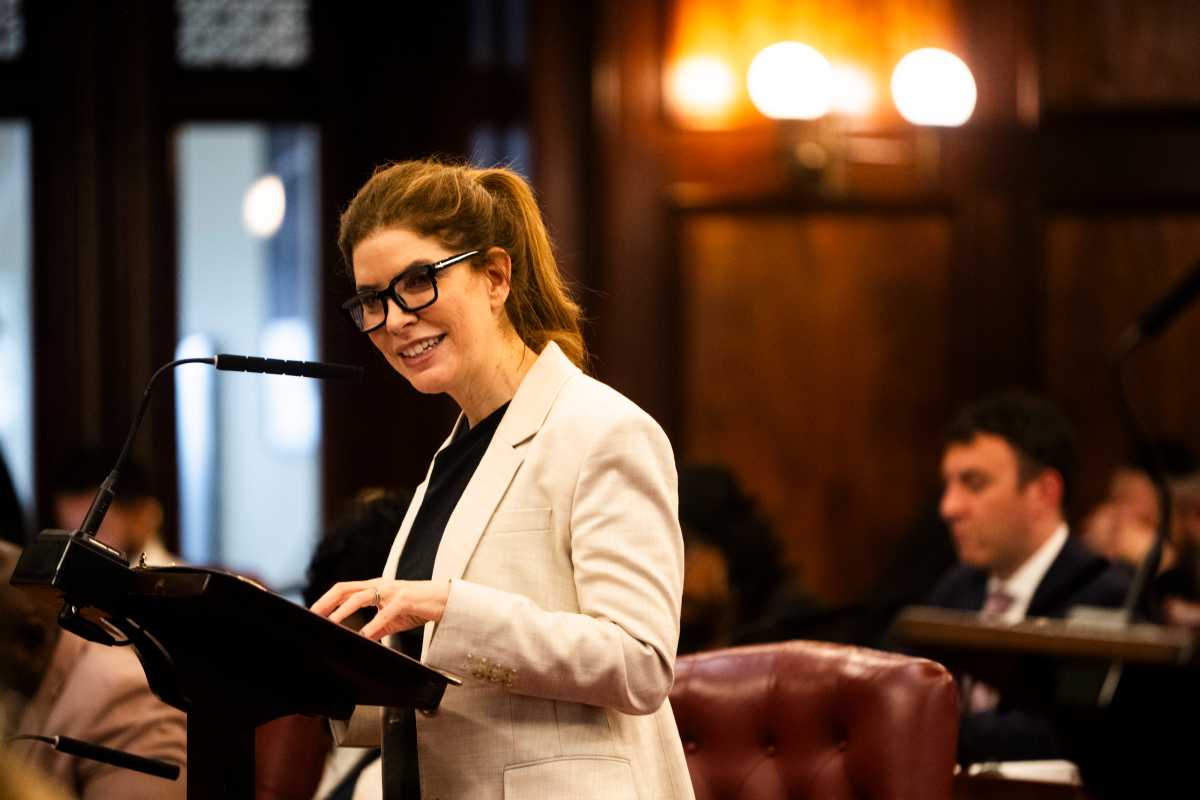
In an interview tied to the milestone, Menin defended higher pay for paraprofessionals and a revised home care bill as fiscally responsible, pushing back on the idea that the Council’s agenda amounts to unchecked spending.
Menin opened with the standard 100-day metrics — more than 1,200 bills introduced, 111 passed, 17 veto overrides, and 84 oversight hearings — along with legislation on no-bid contracts, child care, worker protections, and antisemitism. But speaking to amNewYork, much of the conversation turned to the budget, where she argued that the Council’s priorities should not be judged solely by their upfront cost.
That argument comes as some coverage, such as City and State’s, has focused not just on the Council’s savings estimates but also on whether Menin has fully accounted for the Council’s expensive priorities, including CityFHEPS expansion, the paraprofessional pay bill, and the home care workers measure.
Menin told amNewYork recent revisions to the home care workers bill had changed the equation.
“Based on the revisions we’ve made to the bill,” she said, ” it would actually bring the cost down and not put a cost on the city of New York.”
She made a similar argument about the Council’s push to raise paraprofessionals’ starting pay by $10,000. Menin said the city is spending $1.3 billion a year on Carter cases, in which parents seek private-school placements because public schools are not providing required services for students with disabilities.
“By hiring more paraprofessionals, we would reduce the cost of Carter cases by potentially hundreds of millions of dollars a year,” she said. She also argued that higher wages for paraprofessionals would circulate back into the local economy, saying the Council’s financial analysis found the raises would add about $90 million in economic activity.
How Menin responded to Mamdani’s budget
Menin tied those claims to the broader budget message that has defined much of her first three months. Asked about Mayor Zohran Mamdani’s criticism of the Council’s budget response, she sidestepped the personal dimension and defended the substance, noting that the budget was “not any one person’s budget” but the product of a Council team of more than 20 members, and argued the focus should be on “substance rather than personalizing anything.”
“We didn’t make any cuts to the budget,” she said. “We’ve not cut services at all. What we did is, we found savings.”
She pointed to libraries and cultural organizations as areas where the Council restored proposed cuts and said lawmakers had identified “waste” and “efficiencies” elsewhere in the budget.
That argument has been central to the Council’s broader case against Mamdani’s preliminary budget. In its April 1 response, the Council said the mayor’s plan relied on a 9.5% property-tax increase, reserve drawdowns and the failure to baseline about $1.1 billion in previously funded services and programs.
The Council said it had identified about $6 billion in alternative resources over two fiscal years through re-estimates, efficiencies, savings and other revenue enhancements.
 Mayor Zohran Mamdani and City Council Speaker Julie Menin at the launch of the District 2 Pre-K and 3-K Center on the Upper East Side, Feb. 19, 2026.Photo by Lloyd Mitchell
Menin cited Department of Education contracting as one example of where those savings could come from, noting that the city spends $12 billion a year on outside contracts and that the Council had proposed savings from no-bid, non-competitive, and duplicative services.
“These are common-sense areas of savings for the budget,” she said.
The Council’s formal budget response put the DOE contract budget even higher, at nearly $12.9 billion across more than 6,300 contracts, and called for a closer review of non-essential and non-competitive spending.
Menin is making that case as Mamdani and other critics argue the Council is trying to have it both ways — claiming fiscal discipline while backing proposals that could prove expensive. Recent coverage has focused on that tension, especially around Menin’s opposition to a broad property-tax hike and the Council’s support for proposals like rental voucher expansion and the paraprofessional pay bill.
At the same time, Menin has not opposed every revenue idea; she backed Hochul’s pied-à-terre tax proposal as a narrower way to raise money without hitting working New Yorkers.
Later in the interview, Menin returned to the same core point, saying the Council had been “crystal clear that we are not making any service cuts whatsoever” and that the next phase of negotiations was to “roll up our sleeves and do the work to effectuate these savings.”
Political headaches
The budget fight has unfolded alongside a set of political headaches that have complicated Menin’s opening stretch.
Federal prosecutors are investigating whether Brooklyn City Council Member Farah Louis and her sister, a top aide to Hochul, accepted bribes or kickbacks tied to city funding and contracts connected to BHRAGS, a shelter provider. Neither woman has been charged. Gothamist also reported that Louis steered more than $450,000 in Council discretionary funding to BHRAGS over five years.
Asked directly about the BHRAGS matter, she declined to comment on decisions made under the prior speaker, but said the Council’s Office of General Counsel vets discretionary funding and that “we are certainly focused on that and putting in place strong controls to make sure that the vetting is as robust as can be.” She did not say whether she would change the rules.
She has also had to deal with a legal fight with Republican Queens Council Member Vickie Paladino, whose lawsuit over discipline tied to anti-Muslim social media posts was still pending in April after a judge denied her request to immediately halt the Council’s ethics process, as well as with the fallout from the detention of Council staffer Rafael Rubio by federal immigration authorities.
Those issues have unfolded alongside the budget fight that is now shaping the next phase of Menin’s speakership. Under the City Charter, the mayor must submit an executive budget to the Council by May 1, setting up the next test of whether Menin can pair her message of productivity and fiscal restraint with a final budget deal.