
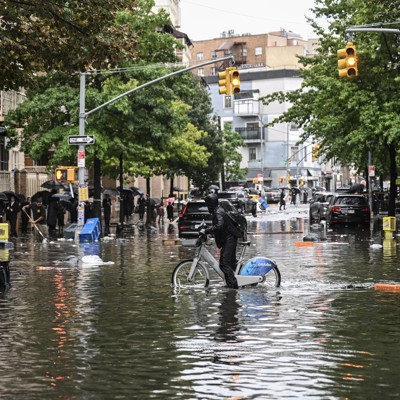
Climate change isn’t coming. It’s already here – look no further than what Queens residents had to endure twice in just three months.
On Aug. 1, a damaging deluge of heavy rain flooded basements and businesses, closed roads and overwhelmed the Bayside Long Island Rail Road station, stranding commuters and leaving Northeast Queens residents to pick up the pieces.
Just 12 weeks later on Oct. 30, the city experienced record-breaking rainfall yet again that swamped streets, overwhelmed our sewers and killed two New Yorkers trapped in basements.
One of the deceased, Juan Carlos Montoya Hernandez, was found in his apartment in Washington Heights. This demonstrates that even high elevation neighborhoods are ill-equipped to stay safe in an era of storms supercharged by climate change.
Unfortunately, this was not a new experience. Over a dozen Queens residents lost their lives to Hurricane Ida in 2021, and extreme rainfall has become a regular occurrence across New York. The 2023 National Climate Assessment found that the Northeast is experiencing more frequent and intense rainfall than anywhere else in the country.
Aging, impermeable infrastructure heightens the risk to waterfront communities from East Harlem in Manhattan to Howard Beach in Queens and beyond. With flood risk in Black communities projected to grow by as much as 20% over the next 25 years as well, failure to adopt lifesaving infrastructure only exacerbates the impact that policies like redlining have had in effectively restricting access to lending for homeownership – all while concentrating industrial land use in communities of color and limiting opportunities to develop high quality, expansive green spaces.
It is clear that New York City’s infrastructure is not prepared to manage these rain events, which will only grow more commonplace and severe due to climate change. New Yorkers should not have to worry that every time the sky darkens, their basements, apartments, businesses and subway stops are going to be inundated. The New York City Department of Environmental Protection cloudburst management projects and the city’s 11,000 rain gardens represent important progress for stormwater flood solutions, but more work needs to be done to make sure New York is ready for more rain.
Luckily, an existing policy could help do just that.
Legislation in Albany, aptly known as the Rain Ready New York Act (S4071/A7476), would provide the city Department of Environmental Protection with the tools it needs to respond to growing stormwater flooding. The bill would add the definition of “stormwater” everywhere “sewage” is defined in the state law. In simpler terms, the Rain Ready New York Act clarifies the ability for sewer and water authorities across the state of New York, like the New York City Department of Environmental Protection, to manage stormwater. In doing so, these agencies can create equitable incentive programs for expanding green infrastructure and taking other flood risk reduction measures. Even in communities with high water tables, programs that support neighborhood-wide deployment of technologies like stormwater planters, modified rain gardens and rainwater harvesting could mitigate flooding and allow for a less dangerous and costly future living with extreme flood events.
Other major cities across the country have already adopted this policy, including Washington, D.C., Seattle, and Philadelphia – and the latter’s clarification of stormwater management authority helped its water department establish its Green City, Clean Waters program.
By its sixth year, Philadelphia’s program had constructed enough green infrastructure to reduce stormwater overflow volume by 1.7 billion gallons – almost three times what had originally been estimated – and supported more than 430 jobs.
Successful stormwater management does more than protect communities from flooding; it also improves the health of our water bodies. New York is mainly served by a combined sewer system, which means that stormwater and sewage travel through the same pipes to wastewater treatment plants. When the volume of stormwater becomes too much for the plants to handle, which happens every time it rains, the untreated stormwater and sewage are discharged into the city’s waterways like Flushing Bay, the East River, the Hudson River and Little Neck Bay.
These combined sewer overflows are key drivers of poor water quality around the city. In the 2024 Long Island Sound report card published by the nonprofit Save the Sound, the inner and outer portions of Flushing Bay and Little Neck Bay received C and D grades for ecological health.
The organization’s 2025 Beach Report gave both Queens beaches failing grades for swimming safety. Combined sewer overflow pollution creates hazardous conditions for wildlife and threatens the health of those who live and fish on these waters. Healthy blue spaces are vital infrastructure that nurture biodiversity and offer free, natural relief from unrelenting heat exposure to environmental justice communities.
New York City needs every tool available to prepare our residents and businesses for extreme weather. By passing Rain Ready New York, the state will help unleash the kind of large-scale projects we need to capture and filter the increasing volume of rain falling on our communities.
The state Senate passed the bill with bipartisan support in 2025 and is expected to pass it again this year, but we need the Assembly to act. We urge the Assembly to take up this important bill so New York has the tools we need to be rain ready.