
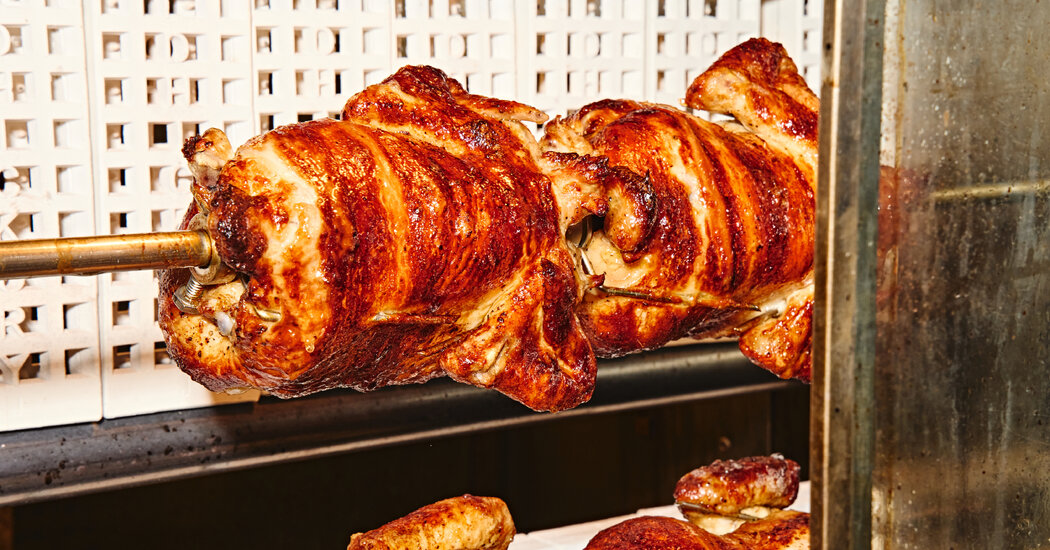
What should half a rotisserie chicken cost?
It’s a question Hugo Hivernat asked himself before opening Gigi’s, his rotisserie restaurant in Greenpoint, Brooklyn, last week. “We want to keep the price affordable,” he told The New York Times in December. “I mean, affordable for New York.”
The chicken is butchered by one cook, foisted onto a rotisserie skewer by another and blistered with a hand torch by a third cook. It’s served with roasted potatoes and three sauces on a silver platter that he found at a flea market in France. But the price he arrived at displeased a local politician.
“$40 half chicken at a wine bar? Really?” wrote New York City Councilman Chi Ossé on Thursday in an Instagram post that appeared to call out the new restaurant, which is not in his district.
It set off a firestorm in the comments among restaurant operators, diners and opinionated bystanders about whether that was indeed affordable for New York, or if it was an instance of egregious price gouging. The Gigi’s chicken is just the latest flashpoint in a continuing debate about the price of dining out in the city.
Operators said the disconnect between owners and diners stemmed from a misunderstanding about restaurant economics. It is only worsened by the fact that a rotisserie chicken can be purchased from just about any neighborhood supermarket at a fraction of the cost. At Costco, for example, a roughly three-pound rotisserie chicken costs $4.99 — the same as it did in 2009.
Supermarkets warp consumers’ perception of what a rotisserie chicken should cost because “it’s a loss leader,” said Henry Glucroft, an owner of Badaboom, a rotisserie restaurant in Bedford-Stuyvesant. Rotisserie chicken is a classic loss leader, a retail strategy in which grocery stores price an item lower than the production cost — in this case, often significantly cheaper than a whole raw chicken — to draw in customers. “We can’t afford to take the loss,” he said.
In response, Mr. Glucroft and his partner, Charles Gerbier, will offer a one-day, “pay what you feel is fair” promotion Tuesday on the half chicken at their restaurant. Dine-in customers with a reservation will have the rare opportunity to name their price. “We want to open the conversation,” Mr. Glucroft said.
On any other day, the half chicken at Badaboom costs $32 with potatoes — no sauces. Cleo Downtown, a rotisserie restaurant opening on Friday in the West Village of Manhattan, will serve a half chicken with side sauces for $32. On the Upper East Side, Chez Fifi sells a half chicken brushed with duck fat for $78.
At the Fly, a chicken bar in Bed-Stuy, half a bird costs $19 — a detail the councilman, who represents the neighborhood and Crown Heights, highlighted in the comments of his Instagram post. Factor in a side of potatoes and three sauces, however, and the total is similar to that of Gigi’s: $38.
Mr. Ossé declined to comment for this story through a spokesman. On Friday, in an Instagram direct message viewed by The Times, he asked Mr. Hivernat if they could speak over the phone. The two are looking for time to talk, according to the restaurant owner.
Mr. Hivernat offers his staff paid time off and health insurance benefits and employs a salaried dishwasher, and insisted the chicken was “the right price” once inflation, labor, loans and his $9,000 monthly rent was considered. He earns about $4 in profit from a $40 half chicken.
“These neighborhoods deserve good food, but there has to be some sort of middle ground,” said Crystal Anderson, a 44-year-old events producer in Bed-Stuy who left a comment supporting Mr. Ossé’s post. “I know it’s really difficult to open new restaurants, but there is only so much reinventing the wheel you can do with a whole chicken,” she added.
Felipe Cha, the second-generation owner of Inca Chicken in Bushwick, has seen chicken prices fluctuate. When his father opened the rotisserie restaurant in 1989, he sold his flame-charred chickens for 75 cents per pound. Today, a half chicken with two sides costs $14.50 before tax.
“The pricing is meant for our hard-working clientele,” said Mr. Cha, 50. On an average weekday, he sells about 250 birds and earns about $4 in profit from each half-chicken sale — roughly the same as that of Gigi’s. His rent, $8,000 per month, is comparable to Gigi’s, too. But it’s a different business model, he pointed out.
“They use better-quality chickens,” he said. “I don’t disagree with the price they’re charging because of all the different things that they have to pay for.”
In addition to food and labor costs, Mr. Hivernat said he had to account for the rent he paid while waiting for permits from the Landmarks Preservation Commission, approval from the Department of Buildings and an inspection from Con Edison.
“That’s all something a council member might be able to do something about,” Mr. Hivernat said. “If I didn’t have to wait two and a half years to open, maybe I could sell a chicken for $38.”
Follow New York Times Cooking on Instagram, Facebook, YouTube, TikTok and Pinterest. Get regular updates from New York Times Cooking, with recipe suggestions, cooking tips and shopping advice.