
There’s something strangely powerful about history… not just the events we read in books, but the human choices hidden behind them. The quiet decisions. The unseen acts. The stories that were never meant to be told.
This is one of those stories.
And in a way, it feels like a confession.
Not mine… but one that history almost forgot.
When we think of Queen Victoria, we often imagine authority, tradition, and strict values. A ruler defined by discipline and duty. But the truth, I discovered, is far more human… and far more surprising.
This realization came to me while reflecting on how society changes over time. What once shocked people becomes ordinary. What once defined rebellion becomes harmless memory. Even figures like George Formby, who once pushed boundaries in entertainment, now feel gentle and almost innocent compared to modern standards.
And yet… every era has its own quiet revolution.
For Queen Victoria, hers didn’t come through speeches or public displays.
It came through something much quieter.
Something almost secret.
The Discovery
In the early 1800s, a place called Holloway Prison became known as one of the first institutions designed specifically for women. At the time, this raised questions—even for the Queen herself.
Why were so many women ending up there?
What had led them down that path?
And more importantly… could their lives have turned out differently?
These weren’t popular questions to ask back then.
But Victoria asked them anyway.
The Hidden Concern
Behind the grandeur of palaces like Buckingham Palace and Kensington Palace, something unexpected was happening.
The Queen was listening.
Not to politicians. Not to advisors.
But to stories.
Stories of women who had fallen through the cracks of society—women who had faced hardship, poverty, and impossible choices. Some had lost their children. Others had simply been pushed too far by circumstances they couldn’t control.
And instead of judging them, she did something unusual for her time.
She questioned the system.
Quietly, carefully, and without drawing attention.
The Secret Plan
This is where the story begins to feel like a true confession.
Because what happened next was never meant to be public.
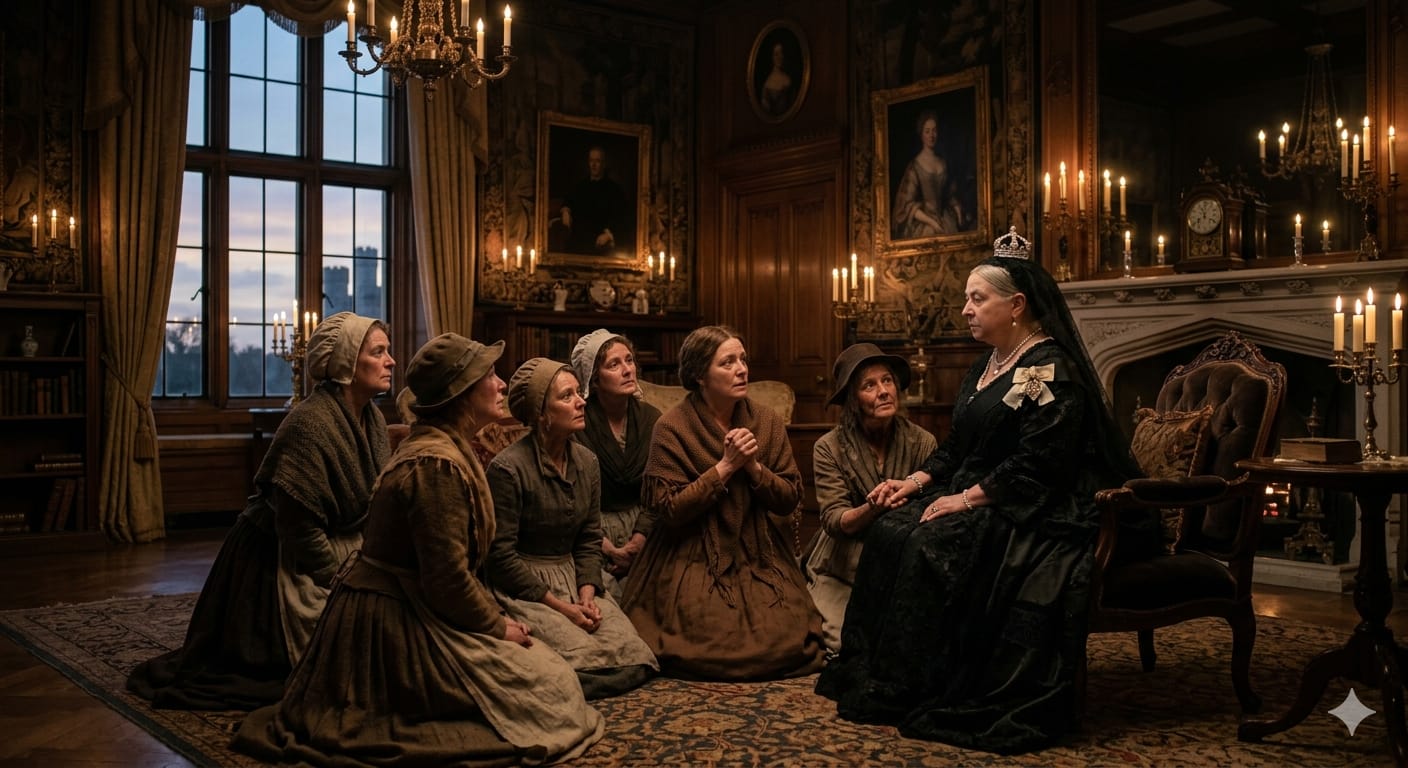
Without announcements, without recognition, Queen Victoria’s inner circle began identifying women who could be given a second chance.
Not charity.
Not sympathy.
But opportunity.
Some of these women—many of whom had been imprisoned—were offered work within royal households. Not necessarily in grand roles, but honest ones. Positions that gave them stability, dignity, and a chance to rebuild their lives.
They worked in places like St James’s Palace and other royal residences, often starting at the lowest levels.
And here’s the most remarkable part:
Their pasts were kept hidden.
Not erased… but protected.
Why It Matters
At a time when reputation was everything, this was a risk.
Even today, the idea might raise eyebrows.
But for Queen Victoria, this wasn’t about image.
It was about fairness.
She believed that some people didn’t choose the paths they ended up on. That life, in many cases, had made the decision for them.
And if that was true…
Then maybe they deserved another chance to choose differently.
The Quiet Legacy
Many of these women went on to build entirely new lives. Lives they never thought possible.
They became part of a world they had once been excluded from. They found purpose, stability, and in some cases… peace.
But the Queen never spoke publicly about it.
No speeches.
No recognition.
No attempt to turn it into a symbol of generosity.
It remained a quiet act of compassion.
Almost like a personal belief she carried within herself.
A Reflection
And this is where the story feels like a confession—not just of a Queen, but of history itself.
We often remember power.
We celebrate achievements.
We document moments that are loud and visible.
But sometimes… the most meaningful actions are the ones no one sees.
The ones done without applause.
The ones done simply because they feel right.
Final Thought
Perhaps that’s the real lesson hidden in this story.
That kindness doesn’t always need recognition.
That second chances can change everything.
And that even in the most structured, traditional worlds… there is always room for quiet humanity.
Maybe Queen Victoria wasn’t just a ruler of an empire.
Maybe, in her own way, she was someone who understood people better than history gives her credit for.
And maybe… that’s the part worth remembering.