
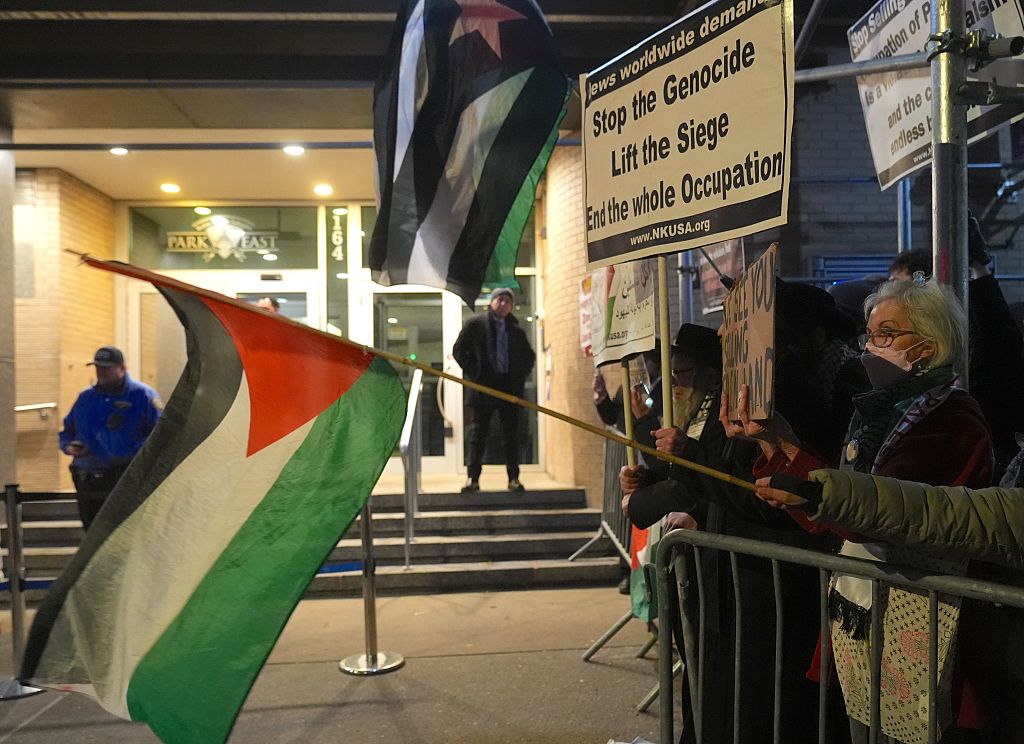
A protest at the Park East Synagogue in Manhattan first prompted the proposal.
Anadolu/Anadolu via Getty Images
Gov. Kathy Hochul proposed the protest buffer zones in her State of the State proposal in January.
Lori Van Buren/Times Union
Assemblyman Micah Lasher sponsors the bill that was folded into Gov. Kathy Hochul’s policy agenda and defended its constitutionality.
Lori Van Buren/Times Union
Assembly Speaker Carl E. Heastie said some New York City members of his chamber have said they want to leave the buffer zones up to local police.
Will Waldron/Times Union
ALBANY — After worshippers entering Park East Synagogue in Manhattan were surrounded by demonstrators protesting Israel’s war strategy last November, a pair of state lawmakers introduced a bill to prevent a repeat incident in the future.

That bill, which would prohibit protests within 25 feet of houses of worship, was then endorsed by Gov. Kathy Hochul and included in her policy agenda for this year’s state budget.
Article continues below this ad
“We need to protect people and their right to exercise their practice of faith without harassment,” Hochul said in recent days. “That is something I expect will happen.”
Hochul is also proposing those buffer zones around health care facilities that offer reproductive medical services, including hospitals, doctor’s offices and clinics.
But disagreement over how effective the legislation would be as written in protecting worshippers from targeted harassment and whether restrictions on the right to protest would survive a legal challenge has complicated the measure.
Make the Times Union a Preferred Source on Google to see more of our journalism when you search.
Add Preferred Source
“Any effort to establish a buffer zone statewide will be unconstitutional and risk criminalizing speech,” said Justin Harrison, senior policy counsel at the New York Civil Liberties Union.
Article continues below this ad
Harrison declined to say if the NYCLU would sue the state if Hochul’s proposal becomes law. The group sued Nassau County earlier this month over a local law that created a 35-foot buffer zone for protests around houses of worship.
Hochul said a legal challenge isn’t something she’s worried about.
“I don’t stop because someone says you’re going to get sued someday,” Hochul said. “I get sued every day of the week.”
But the lawmakers who originated the proposal have also prepared for that possibility. That’s why they set the distance of the proposed buffer zones at 25 feet, said Assemblyman Micah Lasher, a Democrat who first announced the idea.
Article continues below this ad
“A modest 25-foot buffer zone allows people to protest … but simply says you need not run through a gauntlet of hate on your way into a synagogue, church or mosque,” Lasher said.
Some Democrats in the state Legislature have countered Lasher’s proposal in closed-door discussions with a buffer zone of 100 feet, arguing that worshippers would still be subject to harassment at 25 feet.
“The honest truth is that a 100-foot buffer zone would not stand a snowball’s chance in hell of surviving in a court,” Lasher said.
He referenced the 2014 decision in McCullen v. Coakley from the U.S. Supreme Court, which struck down a 35-foot buffer zone that Massachusetts had enacted around abortion clinics.
Article continues below this ad
But the constitutionality of the proposal isn’t the only concern aired by opponents of the proposal. Another is what they view as its impracticality in New York City, where the density of houses of worship and health care facilities could create an incredibly restrictive environment for protest.
Some Democrats from New York City have suggested in closed-door talks that lawmakers reject the “buffer zone” proposal altogether and allow police to take the lead in those situations.
“It’s been talked about but some members feel more comfortable leaving it in the discretion of the New York City Police Department,” Assembly Speaker Carl E. Heastie said.
The New York City Council passed a bill last month that would require police to establish buffer zones around houses of worship when there’s a protest. That has satisfied some Democrats in the state Legislature.
Article continues below this ad
Some stakeholders who initially supported the proposal now also view it as unnecessary, said state Senate Deputy Majority Leader Michael Gianaris. He did not say who those stakeholders are.
“My understanding is that some of the communities who were initially pushing it have now changed their posture and no longer want it,” Gianaris said.
It’s one of several issues that remain unresolved as Hochul and lawmakers continue negotiations around the state budget, which was due April 1.
Article continues below this ad
Lawmakers do not have a projection for when those talks will conclude.