
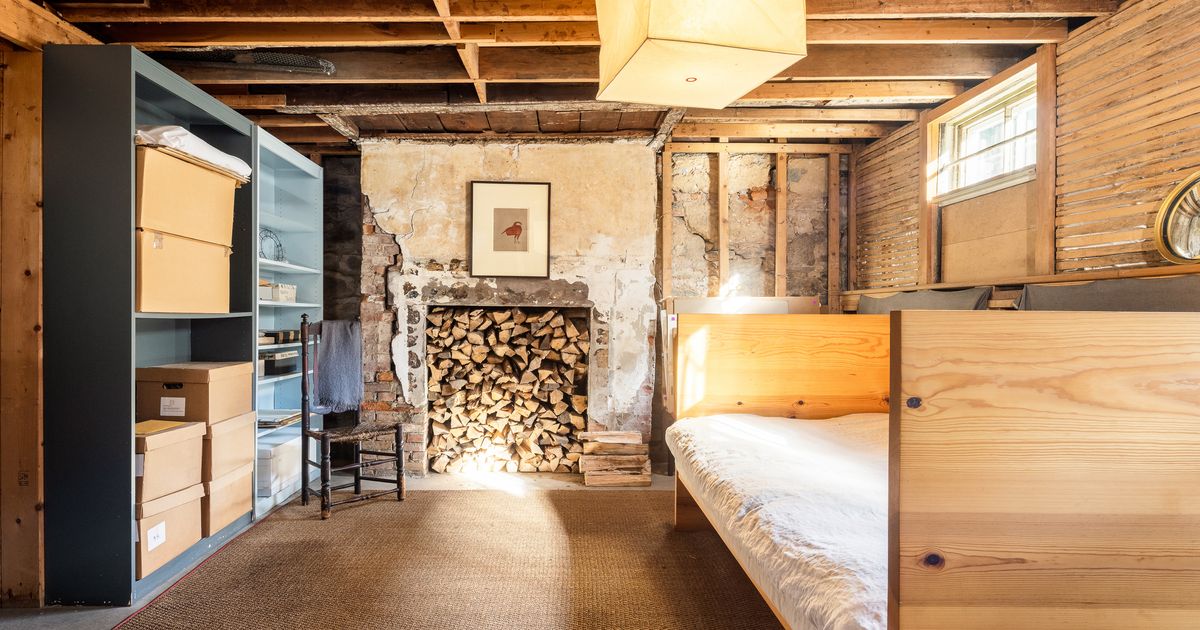
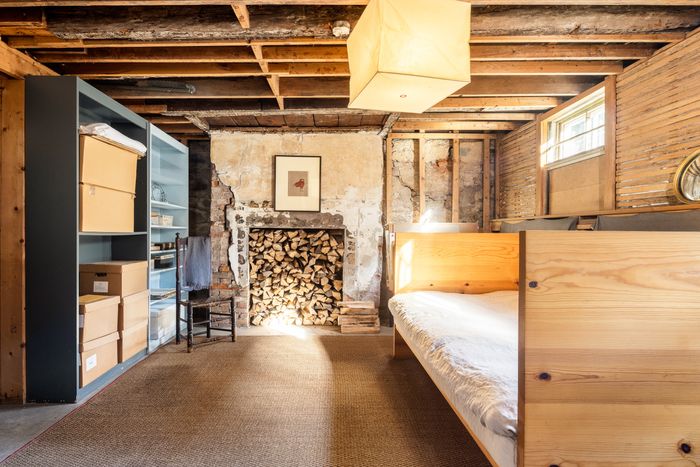
A Donald Judd daybed on the ground floor where walls are taken down to the stone and lath.
Photo: Virginia Carey for Brown Harris Stevens
25 Cranberry Street is one of Brooklyn’s most cartoonishly quaint homes — a squat, wood-frame house covered in raw-wood shingles that peeks up through two dormer windows at its brick and brownstone neighbors in Brooklyn Heights. It shows up on an 1829 map as the home of “Mrs. Bruce,” but it may be older; the broker now listing it for $4.9 million claims it was built in 1790. Inside, the rooms look as old as the exterior, but in an open, unfussily modern way, with wide, wooden floorboards from old growth trees and patchy plaster walls. “I like to think of the young women in their 1840s gowns going up the stairs,” says owner Elisabeth Cunnick, who took pains to protect No. 25 from development as a brand-new four-story brick home rose on an empty lot next door. “I made a promise to the house that if I held on long enough, there would be enough people able to see the house for the beauty it has and not see a gut renovation.”
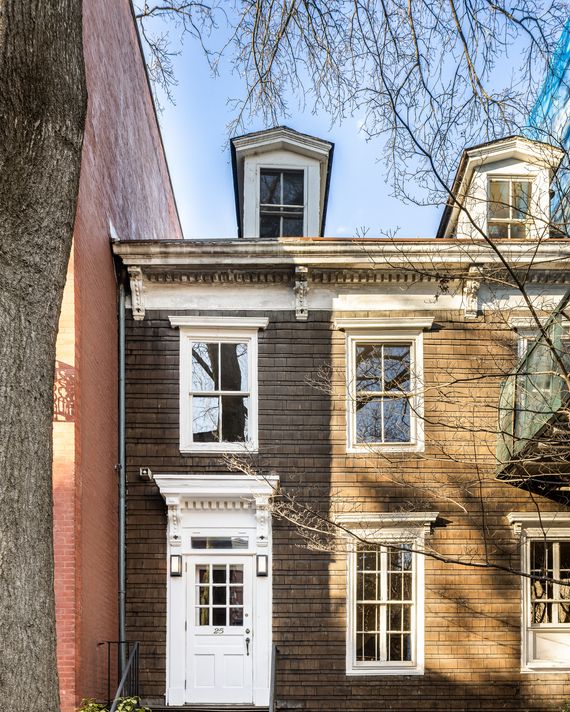
Photo: Virginia Carey for Brown Harris Stevens
Price: $4.9 million ($1,920 in monthly taxes)
Specs: 4 bedrooms, 1.5 bathrooms
Extras: Sitting room, library, laundry room, dressing room, storage area, backyard with 17-foot-deep porch, gated front yard.
10-minute walking radius: Brooklyn Promenade, Montague Diner, the Center for Brooklyn History
Listed by: Joan Goldberg, Brown Harris Stevens
If Cunnick sounds like she’s timing the sale of an artwork, it might be because she comes from that world. In 1995, she and her ex, the gallerist Peter Freeman, sold a single print (an Andy Warhol of Chairman Mao) to come up with the down payment on the $500,000 house. At the time, she was running A/D Gallery, which specialized in selling utilitarian objects made by artists: matte-black bowls by James Turrell, lamps by Richard Tuttle, and glass vases by Jennifer Bartlett. The wares veered toward minimalism: Cunnick was the sole New York dealer of Donald Judd furniture at the time. Her renovation didn’t bring in Duncan Phyfe chairs and period-appropriate wallpaper, either, but instead pared the home back to its raw materials and simple forms.
“We mostly just got rid of things,” Cunnick said. The last owners ran Meunier’s, a posh home-goods store on Montague Street, but their home was “all dropped tile ceilings and avocado green,” Cunnick said. With the contractor Robert Taffera, she peeled back seven layers of wallpaper to reveal plaster walls and took out new boards to uncover 1820s floors. Beams and brick were left exposed and, in some spots, so was the raw lath. “I thought I might cover some of that, but it’s just so beautiful,” said Cunnick. Her aesthetic, as she told The World of Interiors in 2005, was a “thin line between a fine carelessness and squalor.” She made no effort to cover over sections of plaster where cracks were repaired, and traces of white paint still mark the treads of the stripped-down staircase. Additions were minimal; a plasterer added back some indigo pigment in the living area on the parlor level, which opens to a library where a cabinetmaker added built-ins. The hall was painted with raw ocher, which, Cunnick clarifies, isn’t as fancy as it sounds. “It’s just mud,” she says. “One of the cheapest things you can buy.” She even kept the last owner’s appliances and their 1950s robin’s-egg-blue tub and sink — an outlandish move in 1995.
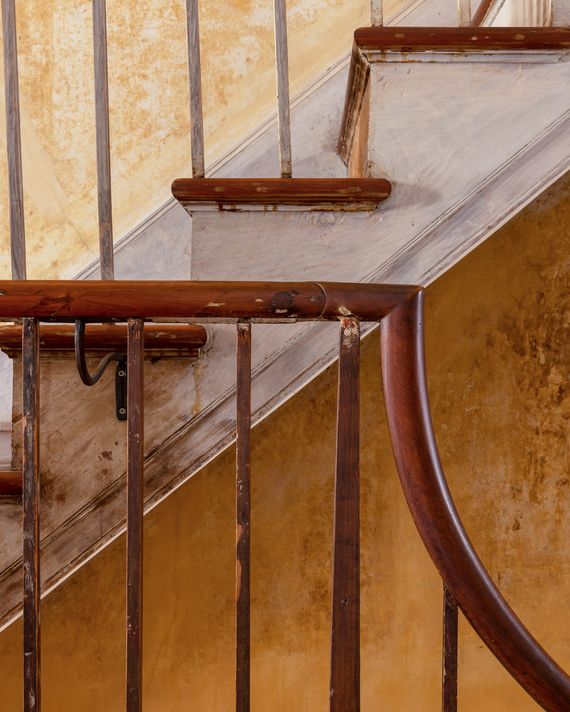
The renovation left traces of the layers that were stripped back.
Photo: Virginia Carey for Brown Harris Stevens
The biggest changes came when Cunnick furnished the place, bringing in Noguchi lamps, a Richard Tuttle chair and lamps, and a Judd side table and daybed, which served as seating in a dining nook. “Though, honestly, when I had lots of people staying, they slept on that,” said Cunnick. She had shocked the art world by showing Judd beds with mattresses and throws, but she felt strongly that for décor to be understood, it had to be lived with. “I use everything in the house,” she said. “That’s just how I live.” Now, she’d like someone else to do the same: She’s spending more time in Connecticut and compared No. 25 to silver she had inherited, then gifted to a niece. Her broker, Joan Goldberg, told me she’s telling interested brokers, “If your buyer would consider the aesthetic in this place something they needed to tear out, the seller’s not going to sell it to them.”
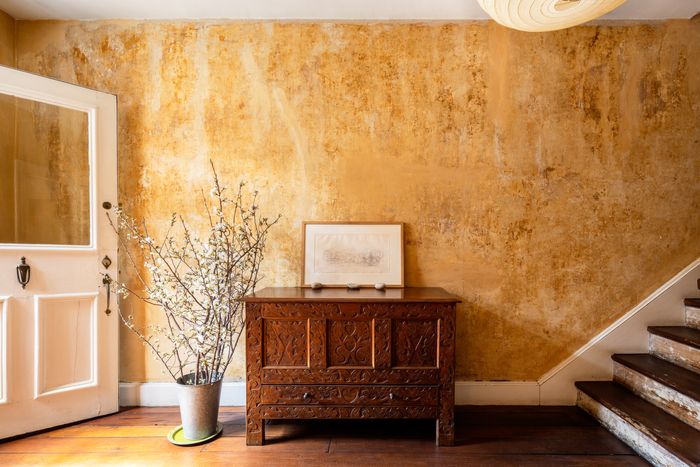
The main entry on the parlor level. A John Cage drawing, made through a process of chance, contrasts with the exactingly carved 17th-century Hadley chest below it.
Photo: Virginia Carey for Brown Harris Stevens
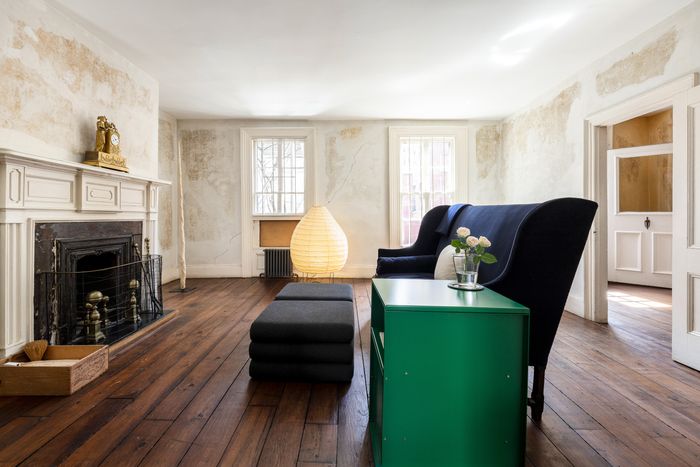
To the right of the entryway is the parlor, which looks over Cranberry Street. The side table is by Donald Judd and the lamp is by Isamu Noguchi, but the couch is 18th-century, and the clock on the mantel is from 1818.
Photo: Virginia Carey for Brown Harris Stevens
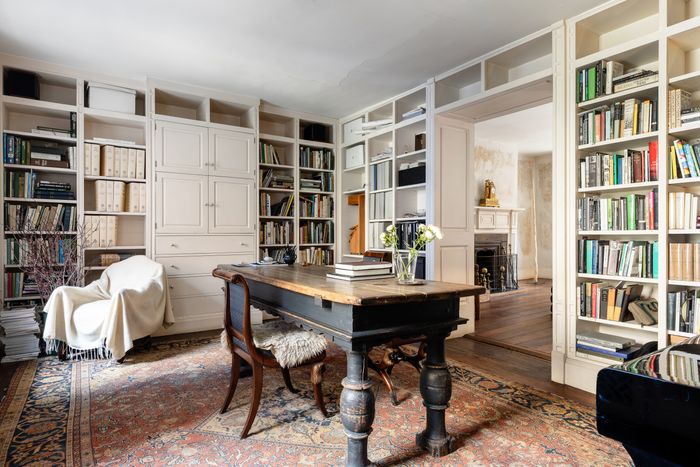
The parlor-level living area connects to a library, where Cunnick added built-ins. She was once a fiction editor for Conjunctions. The table is 18th-century Swedish.
Photo: Virginia Carey for Brown Harris Stevens
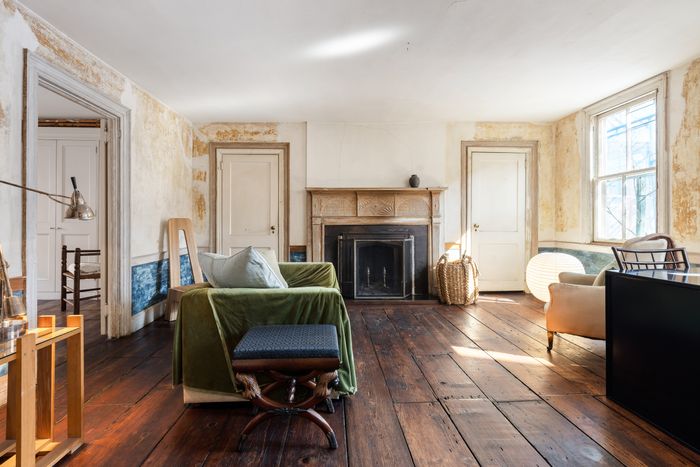
An upstairs sitting area with a mantelpiece that resembles one found in the Lefferts House.
Photo: Virginia Carey for Brown Harris Stevens
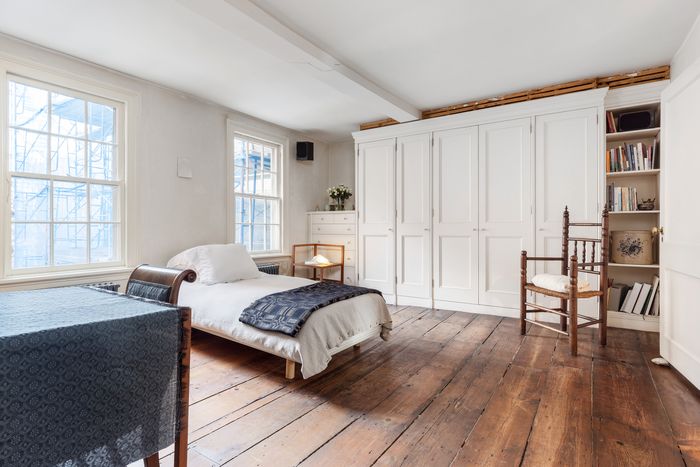
The primary bedroom on the second floor looks over the back garden. Cabinets were added to serve as closets.
Photo: Virginia Carey for Brown Harris Stevens
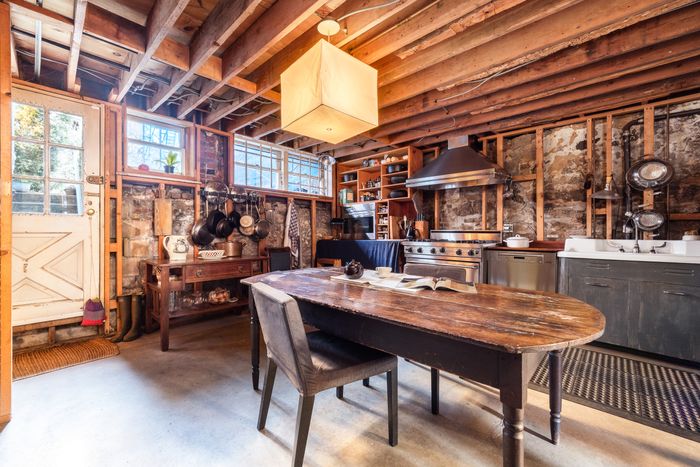
One floor down, on the garden level, is a kitchen that opens into the rear garden.
Photo: Virginia Carey for Brown Harris Stevens
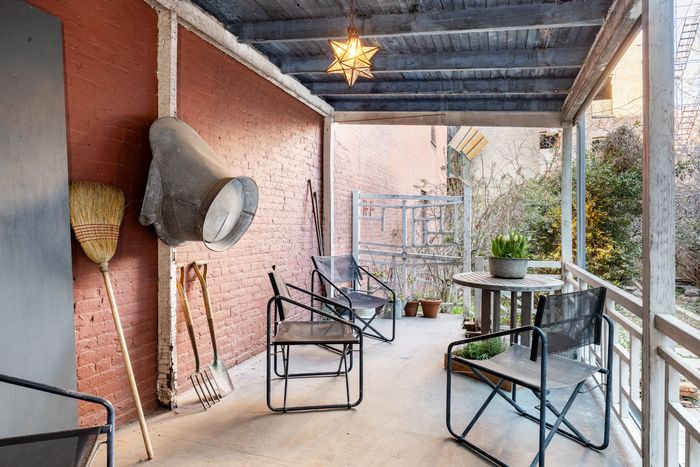
The back porch stretches into the garden, hugging the brick wall of a neighboring residence.
Photo: Virginia Carey for Brown Harris Stevens
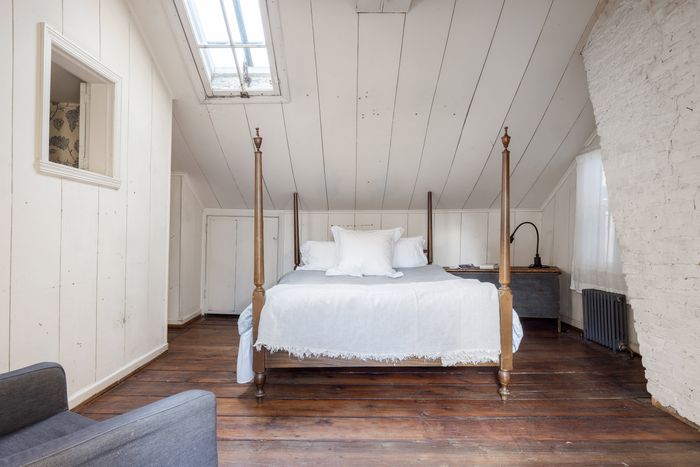
A bedroom on the top floor with a skylight and peephole window into a smaller bedroom next door. Plans to add ceiling height and extend the rear, with a terrace, could pass a landmark review, says Joan Goldberg, since the rear of the house is not visible to neighbors.
Photo: Virginia Carey for Brown Harris Stevens
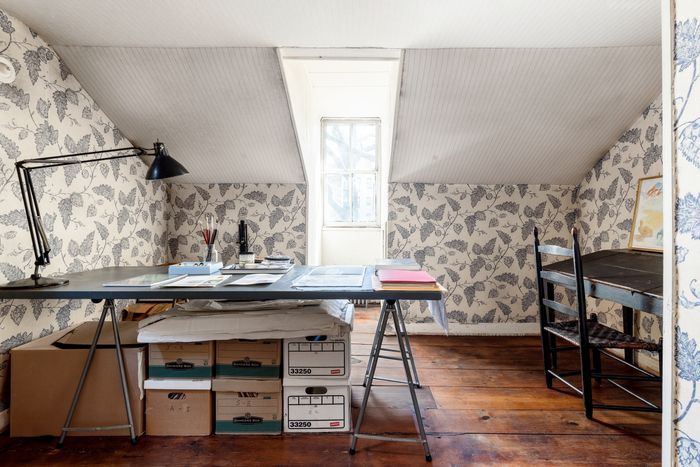
A smaller bedroom on the top floor has been in use as an office.
Photo: Virginia Carey for Brown Harris Stevens
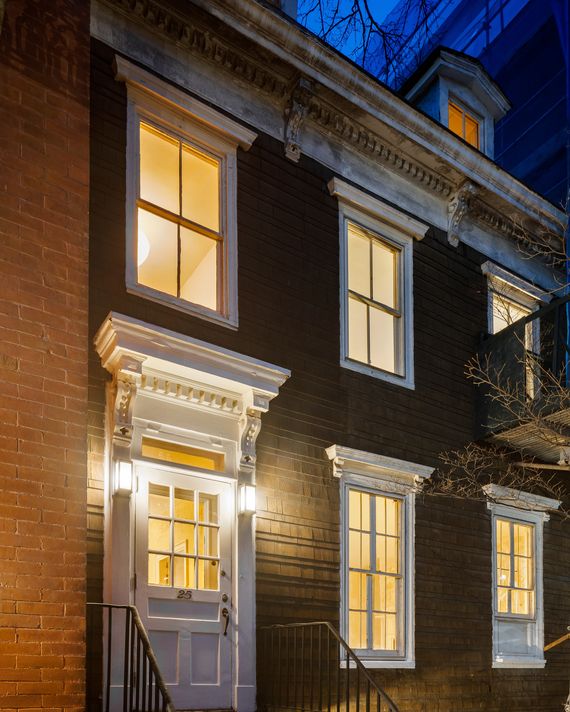
The house stands out in a neighborhood of bricks and brownstones, and Cunnick vowed to stay until a building project next door was done.
Photo: Virginia Carey for Brown Harris Stevens
Sign Up for the Curbed Newsletter
A daily mix of stories about cities, city life, and our always evolving neighborhoods and skylines.
Vox Media, LLC Terms and Privacy Notice
Related