
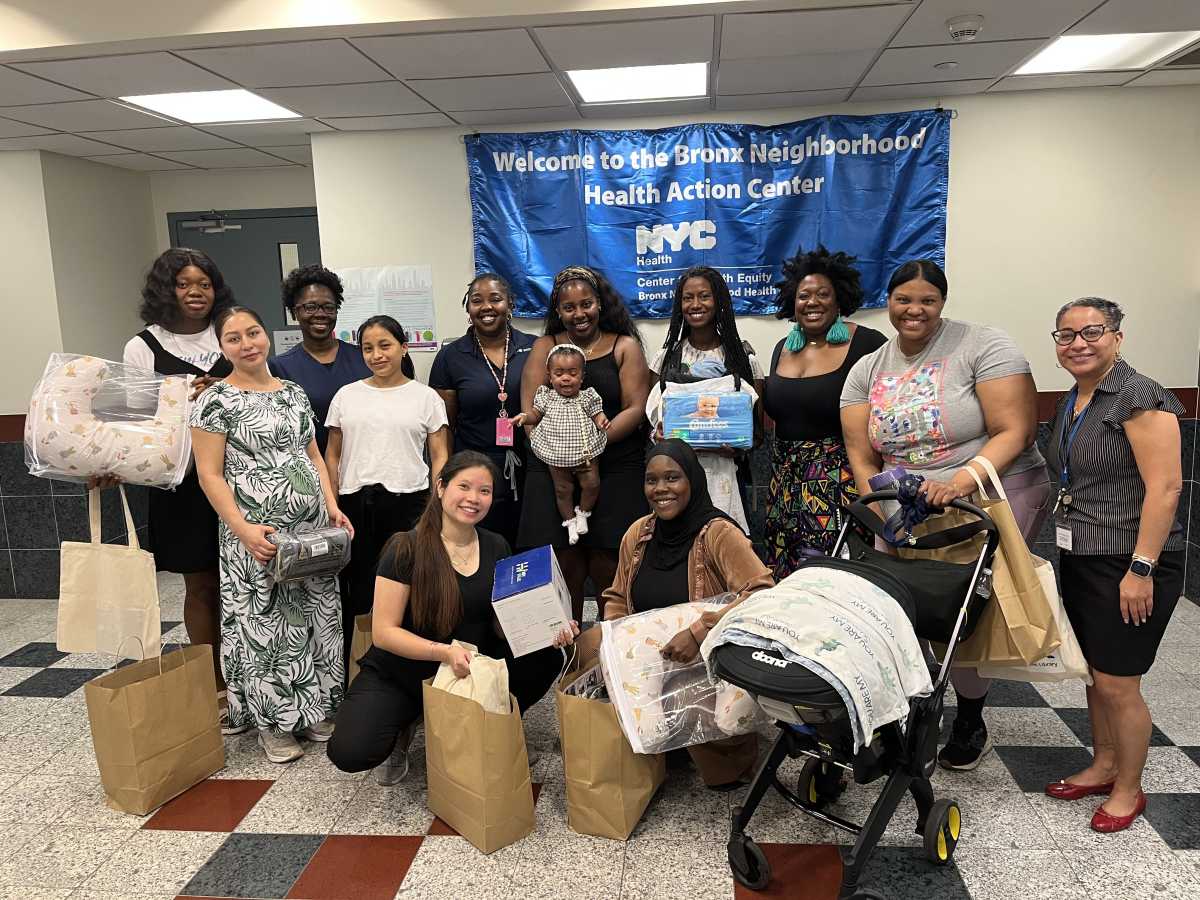
The New York City Health Department planned a series of events highlighting the 10th anniversary of Black Maternal Health Week across the South Bronx, East Harlem and Central Brooklyn to connect pregnant individuals to resources and support them through pregnancy and early childhood.
Expecting mothers and parents attended the Tremont Action Center last week to learn more about their rights as pregnant people and mothers, ways to take care of their health, the importance of doulas, postpartum and lactation support.
Black Maternal Health Week was founded by the Black Mamas Matter Alliance (BMMA), a Black women-led coalition group. It is celebrated from April 11 to April 17.
Aminata Kebbeh, an expecting, first-time mother who frequently visits the Tremont Action Center to participate in classes and activities such as prenatal yoga said she’s been able to meet and connect with mothers and said that the staff are welcoming and the programming is “well-thought-out.”
“It’s been a great space to just come and take care of myself, feel understood and feel seen as I embark on this journey,” Kebbeh said.
Kebbeh looks forward to coming to the center every week because she’s learned about the realities of childbirth and motherhood, which has made her more confident.
She also learned a lot about self-care, postpartum health and human rights at the event.
“The beauty is that there’s so much happening in New York City that don’t have costs attached to it,” Kebbeh said. “Knowing our human rights and knowing that you have lactation rights [in the workplace]… you don’t necessarily have to sacrifice being able to care for your baby and being able to breastfeed for income.”
Chelsea Colebrooke, a first-time mother of an 8-month-old daughter, has been attending the center since she was pregnant to build a support system. Colebrooke said that she learned about the benefits of using medication postpartum despite the stigma around medication, especially in Bahamian culture.
“As a mother myself, I felt dark at times and I also felt very anxious, but I was scared to take medication because of my cultural background and the stigma,” she said. “But coming to today’s workshop, it made me realize that it’s okay. We all need help. And if I’m good, the baby’s good.”
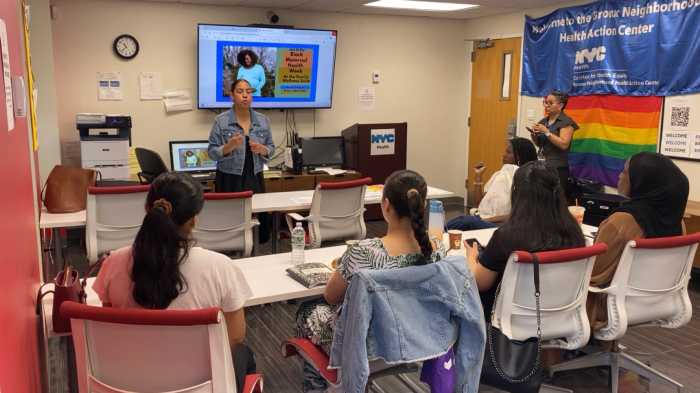 Samelys Lopez leading the first workshop on human rights with presentation from NYC Commission on Human Rights. Photo by Keke Grant-Floyd
Bianca Dominguez is another expecting, first-time mother who was familiar with the center because they were offering free cribs and car seats for expecting mothers. She decided to attend the event to learn everything about pregnancy and maternal health disparities.
“I just wanted to also have a lot of awareness with Black maternal health, because they did mention that Black women are at higher risk whenever they’re pregnant and not advocating for themselves, so I really like to be educated on all the resources that they provide as well,” Dominguez said.
Dominguez told the Bronx Times that it was interesting to learn about the safety of taking medication during postpartum.
“I actually didn’t know that it was okay to take pills if you’re breastfeeding, so that was something that was really helpful,” Dominguez said.
Dominguez plans to share all the information she learned with other mothers.
The theme for this year’s series is “Rooted in Justice and Joy,” and addresses the enduring legacies of systemic oppression, reproductive injustices and health inequities that continue to impact Black maternal health, all while calling for a liberated future rooted in restoration, justice, and joy.
The NYC Health Department’s data shows that Black non-Hispanic women are six times more likely to die of a “pregnancy-related” cause, such as pregnancy complications or postpartum hemorrhage, and four times more likely to die of a “pregnancy-associated” cause, such as postpartum suicide or overdose, than white non-Hispanic women.
Dr. Zahirah McNatt, the chief equity officer and deputy commissioner for the Center for Health Equity and Community Wellness (CHECW) at the NYC Health Department told the Bronx Times about the need for more care and attention in Tremont, East Harlem and Brownsville, which are areas with poor maternal health outcomes.
In each of these three neighborhoods, there is a neighborhood health action center that focuses on providing neighborhood specific services to help reduce health inequities and improve health outcomes.
She said that the department hosted this series in these specific locations, because they are some of the most disinvested neighborhoods in New York City.
“They are neighborhoods with a high level of health inequities as a result of disinvestment, of structural racism and other forms of oppression that have taken place historically and in the present in the city,” she added.
The health department aimed to celebrate the joy of birth, maternal wellness, underscore the existing concerns and challenges, and showcase how they are supporting birthing people in these neighborhoods.
Each action center has a family wellness suite that offers several services to pregnant people and people who are in their postpartum period.
These services include food assistance, breastfeeding support and education, mental health support groups, dance classes, perinatal massage, doula support and many more.
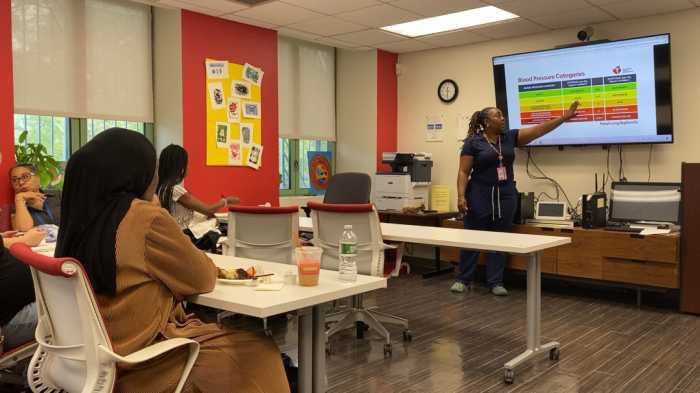 Jhnelle White, a registered nurse, explaining prevention and management methods for blood pressure, gestational diabetes, and postpartum depression. Photo by Keke Grant-Floyd
Beyond Black Maternal Health Week, McNatt said that the department focuses on the issue of maternal death everyday.
“We have set a citywide goal of reducing pregnancy-associated mortality by 10% for Black women by 2030. And that is one of our targets and our commitments as a city,” McNatt said.
She said that there is still a lot of work to be done regarding public policy around maternal health.
However, McNatt mentioned a recent law passed by the New York State Department of Health that requires the department to establish and maintain a community doula directory, and covered doula services under Medicaid.
“Doulas are not the only answer to the maternal health crisis in New York City, but we know they’re one important component and legislating around their brilliance and their genius has been really exciting and successful in the city,” McNatt said.
Dr. McNatt emphasized the importance of pregnant people knowing their rights and having access to community support.
She shared a publicly available resource called the “New York City Standards for Respectful Care at Birth” that educates people on their rights as pregnant people.
“There’s this large community of folks that you can pull around you as you think about pregnancy or when you become pregnant. [We] always want people to know that they deserve that entire community to be wrapped around them,” she added.
At the end of the event, there was a raffle giveaway for a breast pump and storage bags, nursing pillow, yoga mats, baby essentials and a baby food maker. Each mother received a free box of diapers.
Reach Keke Grant-Floyd at kekegfreports@gmail.com. For more coverage, subscribe to our newsletter and follow us on Twitter, Facebook and Instagram!