
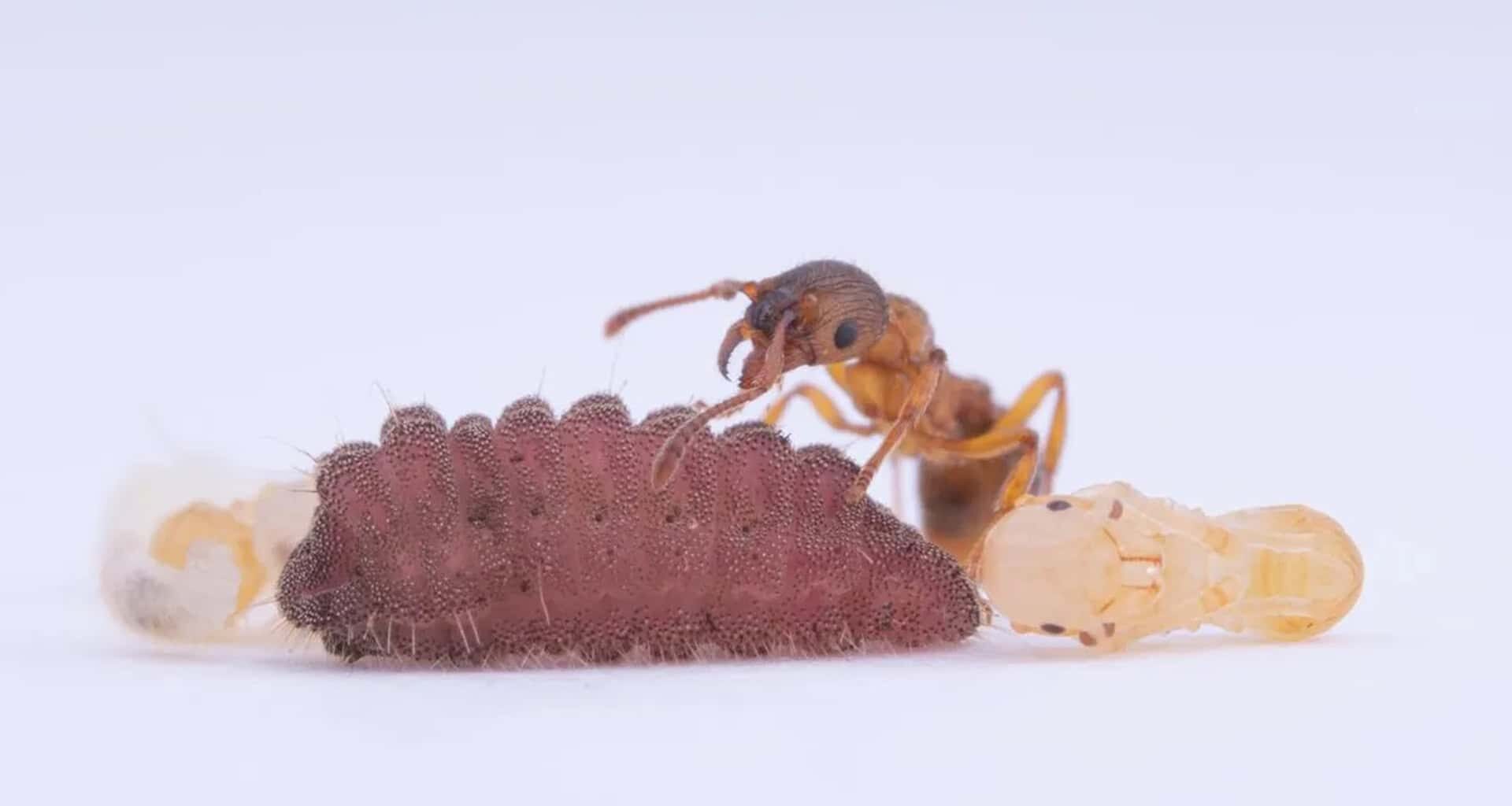
 An ant caring for a caterpillar. Image credits: Daniel Sanchez/University of Warwick.
Soft and defenseless, these baby caterpillars are pulling off the ultimate high-stakes heist. They don’t just sneak into an ant colony, they convince the entire nest to treat them like queens. The ants carry them, feed them the best food, and even prioritize their rescue during emergencies.
It’s the ultimate heist. New research shows that parasitic caterpillars infiltrate an ant colony not just through chemical trickery, but also by mastering the queen’s specific musical rhythm.
For years, researchers thought they do it through a chemistry trick, by smelling like the queens. But a new study shows it’s not just smell. Caterpillars have also mastered the sounds and rhythm produced by a queen ant.
“In order not only to fool the ants, but to achieve a high social status in the colony hierarchy, they (caterpillars) are emitting sounds that are queen-like,” Francesca Barbero, one of the study authors and an associate professor at the University of Turin, told Refractor.
The sound of a queen
This relationship is known as myrmecophily, and for many butterfly larvae, it’s a matter of life or death. If the ants don’t adopt them, the caterpillars simply won’t survive. But how does does a larva trick an entire species?
Earlier research from 2009 answered a part of this mystery. It showed that queen ants produce distinct sounds compared to workers. When these queen-like sounds were played back in colonies, workers responded with extra care and protection.
Some caterpillars, such as those from the Maculinea group, were already known to mimic these sounds to gain similar benefits. However, the sounds are only half th battle.
The new study focused on the rhythm.
Decoding the hidden rhythm
The study authors recorded vibrations from two ant species and nine butterfly species using a highly sensitive, custom-built device capable of detecting tiny substrate-borne signals—the kind ants and caterpillars use to talk through surfaces.
×
Thank you! One more thing…
Please check your inbox and confirm your subscription.
What they found was surprisingly systematic. All species, even those that don’t rely on ants, produced signals with a regular rhythm, with beats occurring at evenly spaced intervals.
However, only the most ant-dependent caterpillars went a step further. They produced a more complex pattern known as a double meter—a layered rhythm that closely matches the queen ant’s signal.
Simply put, the queen ants produce a very specific rhythm, and the caterpillars are capable of mimicking it.
“The higher the level of myrmecophily, the more complex the signal, and this complexity is achieved through a specific rhythmic pattern. This complexity in the rhythm is the first time, to my best knowledge, that has been recorded outside the primates,” Barbero said.
Species like Phengaris alcon and Plebejus argus have perfected the whole mechanism. They start by matching the queen’s chemical scent and then reproducig her rhythmic signature with remarkable precision. This is enough to trick most ants and the result is that worker ants treat them as high-ranking members of the colony, even though these caterpillars often repay the favor by eating the ants’ own larvae.
Do other species show similar behavior?
Interestingly, the caterpillars are also efficient liars. Producing these vibrations is exhausting, so they don’t “speak” all the time. Instead, they wait for the perfect moment to chime in, ensuring their deception is both accurate and energy-efficient.
“These findings highlight the role of temporal patterning in vibroacoustic communication, influencing signal efficiency and recognition in ant–butterfly interactions,” the study authors said.
There are still limitations to the study. For instance, it focuses on a limited number of species, and while the correlation between rhythm complexity and social status is strong, proving direct causation will require further experiments—such as manipulating rhythms and observing how ants respond.
But this discovery opens up a new world of questions. Have we been overlooking acoustic communication in the insect world? While the study was limited to a few species, the team plans to investigate if other organisms are using similar rhythmic tricks to hack their way up the social ladder.
The study is published in the journal Annals of the New York Academy of Sciences.