
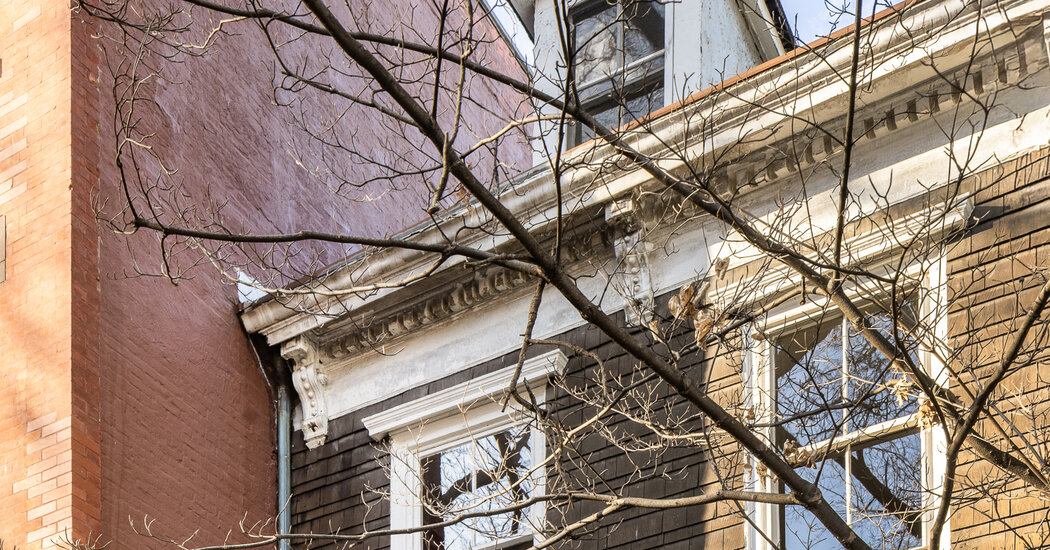
After scraping back seven layers of wallpaper and exposing the ocher patina of the original walls, after peeling back the new floors to reveal centuries-old planks and removing the dropped ceiling and the avocado-colored kitchen, Elisabeth Cunnick invited members of a neighborhood association to tour her home, considered one of the oldest in Brooklyn. The reaction was — to put it mildly — mixed.
Some looked admiringly, others in despair, she said of the visitors who traipsed into 25 Cranberry Street, one of the last surviving wood-frame Federal-style rowhouses in Brooklyn Heights.
Some walls lacked plaster, most lacked paint, the wiring was visible and there was no air-conditioning. It’s not as if Ms. Cunnick lacked the means: The former gallerist and owner of the A/D gallery in Manhattan, Ms. Cunnick and her former husband bought the house in 1995 for $500,000 by selling off their Andy Warhol drawing. What she had created — and what not everyone has appreciated — was a home that is as close as possible to living in the 19th century.
“I know that the walls are cracking. I know there are nails popping up in the floorboards, but I find it absolutely glorious,” said the 70-year-old Ms. Cunnick, who has reluctantly decided to sell the historic home. “I would very much love for there to be someone there who loves the house as much as I do — and who gets it as it is,” she said.
The house’s charm is undeniable — the chalky walls and uneven floors not only have the feel of being from another time, but the house itself is almost completely free of modern materials. There’s almost no wallboard and very little plastic. The house is made of wood and mud, plaster and lime, said Ms. Cunnick, who describes it as “like living in something that breathes.”
The 3,263-square-foot home, listed for $4.9 million, went on the market this week — a month after another rare Federal-style rowhouse, 24 Middagh Street, around the block, went up for sale.
That house is listed for $9.25 million, because it recently underwent a gut renovation, something that the owner of the Cranberry Street property considers an act of violence. “That’s what fishermen do when they catch a fish, or a deer hunter when they shoot a deer,” said Joan Goldberg, the real estate broker representing the sale of 25 Cranberry.
Beyond their price tags, the two houses share a legendary rivalry: Both claim to be the oldest home in Brooklyn Heights. And as far back as 1889, an article in the local newspaper wistfully described the disappearance of the wood-frame homes and speculated on the dates they were built, a mythology that has only grown with the rise of blogs, tour guides, walking maps and competing real estate listings, said Jeremy Lechtzin, an architectural historian.
History books and tour guides have dubbed 24 Middagh the “Queen of Brooklyn Heights.” Like its around-the-block neighbor, it sits inside New York’s first designated historic district, and city records date it to 1829, according to Courtney Clark Metakis, spokeswoman for the New York Landmarks Preservation Commission.
25 Cranberry has a plaque that says: “circa 1828.” Yet the real estate listing for the property claims it was built in 1790.
“1790 would make it one of the earliest — if not the earliest — Federal-style house in all of New York City. So that would be extraordinary, but not impossible,” said Andrew Berman, the executive director of Village Preservation and one of many architectural historians who cast doubt on the date. Mr. Lechtzin, president of the Brooklyn Heights Association who has done deep research into the deeds of historic homes in the neighborhood, pointed out that the land where both homes sit, originally farmland owned by the Hicks brothers, wasn’t even subdivided until 1806, according to a cadastral map.
In 1812, the Hicks brothers sold the lot that would become 24 Middagh for $250. In 1821, it resold for $710 — an increase that may reflect the addition of a house. Similarly, the lot at 25 Cranberry sold for $275 in 1815. In 1827, it and an adjoining lot were sold together for $1,800 — or around $900 apiece — again suggesting improvements. Soon after those resales, the Brooklyn directory began listing named residents at each address, indicating the presence of a house, said Mr. Lechtzin.
Mr. Lechtzin’s research led him to find what may actually be the oldest surviving houses in Brooklyn Heights: Two much plainer houses located at 38 and 40 Hicks Street, whose deeds indicate they were each built circa 1810.
Regardless of which house is actually older, what is undisputed is that 25 Cranberry feels like it is out of another time, an aesthetic that Ms. Cunnick has closely guarded.
“One of my problems has been — and I’ve known it for years — I love that house too much. I can’t leave it. I’m wedded to it,” said Ms. Cunnick.
When a pipe burst at her second home in Connecticut, it forced her to spend time there. That gave her “a little gap — a little window — and I thought I had better step through it while I can,” she said, adding: “So maybe this is my time just to open my hands and let go and hope that someone else loves the house as much as I do.”