
The concept of fluid inclusions in the Renaissance
One of the most beautiful poems ever written about minerals is “On a Crystal Enclosing a Drop of Water” (De crystallo cui aqua inerat), written towards the end of the 4th century CE by Claudius Claudianus (370-ca. 410), one of the last poets of classical Rome15. Claudianus describes the mineral with exquisite poetry employing the scientific knowledge of his time. It reads, for instance:
XXXIII. (LVI.).
This piece of ice still shows traces of its original nature:
part of it has become stone, part resisted the cold.
It is a freak of winter’s, more precious by reason of its incomplete crystallization, for that the jewel contains within itself living water.
XXXV. (LVIII.).
Alpine ice was becoming so hard that the sun could not melt it, and this excess of cold was like to make it as precious as a diamond.
These rhymes demonstrate that a theory of crystal formation already existed during Claudianus time. This theory originated in classical Greece, and it named the objects of its study: crystals. The word “crystal” is derived from the Greek “kryos,” meaning cold. Scholars in classical Greece believed that the transparent, faceted crystals of quartz – rock crystals- were supercooled water, a sort of icicle that formed when water froze to the point of never melting again16.
The “supercooling theory” of the origin of crystals survived from Hellenistic Greece through the Roman Empire and beyond. Pliny the Elder described such drops of water within crystals in book XXXVI of his Natural History, written in the first century CE17. In common with educated people of classical times, the bubbles seen in some crystals had a logical explanation: they were remnants of the mother water, the water from which the crystal formed through supercooling. In modern scientific terms, these bubbles are referred to as fluid inclusions, found in crystals of various minerals. They consist of fluids, either liquids or gases, trapped within the solid crystal during its growth. Observations of fluid inclusions have continued over time. In the early 11th century, the renowned Arab scholar Al-Biruni (973–1048) described all kinds of inclusions in crystals- liquid, gaseous, or solid- providing a correct explanation for their origins18,19. Thus, Renaissance scholars were not only aware of fluid inclusions in crystals; they would have considered them a natural phenomenon, easily explained by the theory of crystal formation accepted in their time. Therefore, depicting fluid inclusions within a crystal sphere was not a bizarre concept but a technical difficulty. However, was the technique for making spheres of transparent minerals known during Leonardo’s time?
The making of mineral balls in the Renaissance
Returning to the poem of Claudianus, we learn that the crystal inspiring the poem is not a faceted crystal but a carved crystal ball. The poet wrote:
XXXIX. (LXII.)
Do not despise this sphere of rock-crystal
XXXVIII. (LXI.)
Children love to handle this crystal
and turn it over and over in their little hands:
Placing the dry sphere against their thirsty lips …
Thus, the technology to carve crystals into spherical shapes was known in the 4th century CE. There is no documentary evidence of how these spheres were produced at that time20, but the technique likely was not much different from that used in the 19th century, as described by George Kunz21 or the technology used by the crystal carvers of the Abbasid and Fatimid kingdoms in the 11th century22,23.
In the Claudianus poem, Maurice Platnauer translated the word “crystalla” as “rock-crystal,” i.e., quartz. However, at the time of Claudianus, “crystalla” could refer to any transparent mineral with flat faces and/or a polyhedral shape. At the time of Claudianus, a “crystalla” transparent sphere could be made either from a crystal of salt (sodium chloride), gypsum (calcium sulfate dihydrate), calcite (calcium carbonate), or rock-crystal (quartz). Large salt crystals were known from various European locations where evaporitic salt deposits and salt diapirs were mined24. However, sodium chloride crystals are too brittle to make spheres. Equally large, highly transparent, single, and twinned crystals of lapis especularis (Latin name for selenitic gypsum) were known from the mining area of Segobriga (near Cuenca, in Spain) and several locations in Italy25. However, gypsum crystals have a layered structure with perfect cleavage parallel to {010} faces. During the mechanical manipulation to shape them into spheres, the formation of many crystalline defects is unavoidable; therefore, the original transparent crystal is converted into a translucent object with moonlight luster. Large calcite crystals, suitable for making spheres, were unknown in the fourteenth century. Additionally, these crystals are brittle and exhibit perfect rhombohedral cleavage, making it very difficult to shape them into a transparent sphere. Therefore, the ball described by Claudianus must be of quartz if it is of mineral origin; the fabrication of highly transparent glass was not known in Claudianus’s time. Quartz crystals are hard (Mohs’s scale 7) and do not easily cleave but have a conchoidal fracture, that is, they have concentric shell-like undulations. They are easy to shape into spheres, and the surface can be polished, retaining the mineral’s transparency. So, assuming it is a mineral sphere, the orb of the NYSM should be of quartz. However, we must consider that in the 15th century, clear “crystal-like” glass was being manufactured in Venice26. Consequently, the transparent orb depicted in the NYSM could be either quartz or glass.
The orb of the New York Salvator Mundi
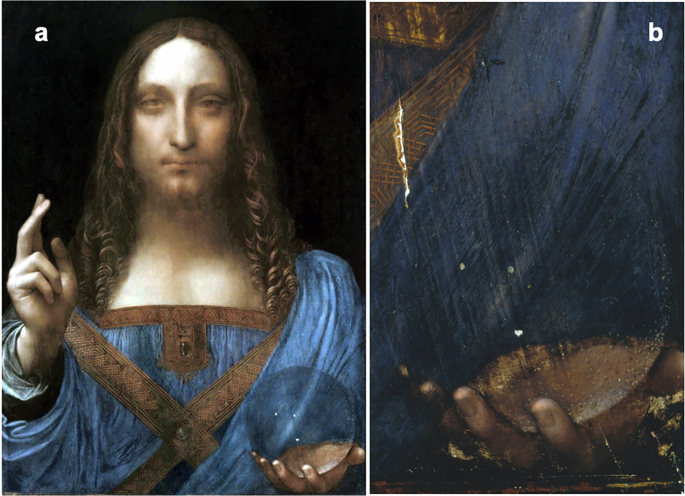
The orb of the NYSM is resting on his open left hand (Fig. 1). The diameter of the sphere can be estimated from the distance between the outer edge of the thumb and the little finger in the outstretched hand holding the sphere. A handspan is an anthropomorphic unit of measurement that varies with time and location, usually around 22 cm. Considering the curvature of the hand, and the location of the thumb and the pinky at the border of the sphere, its diameter is ca. 18 cm: far larger than either crystal or glass balls known in 1500 CE. For example, the ball in the thumb of Childeric (ca. 436–481) was approximately 5 cm27, which is also the largest size of the Vikings’ Visby lenses28. Similarly, the four spherical pomes of quartz of La Majesté de Sainte Foy en Conques (France, ca. 890 CE) are no larger than 6 cm, and the crystal ball used by the famous alchemist John Dee for scrying around 1600 was also 6 cm in diameter29. However, 20 cm or even larger rock crystals were carved in the court of the Fatimid caliphs in 11th-century Cairo to make superb ewers, vessels, and lamps30. These esteemed pieces of art were brought to Christian countries during the 12th and 13th centuries23,30,31. Leonardo was aware of these larger rock crystals because he advised Isabella d’Este in acquiring rock-crystal vessels from the Medici Collection32. Although it might have been possible for quartz spheres similar in size to the one painted in the NYSM to have been carved in the Quattrocento and Cinquecento, as there is no evidence of their existence in Leonardo’s environment, we must conclude that the painter did not use a natural model.
Painting a transparent object involves dealing with a series of optical effects that depend on the object’s molecular structure and shape. Contrary to what has been suggested, no optical effect is perceived in the painting due to the crystal’s birefringence9. There doesn’t have to be. Quartz is a positive uniaxial crystal with moderate birefringence. Unlike calcite, which exhibits a much stronger birefringence, it is hardly noticeable even under the most favorable conditions. When an object is observed through a glass or quartz crystal sphere, the sphere acts as a wide-angle lens, inducing a marked optical distortion in the image. If the sphere is sufficiently distant from the object, it will create an inverted image. To avoid this, the artist located the sphere in the NYSM very close to the robe, thus solving the problem. However, there are other optical effects to consider. The refracted image of any linear object behind the sphere will experience a visual distortion that increases as the object is displaced from the central meridian (Fig. 2b). The painting depicts four pleats in the robe behind the sphere (Fig. 2a). The three secondary pleats overlap little with the sphere, and they are located close to the central meridian. Therefore, the artist correctly understood that they would not be optically affected by the lens effect of the transparent sphere. The central fold runs through almost the entire orb, and the upper part is slightly off the meridian. This would result in a thickening of the fold in the sphere. This optical effect also affects the palm that supports the transparent orb. The palm would be slightly enlarged, as correctly interpreted by the painter. Still, it would also inevitably be observed at the top of the orb. This effect is not seen in the current NYSM but could have been present in the original version. Unfortunately, it is impossible to discern because the paint layers at the upper part of the orb, where these optical distortions would be evident, have completely perished due to harsh cleaning in the past. The original orb would have had glazes and scumbles, which, though thin, could have depicted this phenomenon, even in a subtle way. Interestingly, the Barberini painting and the Hollar engraving, both copies of the NYSM, show this optical effect (Fig. 2c, d). Nevertheless, the reflection of the palm in the upper part of the orb depends strongly on the illumination, the position of the sphere in the palm, and the position of the observer. Leonardo clearly described in ref. 33 that a portrait should be painted with light high up and coming from the north, ideally towards evening or even on a cloudy day. We have photographed a glass orb sustained by a hand under conditions that attempted to mimic Leonardo’s recommendations for illumination; this shows that the optical reflection of the palm in the upper part of the orb is drastically reduced (Fig. 2e). Consequently, the painting of the NYSM does not contain serious scientific errors regarding optical distortions caused by a transparent solid sphere, as previously claimed. Therefore, it is not necessary to appeal, either to the explanation of decorum5 or to a hollow glass sphere13.
Fig. 2: Optical effects of a transparent sphere.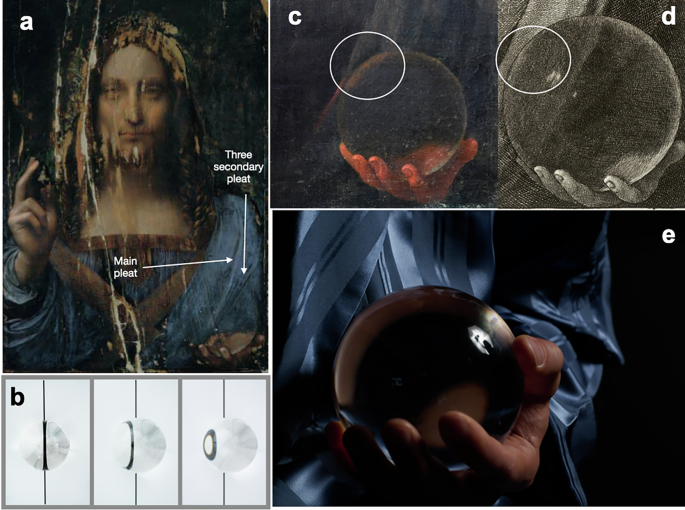 The alternative text for this image may have been generated using AI.
a The Salvator Mundi unrestored. Note the location of the main pleat and the three secondary pleats. b Any line passing through a meridian of a transparent sphere is not affected by the lens, while any line passing through a parallel will suffer an evident optical distortion. c The transparent orb of the Barberini Salvator Mundi (Rome, Gallerie Nazionali di Arte Antica, Palazzo Barberini, inv. 1926, on deposit). d The transparent orb of the Hollar engraving (The Thomas Fisher Rare Book Library, University of Toronto); The circles enclose the reflection of the palm in the upper left of the orb. e A photograph of a transparent sphere of a similar size to that of the NYSM. The picture was taken under some of the illumination conditions described by Leonardo da Vinci for painting portraits. Note that the optical distortion reflecting the palm in the upper left corner of the sphere is reduced to a small arc of the sphere.
Crystal or glass
In addition to three specks of white paint that reflect the point sources of light in the artist’s workshop, numerous specks can be observed on the lower right side of the transparent orb (Fig. 3a). As previously suggested5, these specks could certainly represent fluid inclusions within a crystal. Still, they could also portray air bubbles within glass. At first sight, the location of the speckles on only one side of the sphere already excludes the possibility that these inclusions are air bubbles in a glass sphere, as they would occur throughout the entire volume (Fig. 3b). A more detailed analysis of fluid inclusions is crucial for distinguishing between fluid inclusions in glass and crystal. Technically, the primary difference between crystal and glass lies in their internal order. Glass is an isotropic material, meaning its physical properties do not depend on orientation. Air accidentally included during the manufacture of glass adopts the shape of spherical bubbles (Fig. 3b). Unlike glass, crystals are anisotropic solids, and the shape of their fluid inclusions reflects the symmetry of the crystal structure. Therefore, fluid inclusions within crystals are not spherical bubbles but typically have polyhedral shapes, depending on the crystal’s symmetry (Fig. 3c).
Fig. 3: Speckles in the orb.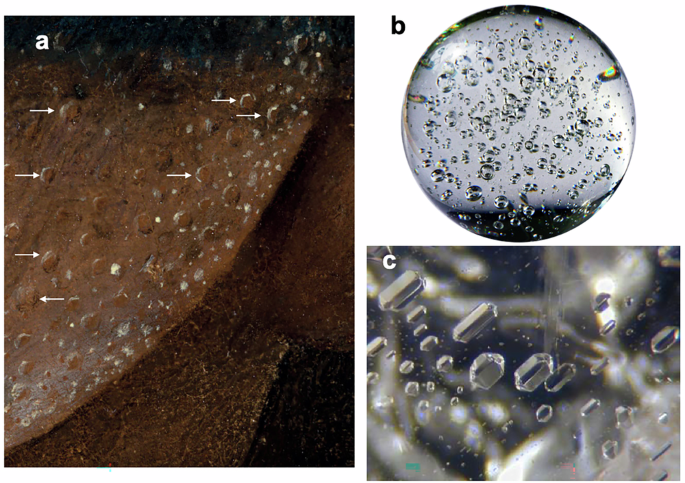 The alternative text for this image may have been generated using AI.
a The speckles painted on the orb of the NYSM. The larger speckles, marked by the arrows, are approximately 2–2.5 mm in size. b Air bubbles in an isotropic material like glass are always spherical. c Fluid inclusions within an anisotropic medium, like a crystal, are polyhedral, their shape depending on the symmetry of the crystal structure, and showing correlations among their orientations. The picture depicts fluid inclusions up to one millimeter in a crystal of quartz from Llandrindod, Wales. Photograph courtesy of David Whipp.
The specks painted on the NYSM orb are very small. The larger ones have a width of 2 mm, and their size decreases toward the sphere’s boundary. Interestingly, the shape of the tiny speckles in the Salvator Mundi appears rather polyhedral to the naked eye of the viewer (Figs. 1 and 3a). Upon closer inspection at higher magnification, these spots are not single smudges of paint with a uniform shape. Instead, they consist of an underpainted middle tone, bordered by a curlicue of white and a dark shadow (Fig. 4a–d). Due to this open structure, automatically recognizing the shape of these objects, which are made of three brushstrokes, is challenging. Nevertheless, we performed an image analysis of these spots after manually outlining their shapes. As shown in Fig. 4e, except for the tiniest specks, the structures are elongated; the larger they are, the more eccentric they appear (Fig. S2). It is notable that some of the white and black brushstrokes are composed of two or even three strokes with different directions (Fig. 4a–d). This might reflect the artist’s intention to depict polygonal shapes rather than circular bubbles. This feature encourages viewers to see these speckles as polyhedral rather than round forms. (Figs. 1 and 2a). The artist who painted the speckles on the NYSM displayed remarkable skill and paid great attention to detail, such as lighting. We examined the curlicue of the white brushstroke used to depict the light reflection. We found these are elongated with an average orientation of 42° NE (Fig. 4f). Consequently, the orb’s illumination comes from 48° NW, consistent with the NW lighting on the face and body of the Salvator. Today, fluid inclusions in crystals are studied with optical microscopy to determine their formation temperature and the chemistry of the fluid from which they originated. In the early 15th century, only simple lenses, such as reading stones, were known, with magnifications no greater than 4×. Leonardo owned one5 and could have learned that fluid inclusions in crystals differ significantly from air bubbles in glass.
Fig. 4: The geometry of the speckles.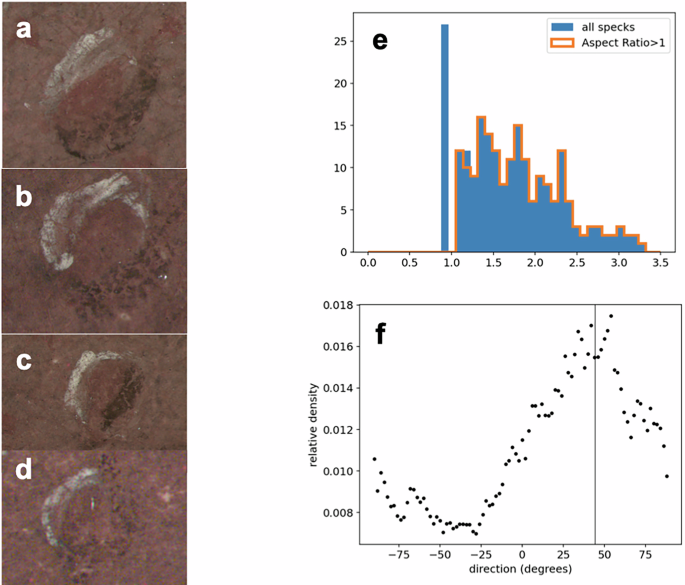 The alternative text for this image may have been generated using AI.
a–d Different views of the speckles painted on the orb of the New York Salvator Mundi. Instead of a single smudge of paint, they are created with an underpainted middle tone, flanked by a curl of white and a dark shadow. Note that the speckles are painted with geometric shapes. e Statistical representation of the size of all speckles (solid blue histogram). Data from non-circular speckles are outlined in orange. f X-axis: angle formed by the perpendicular to the white line (which indicates the light source direction) relative to the vertical, measured from the top in a counter-clockwise direction. Y-axis: relative frequency of bubbles with that orientation. The vertical line indicates the most common orientation, with an average of 44.4 degrees.
Why does painting fluid inclusions in an orb depict the divine order of the world?
Although there is debate over Leonardo’s authorship, most experts believe the NYSM was painted in Leonardo’s workshop. For example, Vecce suggests that the painting was mainly completed by his assistant, Luini, although Leonardo was responsible for the draping of the central part of the tunic, the detailed decorative frieze around the neckline, and the two crossed bands of the stole34. However, an assistant would never have dared to paint flaws or imperfections on a transparent orb that symbolizes divine order and God’s power. In fact, among the many known versions of the Salvator Mundi, twelve feature a transparent orb; of these, only the NYSM shows tiny speckles the size of millimeters (Table S1). In Leonardo’s studio, only the master would have dared to paint these fluid inclusions to show that this transparent orb is made of rock crystal. Why was this message so important that it was worth risking the sanctity of the divine orb?
The keyword is transparency. Transparent crystals have fascinated humans since ancient times35. The earliest objects collected by Homo erectus, dating back at least 780,000 years, were quartz crystals. Transparency, and the only natural solids that exhibit this property—crystals—were soon associated with the beyond and the spiritual by various religions. From the New Testament and the Quran to lapidaries written after Pliny’s Natural History- including works by King Alfonso X the Wise of Castile (1276–1279 CE), Isidore of Seville, and Albertus Magnus36,37 there is a recurring association between heaven, paradise, and supernatural or magical powers with crystalline transparency. This idea was expanded upon during medieval times, when quartz’s transparency, hardness, and light-transmitting properties symbolize knowledge but also the purity of faith and belief26,38. The mystical symbolism of crystals persisted into the 16th century. Teresa of Ávila compared the soul to a crystal castle with seven mansions in her famous book “The Dwellings, “each representing a different stage of the spiritual journey toward union with God39,40.
Leonardo was knowledgeable about crystals, fluid inclusions, and the supercooling theory of crystals. He frequently consulted his copy of Pliny’s Natural History, translated by Landino34. In 1508, he wrote a letter to Raffaello Girolami, the prior of the Signoria, informing him about an important shipment of gems and precious stones that Ridolfo Manini brought to Florence. The brooch on the cloak of the Madonna of the Carnation is a convex, oval rock crystal, a cabochon set in a crown of small pearls. According to Vecce34, this jewel circulated in Verrocchio’s workshop and appeared in other paintings. Additionally, Leonardo, like many other Renaissance thinkers, was interested in the geometry of polyhedra. He drew 60 polyhedra for his friend Luca Pacioli to illustrate De divina proportione. Among them are the Platonic solids, which were rediscovered in Christian Europe during the Renaissance, until Kepler finally redefined them by systematically completing his list in Harmonices Mundi (1621). Crystals are the only natural polyhedra. Painting polyhedral fluid inclusions in the NYSM implicitly suggests that the organization of the universe was based on crystal geometry, foreshadowing Kepler’s theory developed a century later in the Mysterium Cosmographicum, based on Copernican cosmology, in which the five Platonic solids determine the universe’s structure and reflect God’s plan through geometry41.
The transparent globe in the New York Salvator Mundi is an exceptional work from several perspectives. It is a work of such technical and intellectual audacity that its author must have been an expert in geometry, optics, and mineralogy, and also a very skilled artist capable of painting with the mind, as Leonardo recommended in his Treatise on Painting. This orb features the first pictorial depiction of mineral fluid inclusions, predating Brewster’s 1823 publication42 by over three hundred years. Although there is no evidence that a crystal sphere like the one painted in the NYSM existed in Leonardo’s time, we have found at the American Museum of Natural History, a quartz sphere carved at the end of the 19th century, similar in size to the orb of the NYSM, containing fluid inclusions (Fig. S1).