
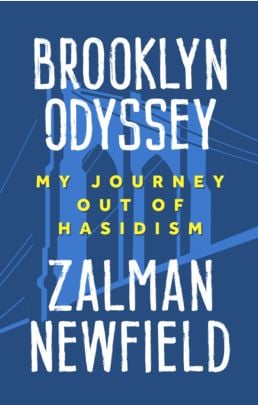
In his new book, Brooklyn Odyssey: My Journey out of Hasidism, Zalman Newfield (associate professor of sociology and Jewish Studies at Hunter College) writes from the vantage point of a teenager who could not find his place in Orthodox Judaism.
His previous book Degrees of Separation: Identity Formation While Leaving Ultra-Orthodox Judaism, while not a parenting book, there is a lot, in fact, that parents can learn from it. There, Newfield interviewed 74 former members of the Lubavitch and Satmar communities who left their communities and observance (he terms it exiting) to understand why and how they left, and the nature of their transition.
In Brooklyn Odyssey, he tells his story of his life growing up in the Chabad stronghold of Crown Heights. While Chabad is known for its openness and welcoming of all Jews, Newfield felt stifled in such an environment.
The problem many teens face is that the box of Orthodoxy is often quite rigid. For those who want to think or be out of the box, they may find themselves castigated. That is the situation Newfield found himself in.
An avid reader of secular literature, he wanted to understand the world more than was available in the sacred Lubavitch texts. Often having to do so serendipitously and often being caught doing so, Newfield found himself in an environment that didn’t meet his spiritual needs.
While raised in a cloistered and confirming environment, as a Chabad shliach (emissary), he traveled around the world, including going to China, Russia, Ghana, and other locations, doing outreach to bring Jews closer.
In a way, he was Schrödinger’s shliach, both bringing those closer to Judaism, while simultaneously distancing himself.
One particularly chilling line in the book is when he writes about his sister’s high school experience, “the lackluster English curriculum taught by bored and clueless teachers seems designed to keep the students uninterested”. He didn’t suffer that as he did not receive any secular education.
As to how to raise children, King Solomon said about 3,500 years ago, in 5 Hebrew words in Proverbs 22:6: “Train children in the way they each ought to go.” Newfield wanted to go in many ways, all of them ostensibly acceptable according to Hslacha, including wanting to go to Touro University, yet was stifled in that regard.
He also writes of parental wrangling and notes, “Why couldn’t Mommy understand that I had changed. That I was not the same naïve boy she had sent off to yeshivas across America and around the world. I’d grown up. I needed different things now.”
Newfield is a sensitive individual who couldn’t find his way in the world he was brought up in. He writes of being left in tears when hearing the masses scream the messianic Yechi to their dead leader, Rabbi Menachem Mendel Schneerson (who died when Newfield was 11), which he felt was an affront to his memory, and also when accused of trying to take the easy way out by a family rabbinic mentor.
The term “off the derech” means “off the path”, describing someone who has left a religiously observant, traditional lifestyle to live a secular life. The problem is that the term derech implies there is but one path. The reality is that there are many paths, and the role of parents and educators is to know that.
Perhaps one of the best books on Jewish outreach is the one by someone who left. But did Newfield really leave? The book opens with a picture of him, his Jewish wife, and his two daughters, both named Jewishly, at his daughter’s bat mitzvah.
Many memoirs of those who leave Orthodoxy are angry tirades full of blame and condemnation. Brooklyn Odyssey is a rare OTD memoir written with personal insights and sensitivity. While this insightful book is titled Brooklyn Odyssey, perhaps a more appropriate one would be: Newfield on Proverbs 22:6.
I’m a senior information security and risk management professional, based in New York City.
I speak at industry conferences, and write on information security, social media, privacy and technology.
My book reviews are on information security, privacy, technology, and risk management. My reviews for the Times of Israel focus on Judaism, Talmud, religion and philosophy.