
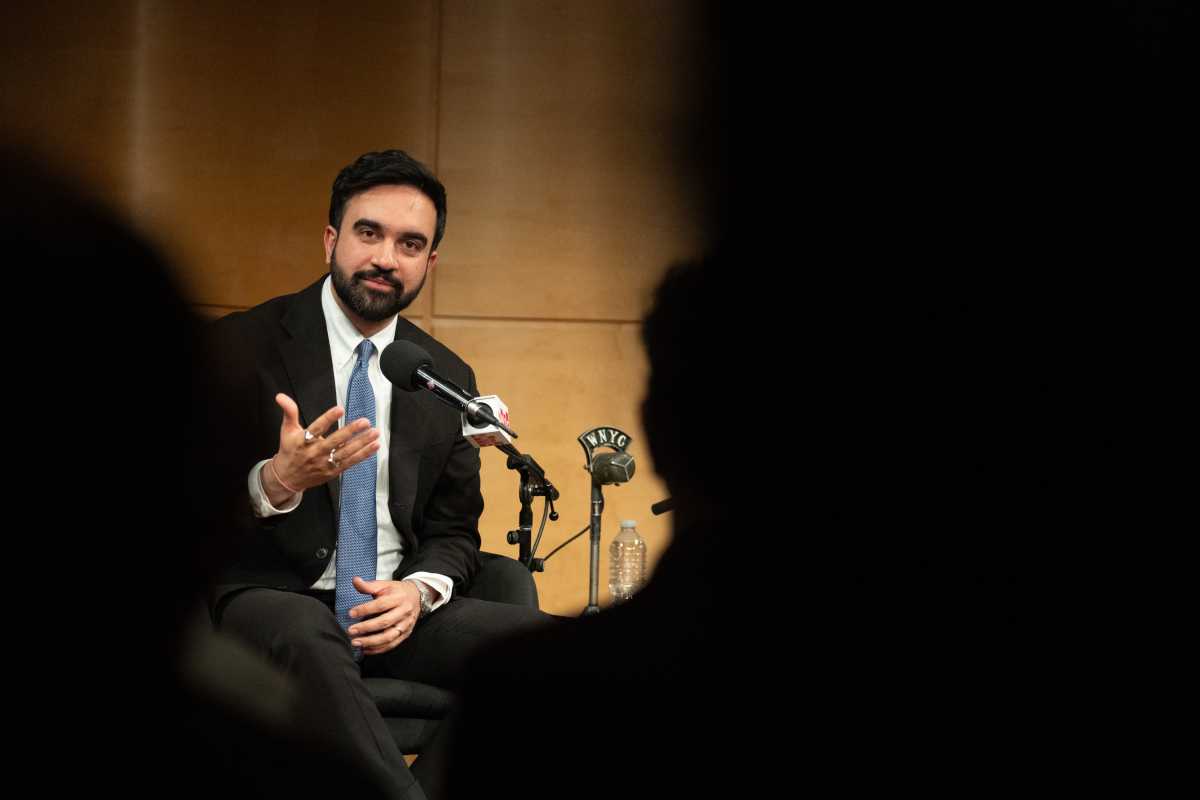
The mayor formally rejected Intro. 175-B, which would require the NYPD to establish protest buffer zones at educational facilities across the city. Mamdani explained his belief that the legislative language too broadly defined an educational institution and would result in “constitutional concerns … regarding New Yorkers’ fundamental right to protest.”
“As the bill is written, everywhere from universities to museums to teaching hospitals could face restrictions,” Mamdani said in his April 24 announcement, pointing out that the provisions of Intro. 175-B, were it enacted, would “impact workers protesting ICE, or college students demanding their school divest from fossil fuels or demonstrating in support of Palestinian rights.”
Mamdani ‘allows’ house of worship buffer zone bill to be law
The other protest buffer zone bill, Intro. 1-B, would establish protective measures near houses of worship. Mamdani said he would “allow it to become law,” but did not indicate that he would put his signature to it. Under the city charter, legislation sent to the mayor’s desk may become law within 30 days if the mayor neither signs nor vetoes it.
Regarding Intro. 1-B, Hizzoner said the final version of the bill “is narrower in scope and effect” and “requires the NYPD to document its existing practices related to protests near houses of worship.”
“That said, I disagree with its framing of all protest as a security concern,” Mamdani added.
Both bills, sponsored by City Council Speaker Julie Menin, were born out of two high-profile demonstrations outside Manhattan and Queens synagogues in recent months, which saw pro-Palestinian protesters using inflammatory language, including in one instance open support for the terrorist group Hamas.
In December 2025, outgoing Mayor Eric Adams signed an executive order directing the NYPD to establish buffer zones for protests near houses of worship. Upon taking office, however, Mayor Mamdani signed an executive order wiping out Adams’ previous directive, among others.
Menin’s bills echoed much of the language of the previously excised Adams order, but with changes to protect constitutional rights. The full Council passed both bills on March 26, with Intro. 1-B approved with a veto-proof majority. However, Intro. 175-B passed with just 30 votes, six short of the two-thirds majority required to overturn a mayoral veto.
It’s unclear, at this time, whether the Council will move to override Mamdani’s veto of Intro. 175-B. A source with knowledge of the City Council told amNewYork that Menin will be discussing “next steps” with her colleagues.
Reacting to the veto of Intro. 175-B, Menin reasserted her belief that the bill protected constitutional rights and should not have been “controversial.”
“Ensuring students can enter and exit their schools without fear of harassment or intimidation should not be controversial,” Menin said in a statement. “This bill simply requires the NYPD to clearly outline how it will ensure safe access when there are threats of obstruction or physical injury, while fully protecting First Amendment rights.”
Mamdani’s veto drew fierce backlash from Rabbi Marc Schneier, president of the Foundation for Ethnic Understanding and senior founding rabbi of The Hampton Synagogue. He recalled pitching the idea for Intro. 175-B. to Mamdani in a personal phone call in an effort to protect students from campus protests. Mamdani told him that he “loved the idea.”
“What have we done to ourselves? A mayor who is redefining antisemitism, days before Jewish Heritage Month, and most certainly will boycott the Celebrate Israel Parade. Now, during a period of mourning—the Omer—the mayor of the largest Jewish city in the world outside of Israel is slapping us in the face,” Schneier said. “Who will protect Jewish students on campuses, being attacked by vicious antisemitic protesters day in and day out? I, along with the entire Jewish community, demand to know what the mayor plans to do to protect students who simply want to walk around their campuses.”
Donna Lieberman, executive director of the New York Civil Liberties Union, applauded Mamdani’s veto of Intro. 175-B, suggesting that if enacted, it would have endangered the public’s right to express themselves, “and make it more likely that going to school, a library, or even a hospital leads to an encounter with police.”
“At a time when New Yorkers are taking to the streets in historic numbers to defend our hard-won freedoms and resist the Trump regime – as we must – the City should be looking to support, not stifle, our right to speak out,” Lieberman said. “We’re glad the Mayor takes free speech seriously and honors our city’s long legacy of activism.”
As the Council considers whether it has the votes to override Mamdani’s veto, the issue is also surfacing in the closely watched District 3 special election, which is on Tuesday, April 28. Lindsey Boylan, who is backed by Mamdani, said she would “vote down any attempts at overriding the veto of this bill.”
“At a time when fascism is at our doors, we must do all we can to safeguard our sacred First Amendment right to protest,” Boylan wrote on X.
Layla Law-Gisiko also thanked the mayor for his veto on social media, and her campaign confirmed to amNewYork that she, too, would oppose an override if elected.
Carl Wilson, who is endorsed by Council Speaker Julie Menin, would support an override, his campaign said.
Updated on April 24 at 2:30 p.m.