
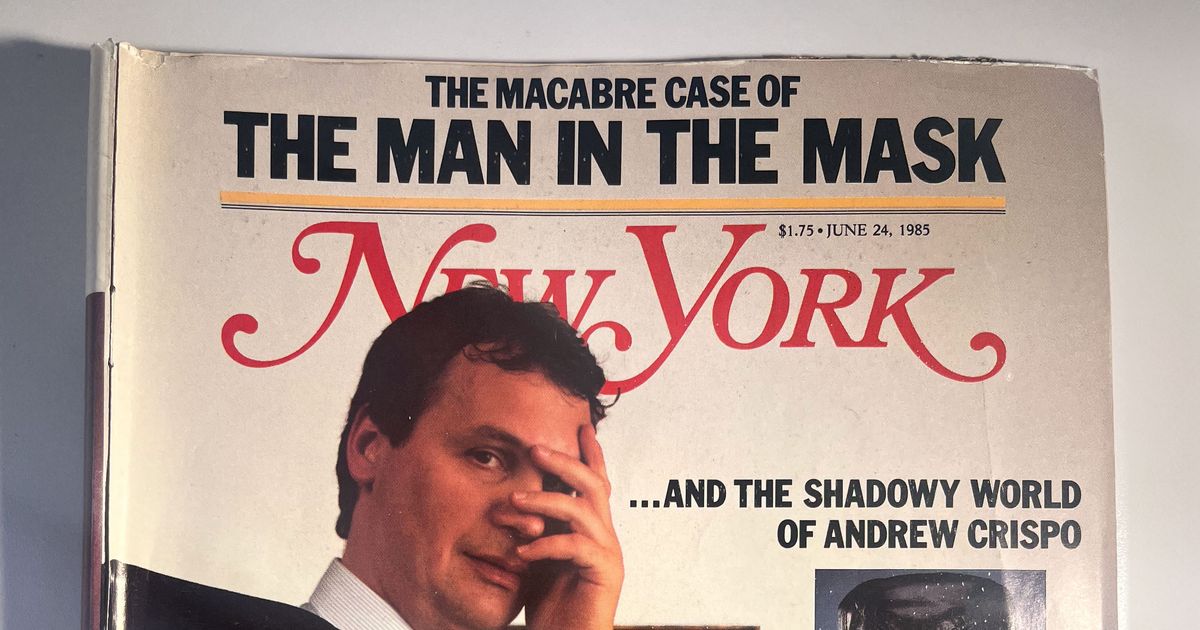
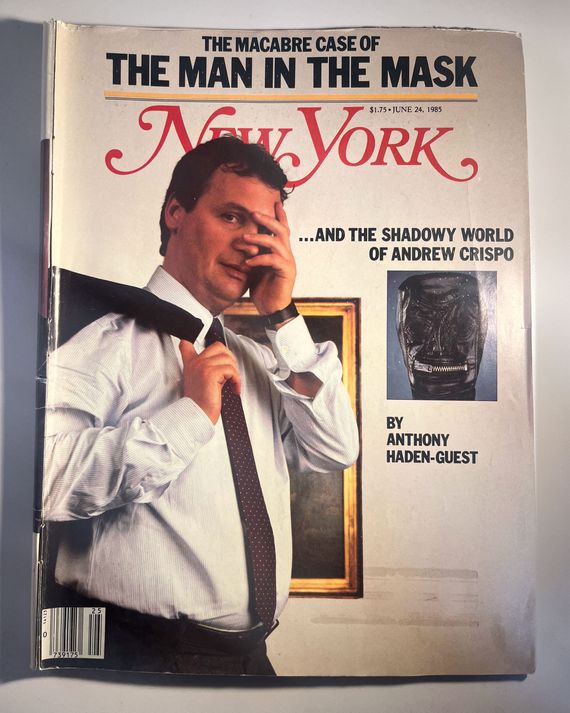
Editor’s note: This story first appeared in the issue of New York dated June 24, 1985. We’re republishing it today to accompany our follow-up story about the Crispo case by Rachel Corbett, which you can read here.
The LeGeros estate is in Tomkins Cove, Rockland County, a domesticated terrain with nostalgic hints of upstate New York wilderness. The grassy lawn alongside the house runs into woodland, and the eastern boundary is a cliff that drops steeply to the Hudson. Strictly speaking, the five youths hiking through the grounds on March 17 were trespassing, but it was a holiday — St. Patrick’s Day — and they were keen to see those pre-Revolutionary traces that give the place a local reputation. These include the former site of a hotel — one guest, supposedly, was George Washington — and a small stone smokehouse.
The smokehouse was where they found the carcass. It was lying beneath a charred door and had been stripped by voracious raccoons. (David LeGeros, who had been asked to look into the smokehouse by his elder brother, Bernard, had earlier described the remains to him as those of a large animal, a Great Dane, perhaps, or a deer.) The hikers inquisitively shifted the door, and what they saw was grisly. It was a human corpse wearing a black leather mask.
My Lost Art World
The police verified from dental records that the body was that of Eigil Vesti, a 26-year-old Norwegian whose disappearance had been reported three weeks before. A few days later, 22-year-old Bernard LeGeros was arrested on the basis of various tips and his own persistent calls to the police.
After his arrest, LeGeros said that it was he who had fired the two rifle shots that had ended Vesti’s life, but that his employer, Andrew Crispo, a 40-year-old art dealer, had been the actual architect of the act. Bernard LeGeros is now in the Rockland County jail, charged with second-degree murder. He has pleaded insanity. He is also facing charges in an unrelated case brought by a student who claims he was kidnapped and sodomized last September. Crispo, who has also been charged in this case, surrendered his passport and was released after posting $100,000 bail.
Though Crispo is being investigated in the Vesti case, he has not been indicted. Rumors wafting through Manhattan suggest he is being protected by powerful persons. This is not the case. The rules of evidence do not allow the statement of one participant in a crime to be used as sole evidence for conviction of another. Kenneth Gribetz, the Rockland County district attorney, will have to come up with a more solid case if he is to indict Crispo.
The rumors about “protection” are not the only exotica that have attached themselves to this case. Tales about everything from snuff films to networks of necrophiliacs, anonymous smears of various prominent homosexuals, and even a threatening telephone call poured in as I pieced together the strange, sad story of Andrew Crispo.
_
The Andrew Crispo Gallery sits in the Fuller Building at 41 East 57th Street — “the crossroads of the art world,” in Crispo’s jaunty phrase — and it’s a handsome place, with chastely seductive walls, flattering to art. This afternoon, though, it had a vaguely sepulchral air, unlit, with artworks stacked higgledy-piggledy against the walls. Andrew Crispo was picking his way through with an aggrieved look. “This is only my third time back here since this whole thing happened,” he said.
Some paintings were still hanging on a far wall, part of the exhibition he was installing the day the police came. It was to have included 19 Picasso plates, and it had a theme. “Oddly enough,” Crispo said, “the theme was masks.”
This was our first meeting. The art dealer looked conservatively sportif (blue blazer, tan slacks, white shirt, sober tie), while his demeanor was an odd balance of high tension and aplomb. He has a powerful neck and shoulders, a soft, recently acquired belly, and an engaging smile, a bit belied by the beads of sweat on his sallow forehead, the darkly darting eyes, the fingers foraging in the pack of Benson & Hedges.
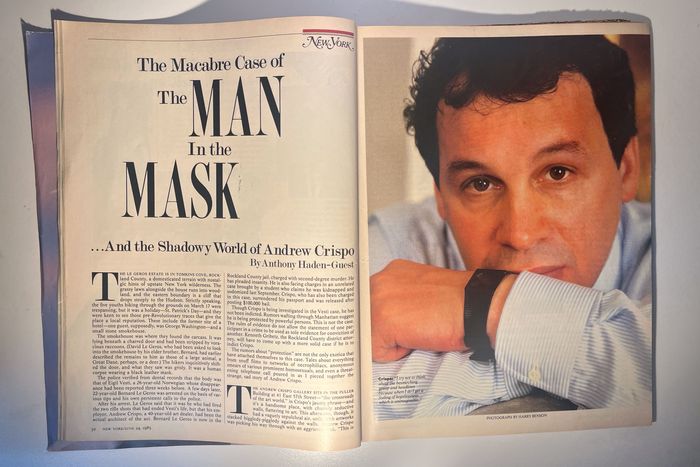
Photo: New York Magazine
We sat in a crimson-walled inner office, with shelves of art books and a clutter of art pieces and memorabilia, including what Crispo told me was “the first sculpture Georgia O’Keeffe ever made” (“She gave it to me. The Rockland D.A.’s investigators broke it”): a ball cock taken from a bathroom cistern, “because I like the shape”; a black, horned African fetish; delicate Japanese trays; and a tiny Raggedy Ann doll (which Crispo calls Little Orphan Annie) beside a furry clockwork monkey, which takes him straight back to the Philadelphia orphanage where he was deposited at birth, 40 years ago.
This was St. John’s. The monkey evokes the sleety day the orphans had been taken to a department store for Christmas. They had sat in Santa’s lap and chosen presents. The next day, the nuns had lined the boys up — “it was like a military school” — to inspect the goodies. Most of the boys had piles of stuff. Crispo, who was “8 or 9,” had only a furry monkey. A nun called, “Will Andrew Crispo step out?” He did so, and became the subject of a lecture. “I was an example of ‘non-greed,’” he said, and doubled up a fist. “Boy! Didn’t they all give it to me afterwards.”
Crispo had foster parents for a short time, but it didn’t work out. He stayed within the state system until his middle teens, when he got a job as a clerk with Judge Adrian Bonnelly, whom Crispo calls his “white-haired angel.” It was Judge Bonnelly who told the young man that Crispo’s father was a man of French descent, that the name Crispo came from his Italian grandmother, and that his mother, who had been 16 when he was conceived, was now married with three children.
“Do you want to meet your mother?” Bonnelly had asked him. “I told him I wanted to think about it,” Crispo said. “That was the only sleepless night I have ever had.” His answer was no. One reason was “I didn’t feel like knocking on my mother’s door.” The second was that he “felt very independent. I had the wonderful feeling of being me.”
The past was the past. Crispo, a closed-off youth (who was, in later years, contemptuous of psychiatrists), focused strictly on the future. In 1963, on the day after he chose not to meet his mother, he met someone who was to play a part in his future — Arthur Smith, a coolly handsome young man three years older. Smith, the son of an engineer in Auburn, Georgia, worked in Manhattan for Edward Garrett, a highly regarded dealer in antique furniture. They took a liking to each other, and Smith suggested Crispo room with him in New York. Crispo, who had not been drafted (“I told them I was gay”), moved in five months later. “I really didn’t want to live in Philadelphia anymore,” he said. “There was nothing I could invent or create.” He and Smith have been sharing quarters for 21 years.
_
Crispo arrived with no job but with ebullient confidence. “I walked down Fifth Avenue, because that was where all the stores were,” he said. “I got a job in Georg Jensen the very first day.” Jensen’s, the modern-design shop, hired Crispo as a stock boy. Soon, he was helping dress windows and fix table settings. One day, he helped an elderly man (“He reminded me of Judge Bonnelly”) buy a blue-and-white cup and saucer.
Some time later, he was walking from Jensen’s, which was at 53rd and Fifth, to meet Arthur Smith at Garrett’s, which was at 57th and Lexington, when his attention was caught by something in a second-floor window: a painting of a clown in a top hat. “I walked upstairs,” Crispo said. “I had never been in an art gallery before. And there was this same white-haired man.”
Crispo introduced himself to the man, art dealer Maynard Walker, and asked about the clown, which was by the American painter Walt Kuhn. “I called him Walter Kuhn,” Crispo said. “So Walker said, ‘Out!’ I said, ‘What?’ He said, ‘It’s Walt. Out! But come back tomorrow.’”
A youth adrift, with a history of suicide attempts, LeGeros was fond of such utterances as “I come into the room like death.”
Crispo began visiting the gallery often. “Every time I went, there was this one drawing sitting on the mantel,” he said. “I asked, ‘Who did that?’ He said, ‘Robert Henri. Do you like it?’ I said yes. He said, ‘Its price is $350, but I will let you have it for half!’ I said, ‘I can’t afford that.’ ‘You can pay me $10 a week.’”
So it began. Another beginning was a job at Edward Garrett, where Crispo replaced Arthur Smith, who had joined the decorator Billy Baldwin. “Andrew is much better at selling than I ever was,” Smith said. Indeed, yes. One day, Maynard Walker told Crispo, “I have a gift for you. But there are conditions.” The gift was Trees, an oil painting, also by Robert Henri, and the conditions were that Crispo could keep the painting, but if he chose to sell it, he would have to use the money to buy more art from Walker. “I told him I liked it, but not that much,” Crispo said. “And I sold it for $1,500 the very next day. He was quite taken aback. He sold me a number of items. I sold most of them. Some I couldn’t part with.”
Crispo was thus launched on the lowest rung of dealership — running, or schlepping, which is buying works inexpensively from one gallery and selling them at a small markup to another. It is a fine enough way to develop an eclectic eye and to accumulate information, and Crispo’s appetite for information was boundless. He had taken his first trip to Europe — Munich, Barcelona, and Rome — when he was 18, and, on later trips with Arthur Smith, he went to England, France, and Russia. “Andrew was crazy about the Kremlin and the Pushkin museum,” Smith said. “We looked at Victorian furniture. We looked at houses, art. Everything.”
Andrew Crispo’s ambition and his desire for artworks were also growing. He spent $9,000 on a Louis XVI desk from Edward Garrett, who told Crispo that he was moving his business to Palm Beach and offered to take him there. Crispo pondered the offer but rejected it. “I decided to go into dealing full-time,” he said. Then, at the urging of George Perret, who worked at the ACA Galleries and who had dealt with the forceful young man on various occasions, he was hired by ACA’s owner, Sidney Bergen. “He had a very good eye,” Bergen said. “He was very charming, he knew how to treat customers. He was a happy-go-lucky kind of kid. A bit nuts, of course. But who isn’t — in the art world?”
Others in the art world felt less warm. “He would come over and buy four or five little drawings,” said a Paris dealer. “He would spend $2,000 and maybe make $2,000 on the trip. But nobody liked him. Then, suddenly, he opened this huge gallery. To everybody’s amazement.”
The amazement was, indeed, widespread. “When Andrew told me he was opening his own gallery, I told him, ‘You’re out of your bloody mind,’ said Perret, a courtly man who was once an actor. But Crispo was nothing if not persuasive. Perret joined him as a public-relations man and as an organizer of exhibitions, the first of which opened in May 1973, five months after Crispo had bought the place on East 57th. It included a Magritte bronze; sculpture from New Guinea, the Hellenistic world, and ancient Egypt; and a piece by Nancy Grossman that shows a human form masked and bound in leather. The theme of the show, and its title, was “The Torso.”
_
Andrew Crispo’s rise from schlepper to assistant to owner of an impressive space had been rapid, and shadowy rumors clung to it from the beginning. “We never knew where the money came from,” said Peter Brown, once a manager of the Beatles, and a close friend of
Crispo’s in those days. “We used to tease him by calling him Funny Money, which he was amused by. He loved the mystery of us not knowing.”
The truth was less exotic. Josephine Gershman (now remarried but at the time a well-to-do widow of a real-estate man, and a collector who had met Crispo before his ACA days) had approached Crispo and offered to fund the gallery with $250,000. She actually came up with $60,000, but this was adequate seed money.
“Our only competition for the space was a massage parlor and the OTB,” Crispo said. Not that he would have communicated such stuff to Peter Brown. Crispo’s mystery-mongering and his glee at the speculation that the gallery was a front for money laundering were already characteristic.
The first show to attract really widespread attention was “Pioneers of American Abstraction.” Among loan pieces on view was a watercolor by Charles Demuth that had recently been acquired by the Baron Heinrich (Heini) von Thyssen-Bornemisza. Crispo said he had misspelled the name, and this was brought to his attention by a middle-aged foreigner in the gallery.
How did the man know? “Because I am Baron Thyssen,” he replied, according to Crispo, who does a Teutonic accent rather well. “He bought several paintings,” Crispo said. “My rapport with the baron was immediate.” Other sources suggest that, on this first visit to the Crispo gallery, Baron Thyssen was actually taken care of by Crispo’s longtime friend and business associate, a slight, dark-haired man called Ronnie Caran.
At any rate, a most fortunate connection had been made. Baron Heini von Thyssen, now 64, has holdings in steel, armaments, and much else, which makes him — depending upon whether you believe him or his ex-wife, Denise — worth either several hundred million or $1.2 billion. The fortune was founded by his grandfather, a steel magnate, and built up by his father; the title comes from his Hungarian mother. Heini Thyssen, a genial, soft-spoken man, lives mostly in Lugano, Switzerland, sometimes in England, and, more relevantly, has built up a collection of works by old and modern masters that is second, as private collections go, only to that of the queen of England.
The Demuth he had bought earlier and the four paintings that he now got from the Andrew Crispo Gallery were the beginnings of another surge by this exuberant collector. Thyssen had decided to bulk up a collection of early-American modernists, and Crispo was right there on the curling wave. Emboldened, Crispo decided to rent the space just upstairs on the third floor, formerly an office for the New York Jets. “Andrew told me he wanted to knock a spiral staircase through,” said D. Thomas Bergen, a financial adviser to artists and galleries. “He asked my advice. I strongly advised against expanding.” Crispo did it anyway.
A complication now arose. Baron Thyssen had a private dealer in Europe. This dealer, a dashing Italian named Franco Reppetti, was having a far-from-private alliance with Denise, the baron’s fourth wife. The baron, who not only loved his wife but was unwilling to contemplate the trauma of a fourth divorce, still allowed Denise veto power over many of his picture purchases. This meant that European dealers found themselves having to cut in Franco Reppetti.
As soon as Reppetti realized that millions of dollars that would formerly have been sunk into European art were being put into American works, he flew to Manhattan. “I admired his honesty,” Crispo said. “He came and said, ‘Andrew, you want to sell pictures to the baron? You pay me a commission.’ I said, ‘Franco, forget it! I’m not interested.’ And for one year, the baron didn’t buy a thing from me.”
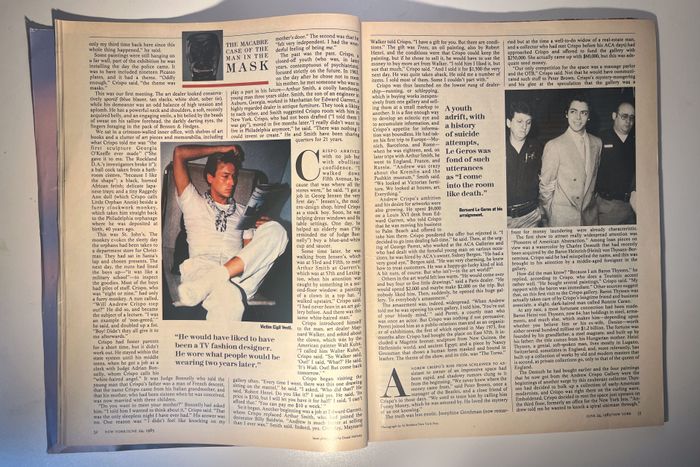
Photo: New York Magazine
But Reppetti’s hold on Baroness Thyssen was already weakening, and, for him, things ended poorly. In June 1977, she was in Manhattan, supposedly holed up at the Waldorf, and Reppetti came to the city to get her back. Rebuffed, he moved into a friend’s apartment in the Meurice on West 58th. He arrived one day with a small suitcase and some very pure cocaine.
Reppetti’s fatal dive took place some hours later. He was found sprawled over the roof of a Volkswagen van in his underpants. The small window through which he had plunged had been opened with such force that it remained stuck. None of his acquaintances believe Reppetti jumped. “Franco would never be seen in public in his underwear like that,” declared a young Italian noblewoman who lived in the Meurice at that time. “He was so fastidious.”
The body was identified by Diane von Furstenberg; the cause of death was listed as suicide. Heini Thyssen arrived in New York and arranged for the corpse to be flown back to Italy. Andrew Crispo took care of the details. Because Thyssen had bought such a huge casket for Reppetti, Crispo said, he found that a special plane would be necessary. It would cost $150,000. “Isn’t that a bit expensive?” he asked Thyssen. He said that the baron, contemplating all those commissions he had given Reppetti, said, “Believe me, it’s a bargain.”
_
Andrew Crispo was now Baron Thyssen’s main man, and the volume of business he began to do was prodigious. “In just one month [Thyssen] spent $3 million,” Crispo said. Most of the paintings would come from other dealers, but they would always be routed through Crispo, whose minimum take would be 10 percent, though with judicious markups, this could rise much higher.
The nature of Andrew Crispo’s relationship with Baron Thyssen has been the source of unending dark speculation, especially among rival dealers frustrated at shelling out commissions. Specifically, it is said that Baron Thyssen, four marriages or no, shared interests other than art with Crispo. These rumors are baseless.
The reality is more mundane. “Crispo is an intelligent man. He can be amusing,” said an Establishment dealer, and a Crispo foe. “But above all, he had the time to devote to Thyssen. Crispo’s and his assistants would go to London, or to Lugano. They were arranging for his cars to go to the airport, things like that. This is something that the really wealthy are subject to. They travel, they have no fixed focus. Crispo and his assistants were running around being Thyssen’s kind of … little gnomes.”
Crispo was also now increasing his leverage and his risk by buying major paintings, assuming that he could resell them to the baron. A Jackson Pollock, for instance. “It was a Pollock nobody wanted, because there had been a different painting with the same title in the catalogue,” Crispo said. “Everybody thought it was a fake. But I looked at it. It was silver and black, with a magical red dot. It had to be a Pollock.”
He researched and found a photograph: Jackson Pollock standing beside this very canvas. “I paid $70,000 for it. The baron paid me close to $100,000. I sold him the Pollock and a Holbein rondelle within the same minute. I am not ashamed of any picture I have ever sold the baron.”
An event in 1979 cemented the relationship. Crispo had been approached by Roy Cohn, who would later become his lawyer, about an arts complex in Perth, Australia, that had run into problems putting together an inaugural show. “I telephoned Heini,” Crispo remembered. “I asked, ‘Do you have any business interests in Australia?’
“‘Well, yes, I have a sheep farming … shipbuilding … some businesses.’
“‘Why don’t you lend some paintings, Heini?’”
So Thyssen, who had been building up his modern collection fairly unobtrusively, went public. “He said, ‘Pick what you want’ — he gave me a free hand,” Crispo said. “The show went on tour. The baron chartered a Lear. It was wonderful.”
It is easy, in hindsight, to say that the Thyssen connection was at once a blessing and a curse. Andrew Crispo was both thin-skinned and cocky, spendthrift and niggardly, and these contradictions were exacerbated by his position of strength. “He was rude to museums,” said a former associate. “He would alienate possible clients.” Also, even in this wily world, Crispo had a slightly gamy reputation. One vendor of old masters claims that Crispo proposed they join in a “ring” operation, essentially an agreement among dealers to keep down prices at an auction (Crispo denies this, saying, “All of the fun is buying and selling”). He was not proposed for membership in the clubby Art Dealers Association. “We always found him a bit … off,” an Establishment figure said.
But Crispo appeared to revel in this. “He was a consummate wheeler-dealer,” a past associate said. George Perret said there were dreams of luring de Kooning to the gallery. Instead, Crispo brought in Lowell Nesbitt, an artist popular with the public.
But mostly, there were the deals for the baron. At one stage, the eclectic dealer even held some of the baron’s gems, including the Star of Peace, the 11th-largest diamond in the world. Crispo says the baron intended to plow the money into art. The problem was that Crispo was not buying pieces outright, but making down payments. His complex finances involved dealings with several banks, including the Bank of New York, and arrangements with art-financing specialists such as Gideon Strauss at Rosenthal & Rosenthal and Martin Ackerman at Sovereign American Arts. “I would hedge the money coming in by going out and making commitments to purchase,” said Crispo. “I guess you could say I got ahead of myself. It got to be what you could call margin buying.” “Andrew thought the Thyssen thing would go on and on forever,” an associate said. “He thought he was Baron Thyssen.” The orphan commended for “non-greed” wanted everything good and fine he could lay his hands on.
_
Andrew Crispo’s private life was appropriately stylish. He bought a house on Gin Lane, in Southampton, where his immediate neighbors include Gloria Vanderbilt, Alfred Taubman, and Roy Lichtenstein. But his life remained intensely private. By his own wish, he met few of his neighbors, not even Lichtenstein, although he sold Steve Martin a Lichtenstein and the Franz Kline in front of which the actor was shown cavorting on a cover of Rolling Stone. His house (“I stole the name from Cole Porter”) is called No Trespassing.
In part, this secrecy seems to have grown because Crispo’s social mores were also changing. When he came to Manhattan, Crispo had been fairly guarded about his homosexuality. “He had a very Upper East Side mentality,” said photographer Christopher Makos, who exhibited at the gallery in 1979.
Privately, Andrew Crispo had always loved games. “He had a mischievous mind — I’m sure it was only mischievous then — and he used to love to play tricks on people,” said a friend who shared a Southampton beach house with Crispo in 1973. “Everything had to be a game — I mean, if something was simple, then it was dismissed.” Sometimes the youthful-looking art
dealer would hitchhike, pretending to be a college kid. That sort of thing. “Andrew could border on the naughty,” the friend added. “But I never saw any wickedness in it.”
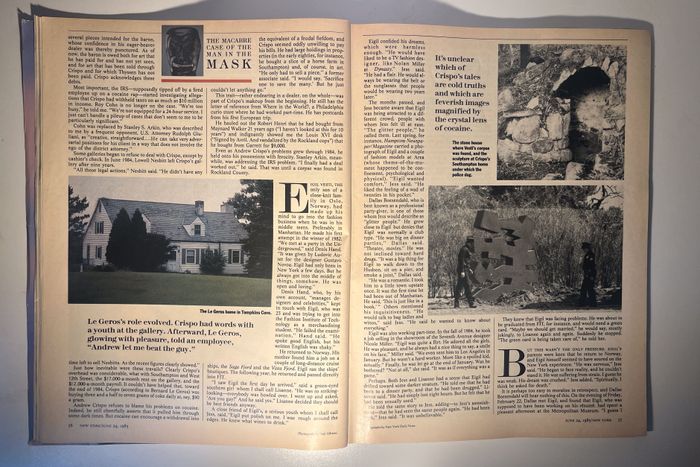
Photo: New York Magazine
But as the ’70s slid into the ’80s, Crispo became more tense. “When I first met Andrew, he didn’t even smoke,” an artist said. “Soon, he was drinking pretty heavily.” Also, he had never enjoyed cocaine, but one summer in the early ’80s, he began to use it with a couple of youthful assistants. “It wasn’t a habit. It was a dependency,” he said. “It used to make me feel good. I always kept too much inside me. It made me talk. It made me open up to people.”
But cocaine, chronically used, is, of course, a personality-altering substance, as is heroin, except that where heroin induces a vegetable calm, cocaine brings out a febrile animalism. Sensitivity can slide into paranoia, while overconfidence — another trait not exactly foreign to Andrew Crispo — can balloon into a reckless sense of invulnerability.
Certainly, Andrew Crispo was subject to ups and downs. Lowell Nesbitt and other artists used the word “mercurial.” “He is hot and cold,” said a former assistant, Susan Slack. “He could blow up at you one moment. The next, it was over.”
Also, his private mind games were moving a bit beyond the mischievous. In one, he would appeal to the compassion of a would-be lover — the straighter-seeming the better — by pretending to be a straight whose young wife had taken her own life and that of a baby daughter because she had believed him dead in a plane crash. Crispo would claim he had been unable to get it together with a woman since. (Crispo denies this. “It’s not my style,” he said.)
Crispo and Arthur Smith left the Upper East Side in the summer of 1982. They took up residence (though now, essentially, in separate quarters) in a penthouse next to a printing-ink factory on West 12th Street and the river. The neighborhood includes nightspots of no specific sexual orientation, like the Roxy; bars for admirers of leatherwear, like the Spike; and hard-core establishments such as the Mineshaft and the Hellfire club.
It is not surprising that Andrew Crispo’s grasp of his business affairs was beginning to falter. Creditors claim they were finding it more and more difficult to collect even small sums. Several years ago, for instance, the Parrish Museum in Southampton printed a catalogue reproducing in color several paintings lent by Crispo’s gallery, and was not paid by Crispo for months. His Southampton house appeared so unkempt that summer that a neighbor, thinking the owner had fallen on hard times, considered putting in a bid. Crispo said he refused such a bid.
Andrew Crispo began to get increasingly entangled in lawsuits with other dealers. He sued and was sued back. He was sued by Christie’s. He sued Martin Ackerman over the ownership of a number of paintings. (Ackerman said this case has been dismissed. Crispo says it’s being appealed.)
Early in 1984, the Bank of New York, claiming that Crispo owed it $700,000, enforced a lien on nine paintings. The bank got its money, the liens were lifted, but Crispo was holding several pieces intended for the baron, whose confidence in his eager-beaver dealer was thereby punctured. As of now, the baron is owed both for art that he has paid for and has not yet seen, and for art that has been sold through Crispo and for which Thyssen has not been paid. Crispo acknowledges these debts.
Most important, the IRS — supposedly tipped off by a fired employee up on a cocaine rap — started investigating allegations that Crispo had withheld taxes on as much as $10 million in income. Roy Cohn is no longer on the case. “We’re too busy,” he told me. “We’re not equipped for a 24-hour service. I just can’t handle a pileup of cases that don’t seem to me to be particularly significant.”
Cohn was replaced by Stanley S. Arkin, who was described to me by a frequent opponent, U.S. Attorney Rudolph Giuliani, as “creative, straightforward … He can take very adversarial positions for his client in a way that does not involve the ego of the district attorney.”
Some galleries began to refuse to deal with Crispo, except by cashier’s check. In June 1984, Lowell Nesbitt left Crispo’s gallery after nine years.
“All those legal actions,” Nesbitt said. “He didn’t have any time left to sell Nesbitts. As the recent figures clearly showed.”
Just how inevitable were these travails? Clearly Crispo’s overhead was considerable, what with Southampton and West 12th Street, the $17,000-a-month rent on the gallery, and the $12,000-a-month payroll. It couldn’t have helped that, toward the end of 1984, Crispo (according to Bernard LeGeros) was buying three and a half to seven grams of coke daily at, say, $90 a gram.
Andrew Crispo refuses to blame his problems on cocaine. Indeed, he still cheerfully asserts that it pulled him through some dark times. But cocaine can encourage a withdrawal into the equivalent of a feudal fiefdom, and Crispo seemed oddly unwilling to pay his bills. He had large holdings in properties (in the early ’80s, for instance, he bought a slice of a horse farm in Southampton) and, of course, in art. “He only had to sell a piece,” a former associate said. “I would say, ‘Sacrifice one to save the many.’ But he just couldn’t let anything go.”
This trait — rather endearing in a dealer, on the whole — was part of Crispo’s makeup from the beginning. He still has the letter of reference from Where in the World?, a Philadelphia curio store where he had worked part-time. He has postcards from his first European trip.
He hauled out the Robert Henri that he had bought from Maynard Walker 21 years ago (“I haven’t looked at this for ten years”) and indignantly showed me the Louis XVI desk (“Signed by Avril. And vandalized by the Rockland cops”) that he bought from Garrett for $9,000.
Even as Andrew Crispo’s problems grew through 1984, he held onto his possessions with ferocity. Stanley Arkin, meanwhile, was addressing the IRS problem. “I finally had a deal worked out,” he said. That was until a corpse was found in Rockland County.
_
Eigil Vesti, the only son of a close-knit family in Oslo, Norway, had made up his mind to go into the fashion business when he was in his middle teens. Preferably in Manhattan. He made his first attempt in the winter of 1982. “We met at a party in the Underground,” said Denis Hand. “It was given by Ludovic Autet for the designer Gustav Novoa. Eigil had only been in New York a few days. But he always got into the middle of things, somehow. He was open and loving.”
Denis Hand, who, by his own account, “manages designers and celebrities,” kept in touch with Eigil, who was 23 and was trying to get into the Fashion Institute of Technology as a merchandising student. “He failed the examination,” Hand said. “He spoke good English, but his written English was shaky.”
He returned to Norway. His mother found him a job on a couple of long-distance cruise ships, the Saga Fjord and the Vista Fjord. Eigil ran the ships’ boutiques. The following year, he returned and passed directly into FIT.
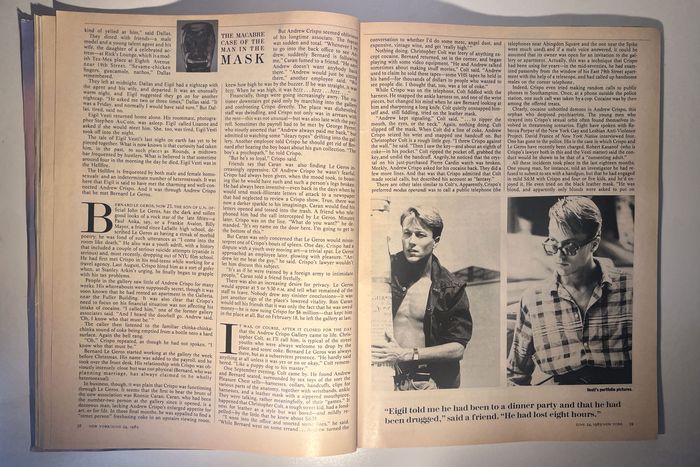
Photo: New York Magazine
“I saw Eigil the first day he arrived,” said a green-eyed southern girl whom I shall call Lisanne. “He was so striking-looking — everybody was bowled over. I went up and asked, ‘Are you gay?’ And he said yes.” Lisanne decided they should be best friends anyway.
A close friend of Eigil’s, a serious youth whom I shall call Jess, said, “Eigil put polish on me. I was rough around the edges. He knew what wines to drink.”
Eigil confided his dreams, which were harmless enough. “He would have liked to be a TV fashion designer, like Nolan Miller at Dynasty,” Jess said. “He had a flair. He would always be wearing the belt or the sunglasses that people would be wearing two years later.”
The months passed, and Jess became aware that Eigil was being attracted to a different crowd, people with whom Jess felt ill at ease. “The glitter people,” he called them. Last spring, for instance, Hamptons Newspaper/Magazine carried a photograph of Eigil and a couple of fashion models at Area (whose theme-of-the-moment happened to be confinement, psychological and
physical). “Eigil wanted comfort,” Jess said. “He liked the feeling of a wad of 20s in his pocket.”
Dallas Boesendahl, who is best known as a professional party-giver, is one of those whom Jess would describe as “glitter people.” He grew close to Eigil but denies that Eigil was normally a club type. “He was big on dinner parties,” Dallas said. “Theater, movies.” He was not inclined toward hard drugs. “It was a big thing for Eigil to walk down to the Hudson, sit on a pier, and smoke a joint,” Dallas said.
“He was a romantic. I took him to a little town upstate once. It was the first time he had been out of Manhattan. He said, ‘This is just like in a book.’” Others mentioned his inquisitiveness. “He would talk to bag ladies and winos,” said Jess. “He said he wanted to know about everything.”
Eigil was also working part-time. In the fall of 1984, he took a job selling in the showroom of the Seventh Avenue designer Nicole Miller. “Eigil was quite a flirt. He adored all the girls. He was pleasant, and he always had a nice thing to say, a smile on his face,” Miller said. “We even sent him to Los Angeles in January. But he wasn’t a hard worker. More like a spoiled kid, actually.” Finally, he was let go at the end of January. Was he bothered? “Not at all,” she said. “It was as if everything was a game.”
Perhaps. Both Jess and Lisanne had a sense that Eigil had drifted toward some darker stratum. “He told me that he had been to a dinner party, and that he had been drugged,” Lisanne said. “He had simply lost eight hours. But he felt that he had been sexually used.”
He told the same story to Jess, adding — to Jess’s astonishment — that he had seen the same people again. “He had been back,” Jess said. “It was unbelievable.”
They knew that Eigil was facing problems. He was about to be graduated from FIT, for instance, and would need a green card. “Maybe we should get married,” he would say, mostly jokingly, to Lisanne again and again. Suddenly he stopped. “The green card is being taken care of,” he told her.
_
But this wasn’t the only pressure. Eigil’s parents were keen that he return to Norway, and Eigil himself seemed to have soured on the New York experience. “He was nervous,” Jess said. “He began to face reality, and he couldn’t stand it. He was suffering from strain. I guess he was weak. His dream was crushed.” Jess added, “Spiritually, I think he asked for death.”
It is perhaps too easy to moralize in retrospect, and Dallas Boesendahl will hear nothing of this. On the evening of Friday, February 22, Dallas met Eigil, and found that Eigil, who was supposed to have been working on his résumé, had spent a pleasant afternoon at the Metropolitan Museum. “I guess I kind of yelled at him,” said Dallas.
They dined with friends — a male model and a young talent agent and his wife, the daughter of a celebrated actress — at Rick’s Lounge, which is a modish Tex-Mex place at Eighth Avenue near 19th Street. “Sesame-chicken fingers, guacamole, nachos,” Dallas remembered.
They left at midnight. Dallas and Eigil had a nightcap with the agent and his wife, and departed. It was an unusually warm night, and Eigil suggested they go on for another nightcap. “He asked me two or three times,” Dallas said. “It was a Friday, and normally I would have said sure.” But Dallas, tired, said no.
Eigil Vesti returned home alone. His roommate, photographer Stephen AuCoin, was asleep. Eigil called Lisanne and asked if she would meet him. She, too, was tired. Eigil Vesti took off into the night.
Eigil told me he had been to a dinner party and that he had been drugged,” said a friend. “He had lost eight hours.
The tale of Eigil Vesti’s last night on earth has yet to be pieced together. What is now known is that curiosity had taken him, in the past, to such places as Rounds, a midtown bar frequented by hustlers. What is believed is that sometime around four in the morning the day he died, Eigil Vesti was in the Hellfire.
The Hellfire is frequented by both male and female homosexuals and an indeterminate number of heterosexuals. It was here that Eigil is said to have met the charming and well-connected Andrew Crispo. And it was through Andrew Crispo that he met Bernard LeGeros.
_
Bernard LeGeros, now 23, the son of U.N. official John LeGeros, has the dark and sullen good looks of a rock star of the late ’50s — a Paul Anka, say, or a Frankie Avalon. Billy Mayer, a friend since LaSalle high school, described LeGeros as having a streak of morbid poetry; he was fond of such utterances as “I come into the room like death.” He also was a youth adrift, with a history that included a couple of serious suicide attempts (cyanide is serious) and, most recently, dropping out of NYU film school. He had first met Crispo in his mid-teens while working for a travel agency. Last August, Crispo hired him as a sort of gofer when, at Stanley Arkin’s urging, he finally began to grapple with his tax problems.
People in the gallery saw little of Andrew Crispo for many weeks. His whereabouts were supposedly secret, though it was soon known that he had rented an apartment in the Galleria, near the Fuller Building. It was also clear that Crispo’s need to focus on his financial situation was not affecting his intake of cocaine. “I called him,” one of the former gallery associates said. “And I heard the doorbell go. Andrew said, ‘Oh, I know who that must be.’”
The caller then listened to the familiar chinka-chinka-chinka sound of coke being emptied from a bottle onto a hard surface. Again the bell rang.
“Oh,” Crispo repeated, as though he had not spoken. “I know who that must be.”
Bernard LeGeros started working at the gallery the week before Christmas. His name was added to the payroll, and he took over the front desk. His relationship with Crispo was obviously intensely close but was not physical (Bernard, who was planning marriage, has always claimed to be wholly heterosexual).
In business, though, it was plain that Crispo was functioning through LeGeros. It seems that the first to bear the brunt of the new association was Ronnie Caran. Caran, who had been the number-two person at the gallery since it opened, is a decorous man, lacking Andrew Crispo’s enlarged appetite for art, or for life. In those final months, he was appalled to find a “street person” freebasing coke in an upstairs viewing room.
But Andrew Crispo seemed oblivious of his longtime associate. The freeze was sudden and total. “Whenever I try to go into the back office to see Andrew, suddenly Bernard is following me,” Caran fumed to a friend. “He says Andrew doesn’t want anybody back there.” “Andrew would just be sitting there,” another employee said. “We knew how high he was by the buzzer. If he was straight, it was bzzz. When he was high, it was bzzz … bzzz … bzzz …”
Financially, things were going increasingly awry. The stationer downstairs got paid only by marching into the gallery and confronting Crispo directly. The place was disheveled, staff was dwindling, and Crispo not only was in arrears with the rent — this was not unusual — but was also late with the payroll. Sometimes the payroll had to be met by George Perret, who stoutly asserted that “Andrew always paid me back,” but admitted to watching some “sleazy types” drifting into the gallery. Another employee told Crispo he should get rid of Bernard after hearing the boy boast about his gun collection. “The boy’s a psychopath,” he told Crispo.
“But he’s so loyal,” Crispo said.
Friends say that Caran was also finding LeGeros increasingly oppressive. Of Andrew Crispo he wasn’t fearful. Crispo had always been given, when the mood took, to boasting that he would have such and such a person’s legs broken. He had always been inventive — even back in the days when he would send mock-illiterate letters of attack to a newspaper that had neglected to review a Crispo show. True, there was now a darker sparkle to his imaginings. Caran would find his letters opened and tossed into the trash. A friend who telephoned him had the call intercepted by LeGeros. Minutes later, Crispo was on the line. “What do you want?” he demanded. “It’s my name on the door here. I’m going to get to the bottom of this.”
But Caran was only concerned that LeGeros would misinterpret one of Crispo’s bouts of spleen. One day, Crispo had a dispute with a youth over moving art — a trivial spat. LeGeros approached an employee later, glowing with pleasure. “Andrew let me beat the guy,” he said. Crispo’s lawyer wouldn’t let him discuss this subject.
“It’s as if he were trained by a foreign army to intimidate people,” Caran told a friend fretfully.
There was also an increasing desire for privacy. LeGeros would appear at 5 or 5:30 p.m. and tell what remained of the staff to leave. Nobody drew any sinister conclusions — it was just another sign of the place’s lowered vitality. Ron Caran would tell his friends that it was only the fact that he was owed money — he is now suing Crispo for $6 million — that kept him in the place at all. But on February 18, he left the gallery at last.
_
It was, of course, after it closed for the day that the Andrew Crispo Gallery came to life. Christopher Colt, as I’ll call him, is typical of the street youths who were always welcome to drop by the place and score coke. Bernard LeGeros was always there, but as a subservient presence. “He hardly said anything at all unless it was yes or no or okay,” Colt remembered. “Like a puppy dog to his master.”
One September evening, Colt came by. He found Andrew and Bernard seated, surrounded by sex toys of the sort the Pleasure Chest sells — harnesses, collars, handcuffs, clips for various parts of the anatomy, together with wristbands, ankle harnesses, and a leather mask with a zippered mouthpiece. They were talking, rather meaningfully, of their “games.” It happened that Christopher Colt, a tough street kid, had a fondness for leather as a style but was bored — and mildly repelled — by the little that he knew about S&M.
“I went into the office and snorted some lines,” he said. “While Bernard went on some errand … Andrew turned the conversation to whether I’d do some mesc, angel dust, and expensive, vintage wine, and get ‘really high.’”
Nothing doing. Christopher Colt was leery of anything except cocaine. Bernard returned, sat in the corner, and began playing with some video equipment. “He and Andrew talked sometimes about making snuff movies,” Colt said. “Andrew used to claim he sold these tapes — some VHS tapes he held in his hand — for thousands of dollars to people who wanted to see people die. I thought that, too, was a lot of coke.”
Crispo insists his “games” were consensual. But he seems to have become entranced by death and its instruments.
While Crispo was on the telephone, Colt fiddled with the harness. He snapped the ankle harness on, and one of the wrist pieces, but changed his mind when he saw Bernard looking at him and sharpening a long knife. Colt quietly unsnapped himself and, still fiddling, tried on the leather mask.
“Andrew kept signaling,” Colt said, “… to zipper the mouth, the eyes, or the neck.” Again, nothing doing. Colt slipped off the mask. When Colt did a line of coke, Andrew Crispo seized his wrist and snapped one handcuff on. But Christopher Colt is a rough little guy. “I threw Crispo against the wall,” he said. “Then I saw the key — and about an eighth of coke — in his pocket.” Colt ripped the pocket off, grabbed the key, and undid the handcuff. Angrily, he noticed that the crystal on his just-purchased Pierre Cardin watch was broken. Meekly, Andrew Crispo asked for his cocaine back. They did a few more lines. And that was that. Crispo admitted that Colt made social calls, but described his account as “fantasy.”
There are other tales similar to Colt’s. Apparently, Crispo’s preferred modus operandi was to call a public telephone (the telephones near Abingdon Square and the one near the Spike were much used), and if a male voice answered, it could be assumed that its owner was open for an invitation to the gallery or apartment. Actually, this was a technique that Crispo had been using for years — in the mid-’70s, he had examined passersby from the window of his East 79th Street apartment with the help of a telescope, and had called up handsome males on the corner telephone.
Indeed, Crispo even tried making random calls to public phones in Southampton. Once, at a phone outside the police station, one such call was taken by a cop. Cocaine was by then among the offered treats.
Clearly, cocaine unbottled demons in Andrew Crispo, this orphan who despised psychiatrists. The young men who strayed into Crispo’s sexual orbit often found themselves involved in threatening scenarios. Eight have spoken with Rebecca Porper of the New York Gay and Lesbian Anti-Violence Project. David France of New York Native interviewed four. One has gone to the police. His is the case in which Crispo and LeGeros have recently been charged. Robert Kasanof (who is Crispo’s lawyer both in this and the Vesti matter) said the conduct would be shown to be that of a “consenting adult.”
All these incidents took place in the last 18 months. One young man, for instance, told an investigator he had refused to submit to sex with a handgun, but that he had engaged in mild S&M with Crispo and four or five kids, and he’d enjoyed it. He even tried on the black leather mask. “He was blond, and apparently only blonds were asked to put on the mask,” said the investigator.
But suddenly Crispo brought out some “really heavy-duty spiked belts.” “Hey!” the man said. “I’m not into that. I’m leaving.”
Crispo swore at him. “You’re breaking the rules,” the man said. “When I say stop, it’s stop.” He added, “Don’t come near me. I do karate.” (Crispo said, “I don’t have a gun. I can’t even fire a gun.”)
With the coming of Bernard LeGeros — whom Crispo would affectionately refer to as “my bodyguard” or “my executioner” — things took a baroque turn. Crispo and his — still willing — partner would be getting things going. Crispo would find a reason to leave, and LeGeros would come in, as if unexpectedly, dressed as a security guard and wielding a handgun or a nightstick. The handcuffed subject would be savagely whipped, often for hours, as a procession of young toughs drifted through the gallery. Often, these would be straight street kids whom Crispo would pay for their exertions with the lash. A young man who claimed he was at a sex session said, “I never saw Andrew hit anybody himself.” He added that “the most emotion I ever saw him show” was when a trick stumbled against a favorite Art Deco screen.
Crispo would usually be sodomized (he admits this blithely), but his conversation could be virulent in its denunciation of homosexuality. One person was told he would be “forgiven” if he started going out with girls. Crispo, indeed, would often talk about women. One man was asked to a “party.” He was told that they would all be having sex with one girl. He wasn’t interested, and left. As he walked out of the elevator, six Hispanic toughs were getting on. He remains convinced that he was to have been the “party” himself.
The world of S&M is a realm of master and slaves, pain and domination. Clearly, it is a world where strict codes are necessary — rules of war, so to speak. It is a world in which anyone who breaks the rules is functioning as a rapist. Crispo insists all his “games” were consensual. He seems, however, to have become increasingly entranced by death and its instruments.
In Southampton, he once pointed to a piece of sculpture on his lawn — a black metal piece by Douglas Abdell — and told a young artist, “That is where I bury my enemies.” Late one night, he chose to discuss necrophilia with a fellow partygoer, and indicated it was a desire he was able to satisfy. Another time, he pointed to some pinkish splotches on the walls and ceiling of his apartment bathroom and told a visitor that it was blood he had not been able to remove. He boasted that he had slit a young woman’s wrists there at her request.
On another occasion, he is said to have asked a young man if he knew anybody it might be appropriate to kill. And on yet another occasion, he was in his inner office with a former employee. They were speaking of somebody who Crispo felt had cheated him of money. Crispo announced that Bernard LeGeros would kill the miscreant for him for just $200.
Bernard happened to be passing. Crispo repeated his claim.
The man said that Bernard told Crispo, “For you, Andrew, I would do it for nothing.”
The people listening to these stories — all firmly denied by Crispo — assumed that they were the wild humors of cocaine. Billy Mayer talked of Crispo’s suggesting that Mayer and a group of friends dress up in Nazi uniforms. Colt spoke of Crispo’s describing the killing of a young woman while performing a sexual act. “Sure, Andrew” was Colt’s response. “Let’s do another line.” Mayer described the talk between Crispo and LeGeros — “they would invent stuff about how to smuggle, or how to kill somebody” — as just “coke talk.” Games.
_
On Friday, February 22, while Eigil Vesti was having dinner in Rick’s Lounge, Crispo, Le Geros, and Billy Mayer had dinner with Edo Bertoglio, a Swiss photographer much admired by LeGeros (he has described him as a “magician”). During the meal, Bertoglio recalled a recent fracas in Puerto Rico.
Edo and his girlfriend had been staying in the same place as a man I shall call Freddy, who works for Limelight. Freddy’s version is that he turned out Edo and his girlfriend for such misdemeanors as nosing open the front gate with their (absent) host’s automobile. Hard drugs also figured in Freddy’s version. Edo’s girlfriend claimed that Freddy had tried to run her down.
Crispo, LeGeros, and Mayer left Edo and went to Limelight looking for Freddy. According to LeGeros’s confession, they intended to lure Freddy away and kill him. Freddy, who is homosexual, knew Andrew Crispo, and he considered Bernard LeGeros a friend. “They asked me to go with them to a party over the George Washington Bridge,” Freddy said. “They asked three or four times. I said I was too busy.” At about 3:45 a.m., after Freddy declined for the last time, LeGeros and Mayer left Limelight.
According to Murray Sprung, LeGeros’s lawyer, Crispo met Eigil Vesti in the Hellfire. “Eigil would have no reason to be suspicious of a man like Andrew Crispo,” said Jess. “He would have trusted him.” (Crispo denied that he met Eigil at the Hellfire. “People like to fantasize,” he complained.) Nevertheless, LeGeros and Mayer say they found Eigil with Crispo in the West 12th Street apartment. Among the reassuringly cluttered elegance — the head of Antinous, the black sculptured tigers, the lustrous Art Deco pieces by Jean Dunand, Lalique, Jean-Michel Frank — Crispo and Vesti used cocaine, and Vesti was subjected to violent sex.
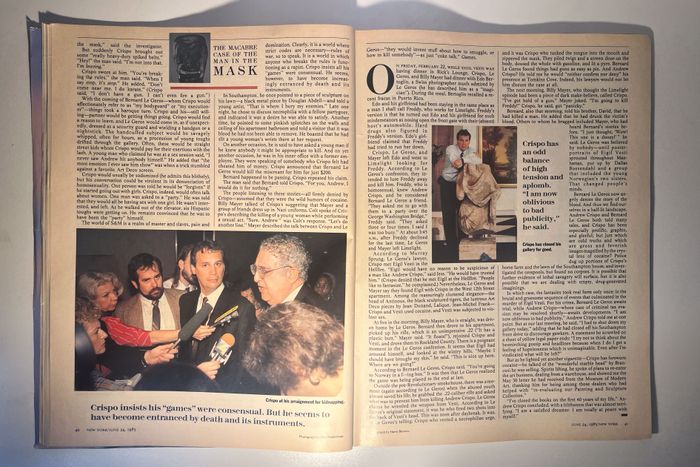
Photo: New York Magazine
At five in the morning, Billy Mayer, who is straight, was driven home by LeGeros. Bernard then drove to his apartment, picked up his rifle, which is an unimpressive .22 (“It has a plastic butt,” Mayer said. “It floats!”), rejoined Crispo and Vesti, and drove them to Rockland County. There is a poignant moment in the LeGeros confession. It seems that Eigil had aroused himself, and looked at the wintry hills. “Maybe I should have brought my skis,” he said. “This is nice up here. Where are we going?”
According to Bernard LeGeros, Crispo said, “You’re going to Norway in a fucking box.” It was then that LeGeros realized the game was being played to the end at last.
Outside the pre-Revolutionary smokehouse, there was a moment (again according to LeGeros) when the abused youth almost saved his life; he grabbed the .22-caliber rifle and asked what was to prevent him from killing Andrew Crispo. LeGeros claims he wrestled the weapon from Vesti. According to LeGeros’s original statement, it was he who fired two shots into the back of Vesti’s head. This was soon after daybreak. It was, in LeGeros’s telling, Crispo who vented a necrophiliac urge, and it was Crispo who tucked the tongue into the mouth and zippered the mask. They piled twigs and a screen door on the body, doused the whole with gasoline, and lit a pyre. Bernard LeGeros found things had gone as easy as pie. And Andrew Crispo? He told me he would “neither confirm nor deny” his presence at Tomkins Cove. Indeed, his lawyers would not let him discuss the case at all.
The next morning, Billy Mayer, who thought the Limelight episode had been a piece of dark make-believe, called Crispo. “I’ve got hold of a gun,” Mayer joked. “I’m going to kill Freddy!” Crispo, he said, got “panicky.”
Bernard, also that morning, told his brother, David, that he had killed a man. He added that he had drunk the victim’s blood. Others to whom he bragged included Mayer, who had heard Bernard’s stories before. “I just thought, Wow! This one is a doozy!” he said. LeGeros was believed by nobody — until poster-portraits of Eigil Vesti sprouted throughout Manhattan, put up by Dallas Boesendahl and a group that included the Norwegian’s two sisters. That changed people’s minds.
Bernard LeGeros now angrily denies the story of the blood. And thus we find ourselves in a half-lit landscape. Andrew Crispo and Bernard LeGeros both told many tales, and Crispo has been especially prolific, graphic, and gleeful; but just which are cold truths and which are gross and feverish images magnified by the crystal lens of cocaine? Police dug up portions of Crispo’s horse farm and the lawn of the Southampton house, and investigated the cesspools, but found no corpses. It is possible that further evidence of lethal savagery will surface, but it is also possible that we are dealing with empty, drug-generated imaginings.
In which case, the fantasies took real form only once: in the brutal and gruesome sequence of events that culminated in the murder of Eigil Vesti. For his crime, Bernard LeGeros awaits trial, while Andrew Crispo — whose case of criminal tax evasion may be resolved shortly — awaits developments. “I am now oblivious to bad publicity,” Andrew Crispo told me at one point. But at our last meeting, he said, “I had to shut down my gallery today,” adding that he had closed off his Southampton front drive to discourage gawkers. A statement he scrawled on a sheet of yellow legal paper ends: “I try not to think about the besmirching gossip and headlines because when I do I get a feeling of hopelessness which is unimaginable. Even after I’m vindicated what will be left?”
But as he lighted yet another cigarette — Crispo has forsworn cocaine — he talked of the “wonderful marble head” by Brancusi he was selling. Spirit lifting, he spoke of plans to reenter the art business, dealing from a warehouse, and showed me the May 30 letter he had received from the Museum of Modern Art, thanking him for being among those dealers who had helped with “re-evaluating our Painting and Sculpture Collection.”
“I’ve closed the books on the first 40 years of my life,” Andrew Crispo concluded, with a blitheness that was almost terrifying. “I am a satisfied dreamer. I am totally at peace with myself.”
Editor’s note: As we digitized this story, we made one change throughout: Bernard LeGeros confirmed to Rachel Corbett that his surname, spelled “Le Geros” in the original, is usually rendered without the space.