
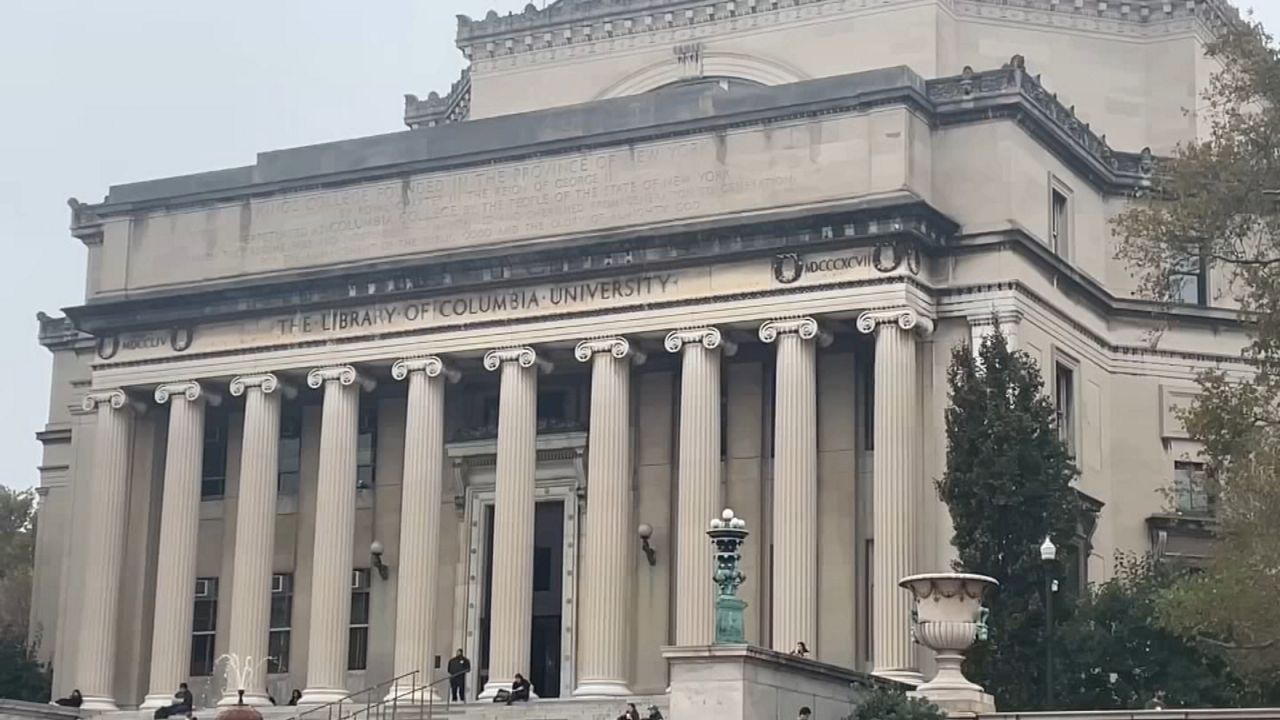
Columbia University was the epicenter of pro-Palestinian protests two years ago.
On Friday, some students on campus say Mayor Zohran Mamdani’s veto of “buffer zones” around schools is a step toward protecting free speech.
What You Need To Know
On Friday, some students on campus say Mayor Zohran Mamdani’s veto of “buffer zones” around schools is a step toward protecting free speech
City Council Speaker Julie Menin says the bill is about public safety and is needed to combat rising antisemitism at schools in the city
For young people who are actively protesting on issues like immigration and gun violence, they believe “buffer zones” will deter others from joining demonstrations
That includes this student activist who’s been protesting against Columbia’s ties to Jeffrey Epstein and the U.S.-Israeli war in Iran, and for Palestinian rights.
“This bill was a thinly veiled attempt to suppress that freedom of speech,” Hagen Feeney, 21, a spokesperson for the “Epstein Off Campus” campaign at Columbia, said.
“It’s being able to express ourselves, in any regard to protest, in speaking truth to power,” he added.
City Council Speaker Julie Menin says the bill is about public safety and is needed to combat rising antisemitism at schools in the city.
NY1 spoke with a 22-year-old Jewish student, who is in his first year of graduate school at Columbia.
While he says he’s more subtle about his Jewish identity, he’s never felt unsafe on campus. However, he does support protest buffer zones because he believes it helps to create an overall safer environment for everyone.
“Whatever ensures the safety of people who are not obstructing on other people’s freedom or like safety, I think there’s nothing wrong with that,” he said. “I think the more police around, the safer it is, so I think that’s good.”
Meanwhile, some high school students NY1 spoke with from NYC Lab School for Collaborative Studies. They say they worry the bill may be framing all protests as a security concern.
“Even if they’re not doing anything, it’s still the fear of, oh, what if I do get arrested for saying the wrong thing or doing the wrong thing?” Noah Henry, a high school student at NYC Lab School, said.
And for those young people who are actively protesting on issues like immigration and gun violence, they believe “buffer zones” will deter others from joining demonstrations.
“Whenever there’s police there, it always causes a little bit more conflict, just because there’s always this question about whether they’re there to protect us or there to be against us?” Natalia Zafra, 15, a NYC Lab School student, said.
She says she regularly participates in school protests and statewide protests with her friend and classmate, 16-year-old Marja Humphrey.
“I just think, in general, it could definitely create a lot of fear for any students,” Humphrey said.
However, some students who want to protect the right to protest at schools also believe it’s important to protect the safety of other students by having an NYPD presence.
“As long as they’re just staying on the perimeter, making sure things are going safely, I think that makes for a good protest, as long as they’re not intervening with people trying to protest peacefully, I think we can work in harmony, and work together,” Lorraine Dunlop, 17, a senior at NYC Lab School, said.