
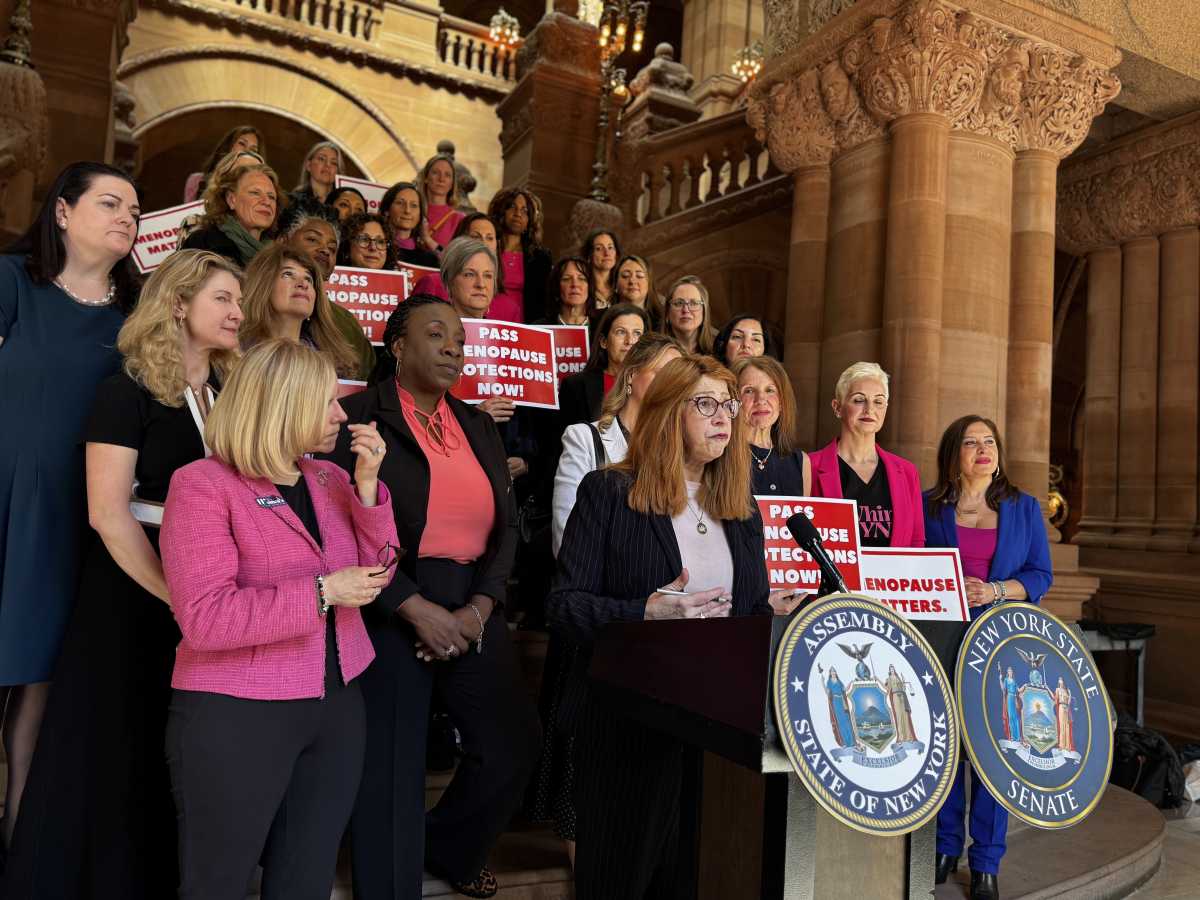
Assemblymember Linda B. Rosenthal (D/WF-Manhattan) pressured state legislators Monday to pass a series of bills aimed at providing greater support for women going through menopause.
The bills include legislation to require insurance companies to cover the cost of menopausal treatments, emphasize better training and education for health care professionals, improve the State Department of Health’s public information on menopause and perimenopause and workplace protections from discrimination against women experiencing menopause in the workplace.
“We cannot let the status quo continue,” said Rosenthal. “At a time when statehouses across the country, and even the federal government, is making it harder for women to exist, New York must lead by championing common-sense policies that prioritize women’s healthcare.”
Rosenthal said that she was committed to pushing the bills through to the legislative finish line for “every woman who was ever fired, misdiagnosed, or simply ignored during menopause.”
Perimenopause and menopause occur when a woman’s body slows down and eventually stops producing reproductive hormones like estrogen and progesterone. This, on average, happens around age 52 in the United States, but can occur as early as the mid-to-late 30s or due to other health complications.
Menopause care bills stalled in Albany
 Hot flashes are perhaps the most common symptom associated with menopause, but the process causes other physical and mental health impacts for women, according to experts.Photo via Getty Images
Some of the bills introduced last year received largely favorable responses in committee, according to official Assembly votes. The bills requiring insurers to cover treatments and protecting women from workplace discrimination have gone through several rounds of amendments.
But nearly the entire package stalled out early in 2026, with little legislative movement on all but the bill requiring the DOH to improve its public information on menopause and perimenopause. A representative from Rosenthal’s office told amNewYork that the state budget, which is now 27 days late, is responsible for the holdup, with insiders telling amNewYork that Albany is expected to pass its seventh budget extension Monday.
Lisa McDonald, director of policy and advocacy of The ‘Pause Life, told amNewYork that it’s beyond time that states started to do more to support and educate women experiencing menopause, which all women will inevitably go through, given that they live long enough.
She said that the natural progression beyond a woman’s reproductive age is more complex and important to women’ s overall health than is commonly talked about. Put simply, menopause does not just equal hot flashes.
It’s something McDonald had to learn almost overnight when, at 46, she had her ovaries removed and was pushed into induced menopause — a type of unnatural and intense menopause in which a woman’s hormone levels plummet almost immediately due to the removal of her reproductive organs.
“ I experienced very severe physical symptoms as well as mental symptoms which I had not been anticipating,” McDonald said. “My physicians were lovely people, but really did not go through any sort of conversation to prepare me for what I was going to experience and what I could expect.”
While McDonald was put on hormone therapy to balance her hormones and mitigate the intense side effects of menopause, she said that the correct course of treatment was also vital to her long-term health and quality of life and women who do not get appropriate care for menopause are at a higher risk of cardiovascular disease, osteoporosis, incontinence, and urinary complications.
Drops in estrogen levels, like during menopause, have also been linked to an increased risk of dementia and Alzheimer’s disease, although studies are ongoing, according to the Alzheimer’s Research Association.
McDonald said that the lack of accurate information and awareness about perimenopause and menopause often creates complications in women’s social lives and the type of support they receive, particularly in the workplace.
“I think the importance for these workplace protections is about normalizing the conversation —allowing it to be sort of out in the open,” she said.
It’s an important step in changing the way women going through menopause are viewed and, McDonald said, devalued and shifting towards getting the support and acceptance they need.
“I think there should be just a recognition that this is a normal change in life and it can be difficult and that if women need support, how to work with their employers to sort of manage this time,” McDonald said.
The legislative movement to protect and empower women going through menopause is gaining momentum nationally, with 25 states that have introduced over 60 different statewide bills in the last few years.
McDonald told amNewYork that the national awareness campaign sends a message of hope, that menopause doesn’t have to mean that a woman’s best years are behind her.