

Feeling nervous about AI? You’re not alone. A community initiative funded by a new research institute at Fordham found that many Bronx nonprofit leaders are hesitant about these new technologies, given the challenges of data stewardship and digital infrastructure in the sector.
“It’s a confusing time for nonprofit leaders and staff when it comes to AI and digital tech adoption because the technology is changing so fast, and resources for professional development are hard to secure,” said Lauri Goldkind, a professor at the Graduate School of Social Service, who served as a project faculty advisor along with law professor Aniket Kesari.
The project functioned as a sounding board for nonprofit groups that have concerns about AI; the goal was to create guidelines for using it in the future.
A New Research Institute for the Bronx
Goldkind and Kesari’s project is one of nine that have been funded by the Bronx Research Institute for Community Solutions (BRICS), which was launched in the fall of 2024.
Part of Fordham’s Center for Community Engaged Learning (CCEL), BRICS operates under the center’s belief that communities thrive when the focus is foremost on their strengths and potential.
In this case, that means asking community groups what issues they’d like to study, and then partnering them with a Fordham faculty member to make it happen.
“We’re having the community-based organization take the lead because they know what they need. They have better connections with the local population,” said BRICS faculty director Akane Zusho, a professor in Fordham’s Graduate School of Education.
Voices from the Community
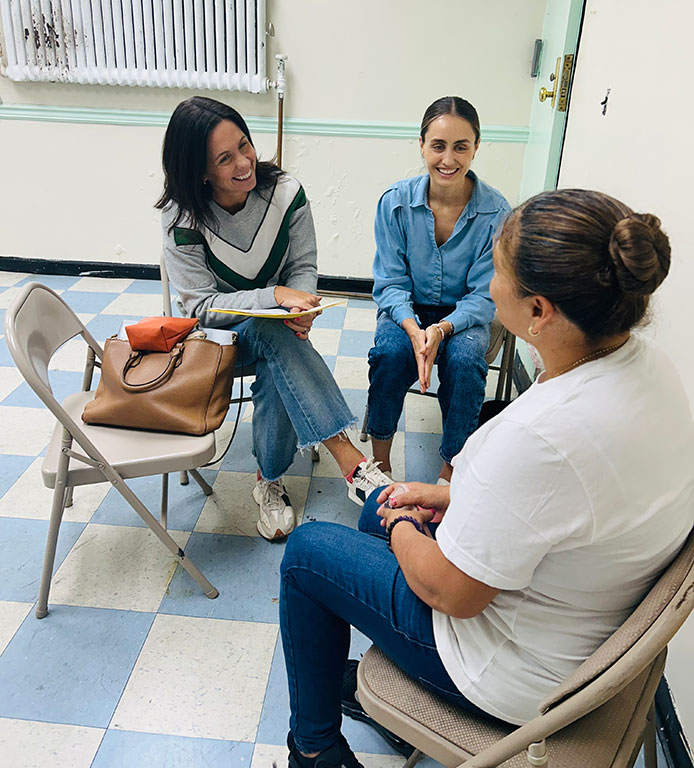 Gabelli School professor Genevieve O’Connor and her graduate assistant Maria Margaret conducting an interview as part of a BRICS study aimed at empowering Bronx residents by fostering financial literacy and resilience
The studies currently underway cover topics such as air quality, financial literacy, and food insecurity. Fordham undergraduate and graduate students join faculty in working with the community partners on these projects.
Funding is provided by BRICS and ranges from $25,000 to $50,000, depending on the length of the study. The institute is supported by a gift from Rose DiMartino, a 1977 graduate of the Graduate School of Arts and Sciences.
DiMartino said she and her wife, Karen Smith, were inspired to support the institute because they wanted to ensure steady funding for studies that could potentially impact policymaking and uplift underserved communities.
“I like the fact that it involves students, too, because it gets them outside of the classroom, and they see and meet real people who have real issues,” she said. “And they start to think, ‘You know what? I can be an effector of change.’ This is what it’s all about.”
Keisha Shay, chief operations officer of BRICS and director of academic development and administration at CCEL, said Fordham faculty have been enthusiastic participants, in part because they have already taught community-engaged learning courses.
“They’re familiar with this process already, whether it’s doing a project or a one-off volunteer activity out in the community,” she said.
For their study, Goldkind and Kesari oversaw virtual workshops earlier this year with over 100 leaders and staff of Bronx-based nonprofit organizations.
The goal was to help members of the community decide how to incorporate technology into their practices. One option would be to prioritize governance and policy-making, which would lead toward the creation of a framework for responsible AI use. Another option is to focus on trust and collaboration between groups, with the goal of making innovation more meaningful.
On June 30, members of the study met virtually for a “community shareout” event to discuss the work. The data collected, currently being analyzed by a Fordham Law student, will be used to recommend which of those two directions makes the most sense.
For Goldkind, working with BRICS was a welcome first step in what she hopes will be an ongoing effort to lift up Bronx-based nonprofits.
“It’s really important to make connections where our students are and where our institution is,” she said. “Academics have all this specialized knowledge that we really need to work hard to unlock.”
The institute will celebrate its newest round of studies at a kickoff event on Sept. 16 from 11 a.m. to 1 p.m. All are welcome.