
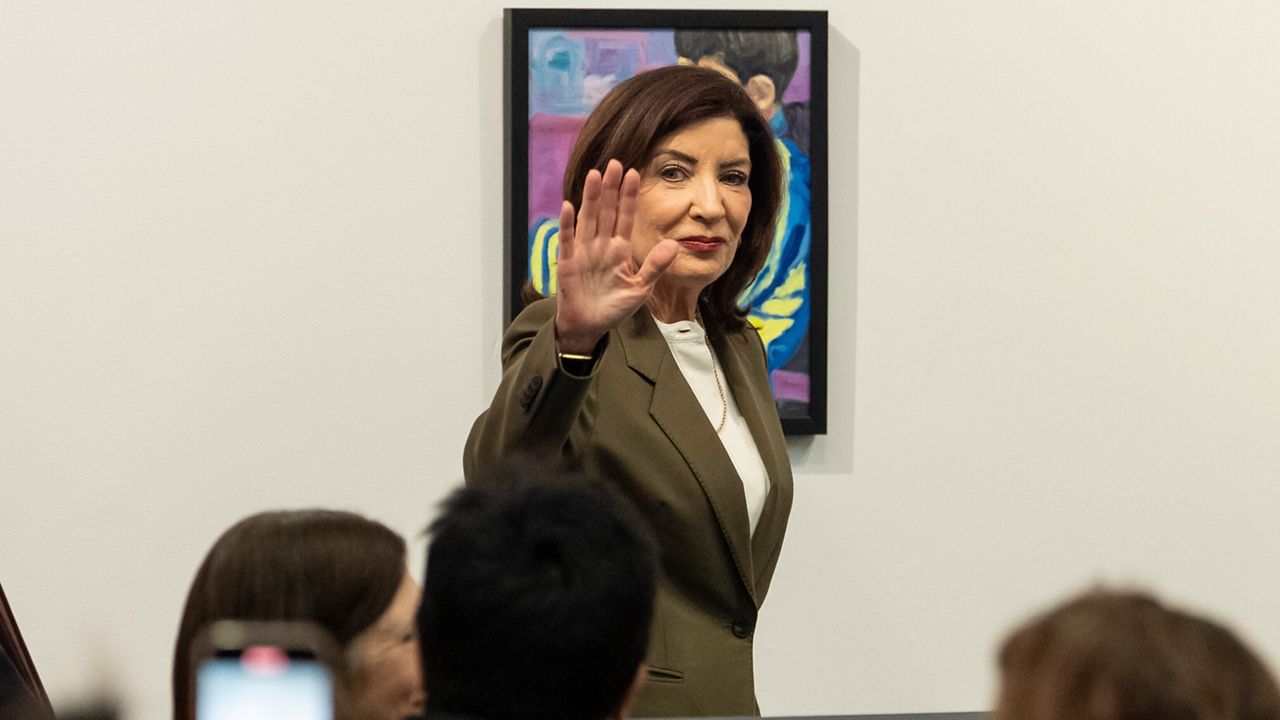
Gov. Kathy Hochul is reminding everyone that a quick check of the past five late state budgets provides a New York governor in her shoes with little incentive not to push the negotiating process into overtime in the name of her preferred policy changes.
In a moment reminiscent of last year’s budget battle, when Hochul, a Democrat, invited reporters down to her office and unveiled a poster board fresh from the print shop reading “good things happen in April,” complete with a list of her budget accomplishments, Hochul rattled off what she feels has gotten done in overtime at a Tuesday news conference.
“Everything I’ve stood for and fought for is for the betterment of the people of this state. The necessary bail changes, which took two late budgets to get through, the necessary discovery changes, the involuntary confinement to help people who are living off the streets without proper care, cellphones, the cellphone ban, which has been extraordinary,” she said, adding that a crackdown on retail theft would also make the list. “I’d prefer to be done on time. My hands are ready to shake, but we’ve just got to work through some more details because my priorities are very important to me.”
This time, the governor did not arrive armed with a printout, but she did turn to staff and tell them to make sure reporters got a full and comprehensive list.
The comments came after a week in which Hochul and New York’s executive budget process sustained heavy criticism from Assembly Speaker Carl Heastie, members of the Democrat-led state Legislature and good-government groups for the ability the state’s executive has to weave changes to state law into the process of approving expenditures, and then hold up the entire process to defend them, though Heastie has been clear his grievances are with the process rather than Hochul personally.
If the governor makes a similar list next year, one of the more remarkable and controversial items in that updated “greatest hits” collection will likely be her operation to dial back the state’s landmark 2019 emissions-reducing climate law.
While significant changes to the law were once almost unthinkable in Albany, so much so that a similar attempt in 2023 only lasted a few days, Hochul and state lawmakers appear to be in the vicinity of an agreement that would give the governor much of what she is looking for.
It comes amid an effort Hochul continues to insist is to ward off utility spikes, which she argues would be triggered by a lawsuit environmental advocates brought against the state when it failed to meet a 2024 deadline laying out regulations for reducing emissions by 85% by 2050 under the law.
“We were sued, we were the defendants in this case, and a judge ruled against us, and that’s why I’m using this time to work with the Legislature to give a longer runway, further out, based in the reality of today that cost pressures have to be factored into this,” she said, referring to a litany of shifts she blames for the current situation, ranging from the Trump administration’s climate policy to the COVID-19 pandemic. “We cannot ignore the fact that there are businesses and families who will be hurt if we don’t have a different timetable and also a different calculation.”
This week, legislative leaders digested an offer from Hochul which would relent on one key concession they have been pushing for: moving the date by which Hochul is asking to submit regulations up to 2028, rather than her originally proposed 2030. Lawmakers had initially pushed for 2027. Senate Majority Leader Andrea Stewart-Cousins underscored the significance of that victory Tuesday.
“We were never comfortable with the governor’s proposal for 2030,” she said. “We’ve been pushing and pushing to get the date up. Getting it to 2029 took quite a lot. So the governor is now saying 2028, so it is certainly better than it was. I think it’s taken a long time with a lot, a lot of effort to get this movement and I think the movement is in the right direction.”
A source familiar with negotiations told Spectrum News 1 that the offer on the table this week would keep the governor’s push to loosen the methodology by which the state calculates emissions to match that of other states, retain a cap and invest style enforcement and funding mechanism, and implement a 2040 interim target date which would be nonbinding but require an aspirational goal of 60% reduction in emissions, while the 2050 hard deadline would remain intact.
Hochul on Tuesday declined to address exactly how the changes would impact utility prices for New Yorkers, calling it premature given regulations won’t be released for years regardless of the final agreement.
As discussions careen toward some sort of deal, environmental advocates are turning up the pressure not just on Hochul to back off her push, but on the Legislature to cease movement in Hochul’s direction.
“Trump’s war is driving gas prices sky-high at a time when one in four New Yorkers are already behind on their energy bills. But instead of leading, Gov. Hochul would rather create chaos,” said Liz Moran, New York policy advocate at Earthjustice. “The Legislature has a choice: join the governor in abdicating responsibility and allow another 15 years of the increasingly unaffordable status quo, or fight to lower energy bills and free New Yorkers from expensive and insecure fossil fuels.”
Stewart-Cousins reiterated that Democratic lawmakers are putting up a fight, as advocates blast Hochul for putting the blame for the delay on the lawsuit and for, as they describe it, failing to factor in the impact of delaying the climate law’s implementation on overall costs to consumers.
Stewart-Cousins stressed that a deal must provide avenues for making progress between now and when regulations are released.
“We’re going to continue to push as far as we can, but here we are,” she said.
Blair Horner, senior policy adviser for good-government group New York Public Interest Research Group (NYPIRG), criticized both Hochul and the Legislature for not having the discussion out in the open. Hochul’s proposal came out after the 30-day budget amendments dropped in February, the last opportunity before bills are printed in which a release of full budget language on a proposal is par for the course.
“This may turn out to be the most secretive budget I’ve ever seen,” he said of the climate law debate. “The governor never advanced legislation, neither house of the Legislature has disclosed the language they are negotiating, so there may be significant changes to a very important law and the public may only find out about it after the fact.”
Those close to the governor have insisted that she has laid out the broader framework of what she is pushing through multiple op-eds and press statements.
Amid criticism from environmental groups over the Legislature appearing to be within reach of a deal with the governor, Senate Majority Leader Andrea Stewart-Cousins stressed that discussions continue to include factors intended to address current utility rates and interim progress on climate goals, not just Hochul’s wish list.
“We’re trying to work on an entire package,” she said.
Stewart-Cousins told reporters utility rebate checks for New Yorkers remain on the table in budget talks, as do other initiatives like legalizing plug-in solar for homes.
“It’s something we know works and can move us forward. We are continuing to push for continued investment in those things and everything that we can do,” she said of expanding solar initiatives.
Hochul herself hinted at a broader package including such details Tuesday.
“If there is new technologies, we’re going to put in some options for how we can achieve the renewable energy goals,” she said.