
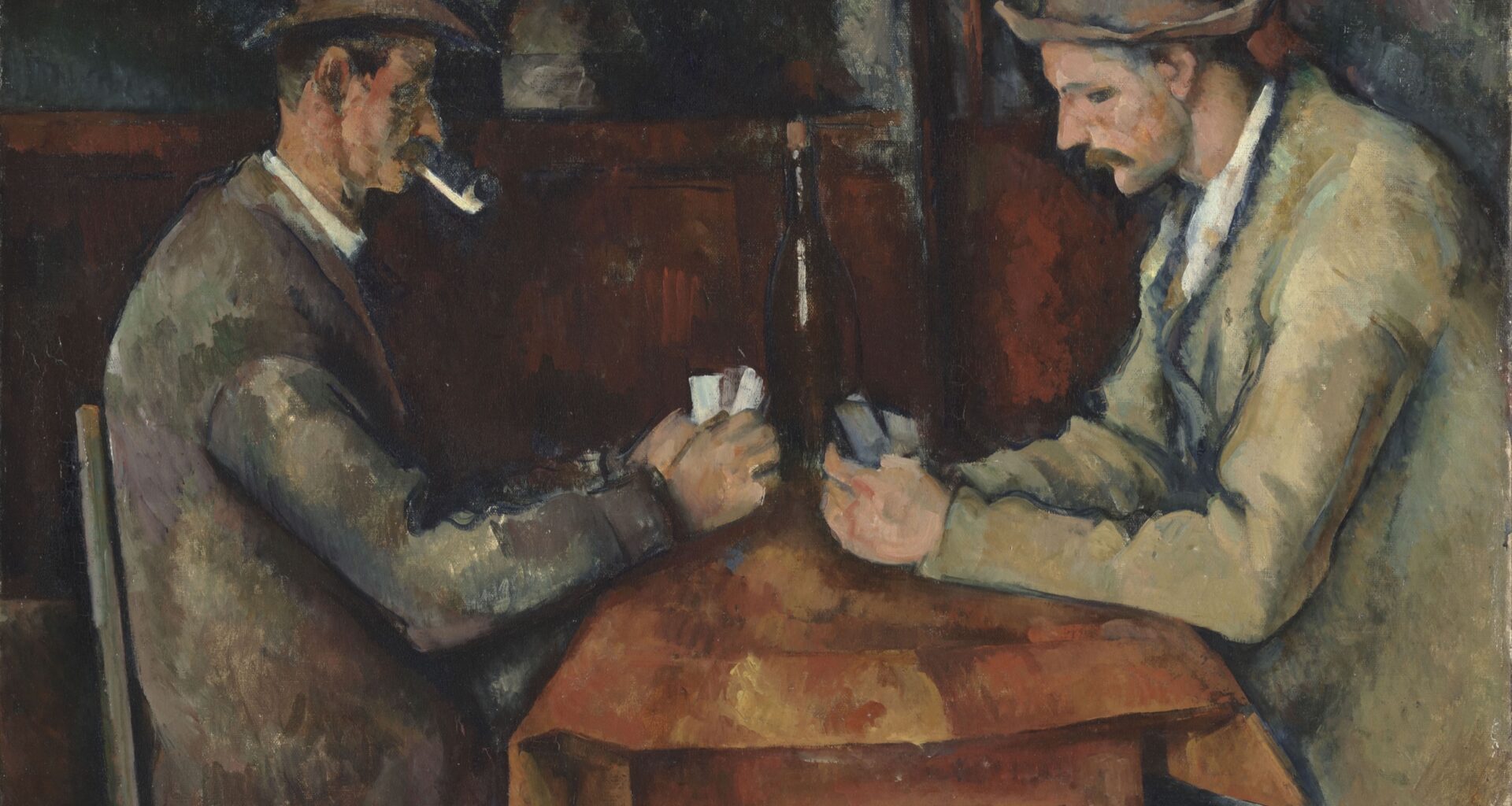
Cezanne
Fondation Beyeler
January 25–May 25, 2026
Riehen, Switzerland
Paul Cezanne occupies a central place in the Fondation Beyeler collection—which is blessed with an outstanding selection of late Impressionist works from France—with a total of seven works (paintings and watercolors). It may therefore come as something of a surprise that the artist was last honored with a major exhibition at this institution at the end of 1999. At that time, Cezanne’s formative influence on numerous figurative and non-figurative artistic positions of the twentieth century was made very clear in a dialogical juxtaposition. The current exhibition now focuses entirely on the late work of the artist from Aix-en-Provence, who was born here in 1839 and also died here in 1906.
This year marks the 120th anniversary of Cezanne’s death. His work has been extensively documented, and exhibitions and publications are so numerous that they are difficult to keep track of. Nevertheless, the sources on his life and artistic method remain incomplete, and facts and legends continue to be mixed up in the discourse. This makes it difficult to contribute new insights. Although the wheel of Cezanne research is not being reinvented in Riehen, a few new biographical details can be added. And the exhibition—which has been carefully thought out and clearly conceived by the museum’s curator Ulf Küster, and is manageable in scope with around eighty works—is convincing precisely because of its focus on the creative phase of the last two decades. In the 1880s, Cezanne found his mature style, which he would continue to develop gradually and consistently until the end of his life.
Once again, the Fondation Beyeler has succeeded in obtaining not only key works from international museums, but also rarely exhibited works from private collections (around half of the loans!). This effort is a hallmark of exhibitions at the Fondation Beyeler and, in times of increasingly difficult loan agreements between museums and collectors and steadily rising insurance costs, cannot be taken for granted.
The exhibition title is kept simple: Cezanne. The spelling without an acute accent has become established in recent years and pays respect to the spelling with which the artist signed his works and which is also advocated by his descendants and the Société Paul Cezanne based in Aix-en-Provence. Visitors can expect to see a representative cross-section of portraits, still lifes, multi-figure depictions such as Group of Bathers (ca. 1895) or two versions of The Card Players (Musée d’Orsay, Paris [1893–96] and Courtauld, London [1892–96]), and, of course, landscapes, including a whole series of variations on Montagne Sainte-Victoire, in eight themed rooms. This diverse kaleidoscope is impressively rounded off in the last room, which hosts twenty-one watercolors. With their rhythmic colors and brilliance, the watercolors are a cosmos unto themselves, not only in Cezanne’s oeuvre, but also in the art of the turn of the century, which was so rich in innovation.
Perhaps the exhibition, with its focus on the last twenty years of Cezanne’s creative life, offers an ideal introduction to the artist’s work and, above all, to his artistic and aesthetic legacy. For in his late work, we encounter a completely different Cezanne than in his earlier years, when the artist’s struggle with color and form, and above all with himself, can be visible in his works. In his dealings with other people, he remained difficult and politically controversial until the end. (During the Dreyfus affair, Cezanne’s anti-Semitic attitude began to show through.) A loner who subordinated everything to art and spared neither himself nor others, he remained his own greatest critic until the end.
His struggles and hesitations in completing a painting are legendary, and this exhibition features works whose motifs appear to have been painted over countless times, such as the relief-like Three skulls on an oriental rug (1904) (from Kunstmuseum Solothurn), or the protagonist in the famous Portrait of Ambroise Vollard (1899) (from Petit Palais, Paris), his Parisian gallery owner, who helped him achieve his artistic breakthrough in 1895 with a major solo exhibition. Cezanne reportedly only stopped working on this portrait after 115 sittings! Such anecdotes create a picture of an obsessively hard-working monomaniac, which has been eagerly cultivated in public discourse since his death.
Comparing the pictures, he seems to have gained considerably more confidence in the application of his artistic method in the 1880s. Numerous works can be found that appear light and lively, sensual and joyful, delicate and powerful at the same time, experimental and unforced. This can be seen most clearly in the exhibition when several variations of the same motif (for example, Montagne Sainte-Victoire, Château Noir, or the gardener Vallier) or at least very similar compositions (still lifes or bathers) can be compared side by side. Cezanne worked intensively on some of these groups of works and motifs for many years. A chronological comparison shows how far Cezanne distanced himself from the Impressionist style of his colleagues. Thanks to Camille Pissarro, Cezanne’s palette gradually brightened in the 1870s. However, he never completely adopted the short, comma-like brushstrokes characteristic of Impressionism, which make light and colors on the canvas vibrate and breathe. Cezanne found another method, which he called “réalisation.” If we expect a realistic rendering of an image, his rather broad, sometimes brittle, but deliberately placed, stain-like brushstrokes (“taches”) make the motif appear unfinished in many of his works. The composition and the anatomy of the figures’ bodies are often simply wrong. In Cezanne’s work, however, color, light, painting, and image all take shape at once, so to speak; everything happens simultaneously when viewed.