
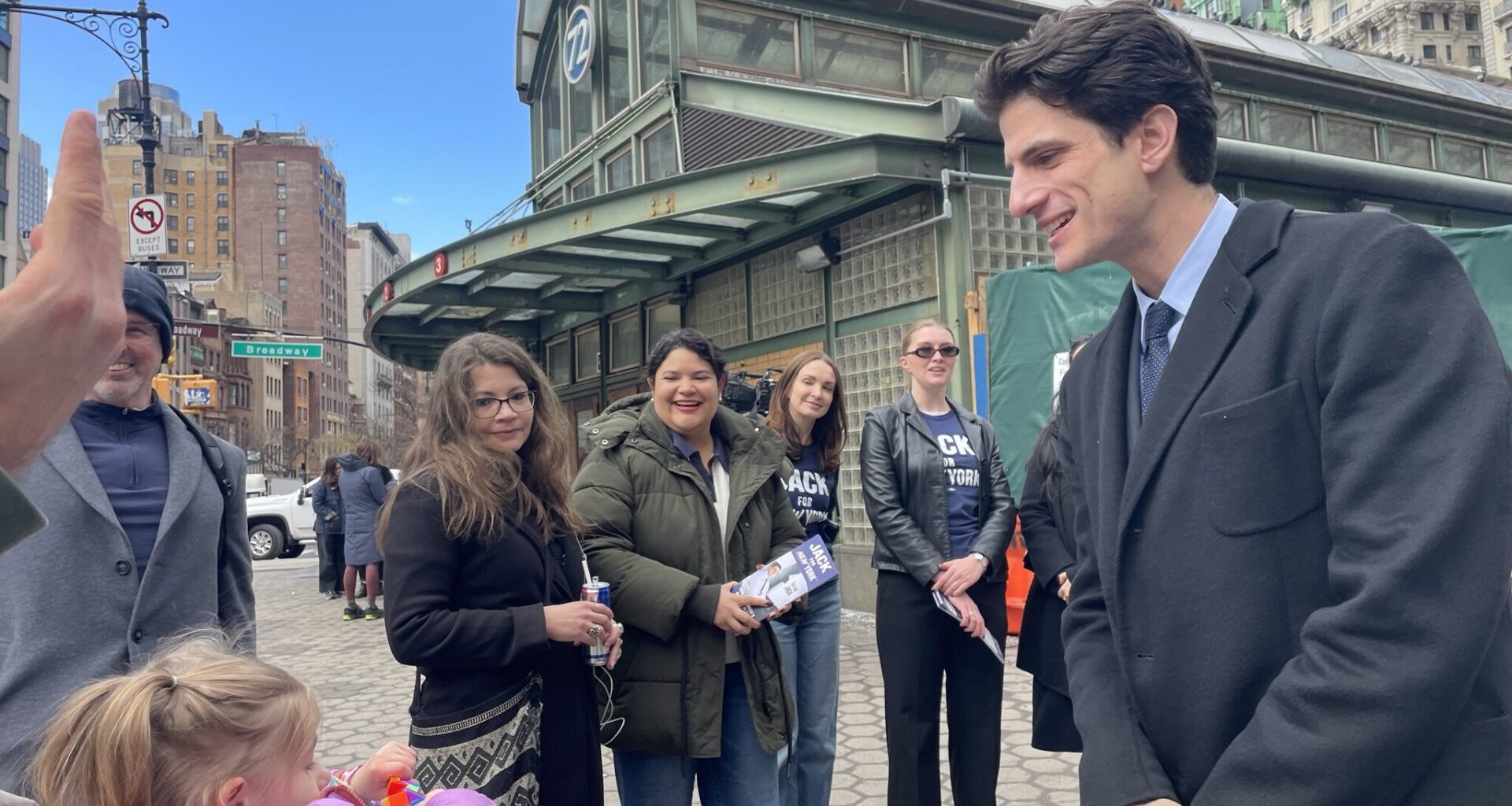
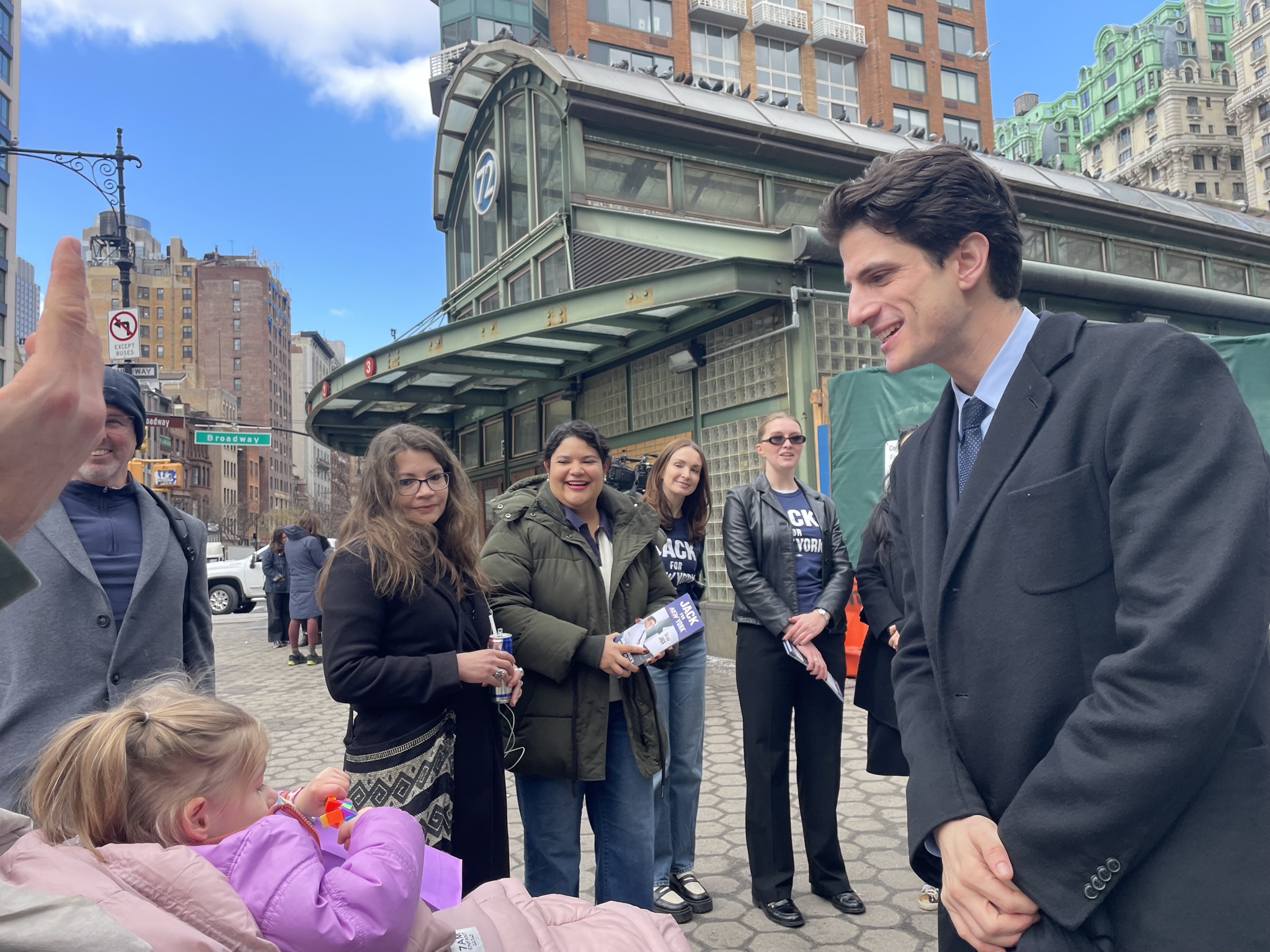
 Jack Schlossberg outside of the West 72nd Street and Broadway train station. Courtesy of Schlossberg’s campaign.
By Gus Saltonstall
Lately, there is growing attention surrounding Jack Schlossberg, the 33-year-old grandson of President John F. Kennedy, and one of many Democrats vying to succeed longtime Rep. Jerrold Nadler in New York’s 12th Congressional District, which includes the Upper West Side.
In part, that increased buzz comes from Schlossberg being shown to be leading the Democratic primary race in two polls conducted in recent months by other candidates, George Conway and Assemblymember Alex Bores.
Importantly, there has been no independent poll conducted for the NY-12 race yet.
Long before Schlossberg decided to run for Congress, he spent much of his childhood on the Upper West Side attending the Collegiate School.
Professionally, Schlossberg has business and law degrees from Harvard University, spent time working at an e-commerce company in Japan and within the U.S. State Department, served as a political correspondent for Vogue, and a surrogate for the Biden and Harris campaigns during the 2024 Presidential Election.
This is his first time running for political office.
Including Schlossberg, there are 10 Democrats still running for the NY-12 seat, along with five Republicans and four Independent candidates.
West Side Rag is looking to profile as many of these candidates as possible in the run-up to the June 23 primary elections.
Most recently, we spoke with Schlossberg. Our interview focused on his stances related to important campaign issues, his family’s political history, how he views President Donald Trump, his thoughts on the Upper West Side, and why, in his opinion, Barney Greengrass serves the best food in the world.
This interview has been lightly edited for clarity.
WSR: This is your first time running for political office. Why was this the right time and the right district to do so?
Schlossberg: This is the only district. This is where I’m from. I was born and raised here. I live here now. My family has lived here for many generations. And, why now? Because I think I would be a great person to represent this place, which is among the most important and consequential districts in the country. At a moment where we really need to do things differently than how we have in the past. I understand how to practice politics in 2026 in a way that others don’t, and I’ve got the experience and skills that would make me a great congressperson.
WSR: Did your family’s political history motivate you to seek elected office?
Schlossberg: I’m really inspired by my family’s legacy of public service. I certainly think about that history all the time, especially now, when it’s under attack by President Trump. The work of not just my family, but anyone who has a family who had a hand in building America, building New York City. President Trump is trying to dismantle a lot of that work and when faced with that, of course I want to do something.
WSR: If elected, you’d be put side to side with the Trump Administration. What would your mindset be within that relationship?
Schlossberg: It would be a combination of knowing when to fight and when to dance. How to deliver for the district without compromising on our values. I would be focused on getting the Democratic Party’s confidence back, and that we can do two things at once. We can hold this administration accountable, we can hold President Trump accountable, we can hold his cabinet secretaries accountable for the corruption and abuses of civil rights — violations that we have seen with our own eyes in broad daylight — and we can also have a responsibility at the same time as a party to be more persuasive and to bring people to our side and advocate for what we want to accomplish, whether it’s our plan to make rent more affordable, healthcare, immigration, there’s so much work to be done. It’s a combination of fighting back and delivering for the district and the country.
WSR: How would you look to balance the work you have in D.C. on national and global issues with making sure you show up for the residents in the district on quote-unquote smaller issues?
Schlossberg: [A] representative’s top job and number one priority is delivering for the constituents that elected them. That is my priority. I don’t believe that those two things are at odds with each other. A reason that I would be a great congressman, and I have a lot of confidence in myself, is that I think I could do both for the district in a way that others couldn’t. I could bring people to the table and I can elevate the stature of this district on Day 1 in a way that others can’t. I can pass legislation that has national significance and also do things like get funding for infrastructure projects in the district like the Second Avenue subway, while also speaking to the larger national questions that our country is facing now.
WSR: What would you look to accomplish on affordability in NY-12, especially when it comes to housing?
Schlossberg: I talk to people every day. Housing and affordability are at the top of pretty much everybody’s list of focuses. We have released a plan, it’s called “Jack’s Housing Fairness Plan,” which has three pillars, one for renters, one for property owners, and one for public housing. Our plan for renters has been very well received. I’m the only person who has ever proposed this, which is shocking to me, but I am proud of it, deduct your rent from your taxes. If you can allow residents here to deduct their rent from their federal income taxes, or at least a portion of it, it would save people thousands of dollars a year immediately.
Of course, we also need to increase the supply of housing here by building, but that takes time. A renter’s reduction would help people immediately. The same is true for property owners with a full repeal of the SALT Cap. President Trump punishes blue states like New York for our political beliefs by making us pay more into the federal government than we get out, and the SALT Cap is a primary mechanism he uses to do that.
On public housing, I want to make sure we protect and fully fund Section 9 here in New York City. We don’t have to choose between development and public housing, so I’ve proposed what I call the “Fix it Now” caucus, which would be devoted exclusively to addressing the backlog in repairs nationwide in municipal public housing authorities. NYCHA tenants need to live in safe, dignified, and habitable places, and too often they don’t. Repair requests take on average more than a year to [fulfill] and the federal government can do a lot more, and we can do better for the people that live here.
WSR: There’s a debate between the need to preserve a neighborhood like the Upper West Side and the importance of creating new development. Where do you stand on that balance?
Schlossberg: The best answer is to have the community decide. Community input should really be guiding these decisions. We have to serve both interests at the same time. Nobody wants to have the character of the Upper West Side fundamentally change, but at the same time you can still alleviate the problem and expand housing supply without doing that. But, it should be up to the people who actually live there on how that’s done.
WSR: What would you look to accomplish on the subject of immigration, if elected?
Schlossberg: It’s a two-part answer. The first is to abolish ICE, dismantle ICE, and that’s because ICE didn’t exist in its current form before the Big Beautiful Bill was passed, and now it’s the highest funded federal law enforcement agency in the country. They are violating civil rights and there’s virtually no accountability there. So, I’m proudly in favor of dismantling ICE and creating a new federal agency in its place with much more specific guard rails and protections for civil rights, but that’s not an answer to the big question. The question of what to do about immigration.
The only answer there is comprehensive reform to our system that both addresses the problem of illegal immigration by investing in processing people and having more administrative judges and courts to make sure that we can process people that come here. And then also, providing a pathway to citizenship for people that live here, who may be undocumented but who have lived here and worked here and who have families here and pay taxes. They need to be given a pathway to citizenship in a way that works for our time and without violating civil rights.
WSR: Among these issues, do you have a first bill that you would look to sponsor?
Schlossberg: It’s very hard at this moment to choose one specific issue that is more important than the others. With that being said, if we don’t reform our campaign finance laws, it’s going to be pretty hard to do anything about any of the issues that we care about, whether it’s healthcare, education or immigration. Corporate interests and billionaires have so much influence on our elections now, more than they ever have. Billionaires made up 20% of spending on election costs in 2024. The Super PACs, Corporate PACs, AIPAC, taking money from big tech, it’s all part of the integrity pledge that I have made as a candidate, which I am very proud of, because I think we need to offer the American people a solution to Citizens United and that the Democratic Party can impose a new standard on itself by electing candidates who choose not to take that money.
More than that, we need to reform our campaign finance laws because otherwise, powerful interests are going to continue to control members of Congress and flood money into primary races, so their preferred candidate wins. That’s going to make it very hard, and is responsible for why on so many issues, despite the public agreeing, the ball doesn’t move forward at all. So, campaign finance should be our top priority.
WSR: On a more local level. What comes to mind when you think about the Upper West Side?
Schlossberg: My childhood, my upbringing, all of my friends from high school, taking the bus to school every day, memories, a proud tradition, and a very specific culture. The Upper West Side is where my dad’s family is from, I went to to the Collegiate School in the neighborhood, and the Upper West Side is an example of a community that prizes intelligence, work ethic, and stands for progressive values that are the backbone of the Democratic Party.
WSR: What would you say to a voter who agrees with your stances and messaging, but worries slightly about your age or lack of experience holding political office?
Schlossberg: I would say our campaign is for the young at heart, regardless of age. It’s for anyone who thinks the status quo and the playbook that our party has been using needs to be changed and we need to try something else. If not now, then when? If there are questions about my experience because of my age, I would hope that they know my experience, because I think that’s why people are drawn to my campaign, because of my experience. My experience working at the State Department for Secretary [John] Kerry, my experience working in Tokyo for a Japanese company, my experience with a law and business degree, and as a top surrogate for the Biden and Harris campaign. My experience is one that has taught me how to practice politics in a way in 2026 that is the way of the future.
I may look young, but I have the soul of a retiree, of an 85-year-old man who loves to read and listen to music and hang out with his parents most of all.
WSR: Rep. Jerry Nadler has become a figurehead of the Upper West Side. Are there parts of his legacy that you would look to continue, if elected?
Schlossberg: Absolutely. Congressman Nadler is a progressive stalwart and champion on environmental issues, on LGBTQ issues, among many things, he led the impeachment against President Trump and his time in the [House] Judiciary Committee is inspiring. I would say most of all, something I’ve heard from people, especially on the Upper West Side, is that they felt he was a congressperson who was available and accessible to them, and that his constituent services were incredible and he was attentive to the needs of his district. I want to continue that.
WSR: Favorite places on the Upper West Side?
Schlossberg: Barney Greengrass is where my family celebrates all of our major accomplishments. There’s literally no better food in the entire world than Barney Greengrass, it just makes me so happy when I go there, I absolutely love it.
Whenever I walk by where I went to high school or when I visit my friends from high school, one of them, their parents live on Riverside Drive and it’s about the people who made me who I am. All of the important lessons I learned in life, I learned between the Upper East and Upper West Side, those are the memories that come to mind for me. I love Riverside Park. I paddle on the Hudson River all of the time. I constantly paddle up and down Riverside and I look at the people running on the pathway. And the JCC because it’s where I play basketball.
WSR: Important follow up. What’s your Barney Greengrass order?
Schlossberg: I’m actually somebody who shakes it up. Sometimes I want Leo’s lox and onions, but other times I just want a bagel with nova. I can’t really be pinned down. I almost always get poppyseed but sometimes I get sesame. And there’s really no rhyme or reason to that. And then, usually I take home with me a couple of pieces of sturgeon but I don’t eat that there, I save it for a snack after.
WSR: And finally, what do you say to someone who simply asks, ‘Why should I vote for you?’
Schlossberg: Our campaign is different from all of the other campaigns for many reasons. One is where our where our money comes from. We’re powered by small dollars; our average contribution is under $40. I don’t take money from Super PACs. We are meeting people in the district. Being more accessible. Shaking more hands. The second is we have released more policy proposals to address the issues of the people who live here than anybody else. We have plans for protecting houses of worship, we have our “Ricochet Rule” to stop the flow of illegal guns, and I am the only person who has asked the question of how much is the city paying for the permanent perimeter around Trump Tower, and who has a plan to get President Trump pay the $300 million bill, so that we can invest it in cops, teachers, and transit.
It also shows I’m focused on the concerns of the people who live here. Deduct your rent from your taxes, that is something that everybody can get behind.
Lastly, I would say, probably nobody, in the history of our politics, knows how the House of Representatives, where I seek to serve, how that works, what political power means there, than Speaker Nancy Pelosi.
Speaker Pelosi has endorsed our campaign proudly, and I’m very proud to have her endorsement. She has the confidence in me, and if others believe, as they should, that she is the backbone of our party, since she has done more for more healthcare, for children, for civil rights, than nearly anybody. She is the most important female certainly in American political history, and she’s behind us all the way.
Our campaign slogan is “Believe in Something Again,” and it’s as dumb as it is true. Believe in something again—why? Because our country and this city were built by people who believed in something larger than themselves, that we were all in this together, that their vote counted, but right now we can’t believe in anything. We can’t believe what Trump says at all. We’re at war and we’ve got no idea what’s going on. The president lies to us constantly. I still believe in politics and I always will. I want others to reconnect in their belief of something larger and their belief that things can get better, if we all participate.
You can find out more about Schlossberg’s campaign — HERE.
Read More:
Subscribe to West Side Rag’s FREE email newsletter here. And you can Support the Rag here.