
For a New York Jets team that won three games last season, it (strangely) doesn’t seem like there are many roster spots to be won for an undrafted rookie.
That’s not to say there aren’t any spots available — just not as many as you would think. That might help explain the who and the why of their reported undrafted rookie class. As of Thursday morning (again, the class isn’t official yet), the Jets have yet to sign any undrafted free agents at quarterback, offensive tackle, defensive line or safety.
Last year wasn’t a particularly lucrative undrafted free agent class for the Jets, though a handful did wind up playing roles. Their top-rated UDFA signing — Michigan running back Donovan Edwards — was released after training camp and spent the year on the Commanders’ practice squad (the Dolphins signed him in January). Safety Dean Clark didn’t make the team out of training camp but wound up playing 12 games and making two starts. Quarterback Brady Cook played in five games and started four. Safety Jordan Clark and defensive tackle Payton Page played in four apiece.
What about this year’s class? There aren’t a lot of highly-rated prospects, but there is at least one who, if he can win a camp battle) has a chance at playing a significant role for the Jets in 2026.
Here’s a ranking of the UDFAs most likely to stick around with the Jets in 2026, from least likely to most. (Positional rankings are according to “The Beast”):
12. Sam Scott, RB, Wyoming (RB No. 40)
Scott is being signed largely based on his impressive athleticism. At 6-foot-1, 213 pounds, he ran a 4.46 40-yard dash, 6.83-second three-cone and had an 11-foot-2-inch broad jump with 20 bench reps of 225 pounds at Wyoming’s Pro Day.
NFL.com’s Lance Zierlein wrote that Scott “looks the part with good size and a muscular frame. The speed and explosive leaping ability he displayed at his pro day is sure to catch the eyes of evaluators.” Zierlein added that he “has the traits and athleticism to warrant consideration on special teams.”
Scott also never hit 100 carries or 450 rushing yards in a single season at Wyoming, though he did grade out well last season as a blocker and started his career out at linebacker, so he has some experience in special-teams coverage as well.
Scott told reporters at his Pro Day that “you could say there’s a chip on my shoulder. I put my best foot forward to see what I could do in terms of showing my athleticism. And I knew I was one of the most athletic guys in this class. I wanted to express that.”
11. DT Sheffield, WR, Rutgers (No. 53 WR)
He’s diminutive (5-7, 175), but Sheffield is a great athlete, running a 4.43 40 with a 42-inch vertical and a 4.09-second short shuttle — which would have been the second-best mark among all players to test at the NFL Combine.
The upside, per Dane Brugler, is that Sheffield has the burst to get behind defenders and thrives at “creating vertical separation on slot fades.” He also had nine catches in traffic in the slot in 2025, which ranked fifth among all receivers.
The downside: Sheffield is already 25, has some issues with drops (10 combined last two years), he’s a slot-only receiver without much history of production as a returner, and he only forced two missed tackles last season. His size will ultimately be the biggest barrier to entry into the NFL.
10. Kendrick Blackshire, LB, UTSA (LB No. 85)
It is mildly surprising that the Jets are, at least initially, only bringing in one linebacker since that’s the defensive position with arguably the biggest depth concerns. It wouldn’t be a surprise if the Jets signed a veteran at some point to contribute as a backup behind Demario Davis and Jamien Sherwood.
Blackshire is a bit undersized (6-1, 236) but ran a 4.51-second 40-yard dash. He started his career at Alabama before transferring to UTSA in 2024. He dealt with injuries in his first year and only had 48 tackles, one sack, one interception and one pass deflection in 2025.
9. Chase Curtis, TE, TCU (No. 59 TE)
Curtis started his college career as a baseball player, switched to football, walked on at TCU and became a quality blocking tight end for the Horned Frogs.
He tested pretty well for his size (6-4, 241), with a 4.68 40-yard dash and 6.97 3-cone. Curtis just didn’t show much as a pass catcher in college (13 catches for 167 yards and two touchdowns in 2025). He graded out well as a run blocker in all but one game last season.
The Jets are locked into Kenyon Sadiq, Mason Taylor and Jeremy Ruckert at the position, plus fullback/tight end Andrew Beck will push for a roster spot — as will tight end Jelani Woods, also primarily known for his blocking.
8. Xavier Hill, G, Colorado (No. 70 G)
The Jets seem pretty set on the interior of the offensive line unless Hill were to outplay veteran Xavier Newman in training camp, but he can still stick around on the practice squad. The starters on the interior will be Dylan Parham, Josh Myers and Joe Tippmann, with sixth-round rookie Anez Cooper and Newman as the primary backups.
It can’t hurt that Hill can play both guard spots and at center. Per PFF, he ranked 11th in pass-blocking grade among guards — and 188th (of 233 to play 500 snaps) at run blocking. At Memphis in 2024, he was graded the sixth-best guard in the country, 11th at run blocking and 12th at pass blocking.
“Being able to not be a one-side, one-position guy, being able to have that versatile mindset,” Hill told reporters at Colorado’s Pro Day. “Whatever the team needs, whatever the team gets. That’s how I approach it.”
He ran a 4.99-second 40-yard dash at 313 pounds and put up 26 bench press reps.
7. Mory Bamba, CB, BYU (No. 42 CB)
Bamba is one of three Jets UDFAs from BYU, though the other two are purely special teams players.
Bamba is an elite athlete with tantalizing traits. He measured at 6-2, 193 and his numbers at BYU’s Pro Day were ridiculous, namely the 4.29 40-yard dash he ran and his 11-foot, 1-inch broad jump. He went to college initially for track and field, bounced around junior colleges and switched to football before ending up at BYU. The production isn’t quite there (zero interceptions, nine pass deflections in 36 games), but his traits are appealing.
Of Bamba, Brugler wrote that he has “a rare combination of body length and speed, which allows him to connect himself to vertical patterns and stay in position. He has a thin build through his hips and in his lower half — he looks like a former track athlete. He can be inconsistent in his mirror and match at the line, and there is some tightness in his leggy turns. He might be better suited for zone, where he can read the quarterback’s eyes, but regardless, he needs to play with better ball skills in coverage. Some tackle attempts are an adventure, but he has adequate toughness for run support.”
Here’s what BYU coach Kelani Sitake had to say about him last season: “Mory Bamba is really big, long, and super fast. When you combine that with how physical and how strong he is, pound for pound, one of the strongest guys on our team as well. (He) definitely has the speed and the ability to play for the next level as a cornerback.”
6. Malik McClain, WR, Arizona State (No. 59 WR)
The Jets only added one wide receiver this entire offseason: first-round pick Omar Cooper. General manager Darren Mougey opted not to add any veterans in free agency — though he could still add a veteran at some point.
The locks for the roster: Garrett Wilson, Cooper, Adonai Mitchell and returner Isaiah Williams. Arian Smith and Irv Charles will push for spots based on their special-teams contributions. The only others on the roster are Quentin Skinner — a training camp UDFA darling last year — and Mac Dalena.
McClain does fit the Skinner mold as a tall, lanky wide receiver (6-4, 205) with some speed (4.46 40) and athleticism (40-inch vertical, 11-foot, 4-inch broad jump), albeit not much college production (441 yards, one touchdown in 2025). He did go for 159 yards on seven catches in a loss to Houston when first-round wide receiver Jordyn Tyson was out.
5. Caullin Lacy, WR, Louisville (No. 51 WR)
Lacy made some plays as a wide receiver (635 yards, two touchdowns), though his primary appeal is as a returner. There’s not really another roster spot for a returner with Williams and Kene Nwangwu both on the roster, but the Jets did keep Jamaal Pritchett on the practice squad all of last season, and Nwangwu has a long injury history.
Lacy is on the smaller side (5-9, 183) and didn’t test particularly fast (4.55 40), but he scored three return touchdowns at Louisville (two punt, one kick), and Brugler wrote that he “has the vision and acceleration to be dangerous with the ball in his hands.”
Louisville coach Jeff Brohm said this after one of Lacy’s best games last season: “He is someone that we need to get touches — whether he’s in the slot, on the outside, or in the back field and the return game. In all four spots, we need to utilize him because he’s strong, he runs well with the ball, he’s a competitor, he’s tough, and he is someone that has to hopefully contribute like this every game for us to win.”
4. Nathan Voorhis, edge, Ball State (No. 48 edge)
Voorhis is the feel-good story of this class. He grew up in Stroudsburg, Pa., about an hour from MetLife Stadium. After he signed with the Jets, Voorhis posted a photo of his younger self at a Jets game. He has some juice to his game as a pass rusher, even if he’s a bit undersized (6-2, 251) and not especially fast (4.76 40). It’s at least notable that he’s the only edge rusher in this (initially reported) UDFA class.
The Jets have four edge rushers locked into jobs: David Bailey, Will McDonald, Joseph Ossai and Kingsley Enagbare. No one behind them should feel secure. Tyler Baron was disappointing after the Jets traded up to get him in the fifth round last year. Braiden McGregor has stuck around for a couple years as a UDFA despite a lack of production. Voorhis will compete with them for a spot on the roster and/or practice squad.
Per Zierlein, Voorhis is “fairly instinctive as a rusher and made noticeable additions to his rush menu last season. While he collected tackles for loss in 2025, he’s below average at beating run blocks and securing his gaps. He lacks traits, explosive testing and sustained production, but his consistency as a rusher is worth keeping an eye on.”
PFF had him graded 27th at pass rushing among edge rushers with at least 100 pass rushing snaps in 2025, which ranked ahead of a handful of drafted edges like Gabe Jacas, Keyron Crawford, Caden Curry and Zion Young.
3. Garrison Grimes, LS, BYU (No. 4 LS)
The longest-tenured Jet at present is long-snapper Thomas Hennessy, who has been here since 2017, long enough to have played for Todd Bowles, Adam Gase, Robert Saleh and Aaron Glenn. He is under contract through 2027 but will turn 32 in June; it seems the Jets are bringing in some competition for Hennessy.
There isn’t much in the way of scouting reports out there about long snappers, but there is this: He might be the most athletic long snapper to come into the NFL … ever? That’s at least according to the RAS scoring system. Grimes ran a 4.81 40-yard dash with a 32.5-inch vertical, 9-foot-7-inch broad jump with 22 bench press reps.
2. Chip Trayanum, RB, Toledo (No. 18 RB)
According to Brugler, Trayanum was the only draftable prospect of this Jets UDFA class — and he was graded as a seventh-round/priority free agent value. NFL.com had him graded as a sixth-rounder.
He’s an intriguing prospect with some size (5-10, 224), athleticism (4.5 40, 37-inch vertical) and strength (27 bench press reps). He’s a strong runner with some special-teams experience. The Jets seem pretty set at running back with Breece Hall, Braelon Allen and Isaiah Davis. If they want a fourth running back — Nwangwu is a running back but really just a returner — Trayanum will get a chance to prove he deserves to stick around.
He bounced around college, spending two years at Arizona State, two years at Ohio State as a linebacker and running back, missed most of 2024 with an injury and then broke out for Toledo last year: 1,015 rushing yards and 14 total touchdowns.
Brugler described him as “a well-put-together athlete” and wrote that he “looks the part, with a muscular torso and quads. His vision tends to be hot and cold, but his run strength and balance make it a chore to get him on the ground. He has the frame to be a strong blocker but needs to be more efficient getting squared with his technique. His nickname is a reminder of the chip he has on his shoulder — and character feedback from multiple programs is glowing.”
Zierlein called him a “pile-mover and body-blow puncher capable of wearing down defenses with his downhill physicality.”
Trayanum had the ninth-most runs of 10-plus yards (33) among all running backs in 2025, per PFF.
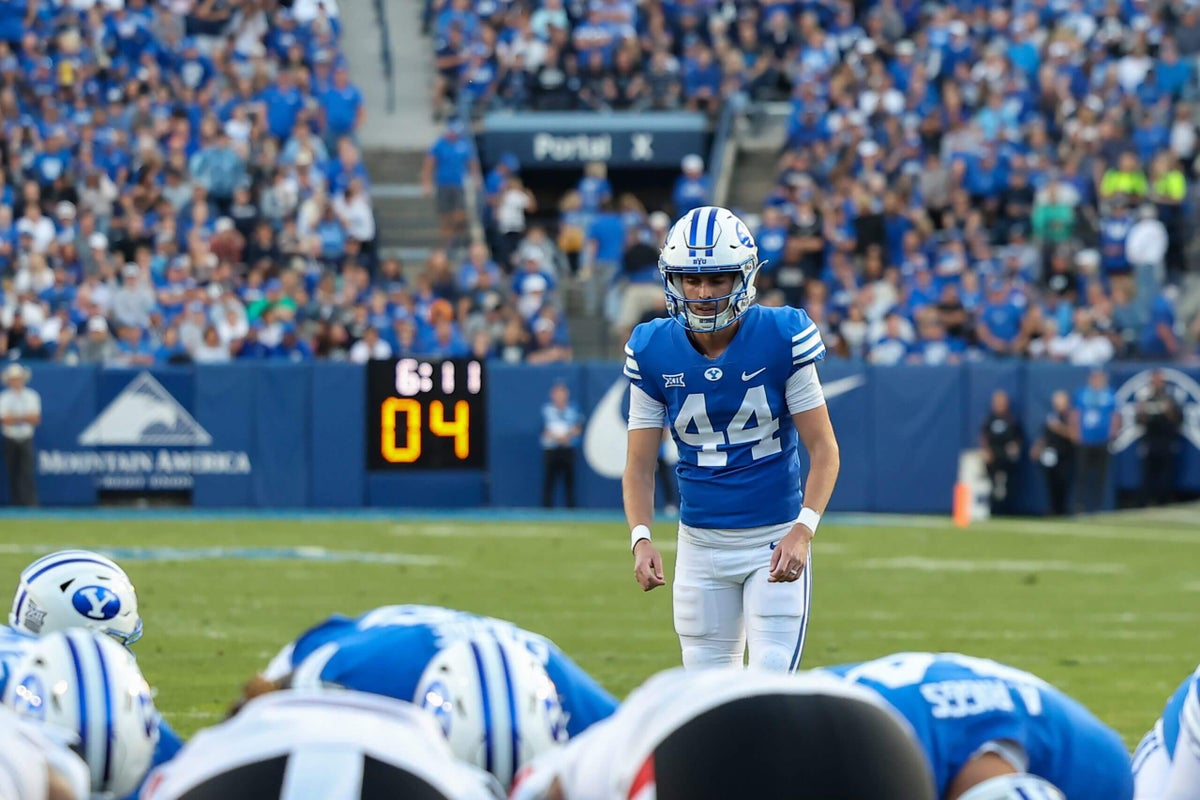
1. Will Ferrin, K, BYU (No. 4 K)
The Jets went into last year’s training camp prepared to let an undrafted rookie (Caden Davis) and another young kicker (Harrison Mevis) duke it out. It didn’t go well to the point that veteran Nick Folk was eventually signed during training camp. Folk won the job over Mevis, had a stellar season and then left in free agency, signing with the Falcons. Back to square one.
Ferrin is being brought in to push 25-year-old Cade York, a kicker with leg strength but who has struggled in the NFL, only converting 73.3 percent of his field goals on 45 tries; he hasn’t kicked in an NFL game since 2024. The Jets also have German kicker Lenny Krieg, but he has no NFL experience (though he did spend last season on the Falcons practice squad).
If Ferrin can find some of his 2024 magic, he has a real shot to win the job. That year, Ferrin made 24-of-27 field goals and 6-of-7 from 40 yards to 49 yards. He only made 23-of-30, and his biggest struggle was that range — he went 2-of-7 from 40 yards to 49 yards, though he did convert 8 of 11 from 50 yards over those two years combined. Zierlein wrote that Ferrin “struggled with ball striking and flight path in 2025.”
This is what Sitake said about Ferrin going into 2025: “Will Ferrin is one of the most clutch individuals I’ve ever met. He enjoys every moment. Every time there’s a clutch kick, he is embracing the opportunity that he’s in, and he’s excited about it. You just don’t have a lot of guys like him. He’s got ice in his veins. I know people say that often but you can see it in him. He loves being around his teammates and he’s been such a great leader for us. I’m really grateful that he’s our kicker, he’s an automatic guy.”