
Public health, explained: Sign up to receive Healthbeat’s free New York City newsletter here.
As New York City emerges from one of the coldest winters in years, those who serve the growing population of seniors facing food insecurity are reflecting on what more can be done – before summer, when extreme heat could bring another barrier to aid distribution.
“They have to think: Do we want to be hungry or do we want to freeze?” said Tyler Efferon, executive director of EV Loves NYC, a food pantry in the East Village. He noticed seniors were missing from food distribution sites this winter.
“We usually do 384 meals, and this past week we only did 240 meals,” he said in February.
In 2023, 1 in 10 New Yorkers ages 65 and older experienced food insecurity – a 3% increase from 2021, according to Feeding America, a nationwide network of food banks, food pantries, and soup kitchens.
Since the pandemic, the city’s total population has declined – but the senior population has continued to grow, according to a 2025 report by the state comptroller’s office. The city’s 65-and-older population grew 53% from 2000 to 2023 – 17 times faster than the total population.
Many seniors in need don’t have the mobility to get to food distribution sites, especially when sidewalks are slippery with snow and ice, said Alexina Cather, former deputy director of the NYC Food Policy Center at Hunter College.
“When it’s 5 degrees outside, you cannot come,” Julie, 63, told Healthbeat as she braved a frigid evening in February to pick up free groceries from a City Harvest truck on Manhattan’s Upper East Side. She declined to give her last name. “One Monday I came, but it was too cold, so I went home.”
It can be hard during summer heatwaves, too.
City Council Member Elsie Encarnacion, whose district includes part of the Bronx and the Upper East Side, introduced a bill on April 10 at the Committee on Aging to require the city Department for the Aging to develop a protocol for conducting in-person and phone wellness checks during extreme hot or cold weather.
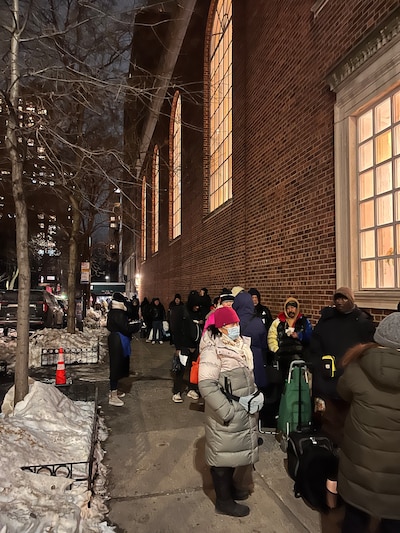 People line up to receive food distributions from City Harvest in New York City in February. (Apolline Lamy for Healthbeat)
For older people, exposure to the cold poses a higher risk of hypothermia, as the human body’s ability to regulate temperature deteriorates with age.
Chris Jay, a 61-year-old unemployed man who lives in an apartment in Sunset Park, said he defied the cold every Monday this winter to get food at the Gotham Food Pantry, where he received a hot meal at 6 p.m.: chicken, rice, vegetables, and lemon cake.
Afterward, he spent an hour and a half in 23-degree weather on the steps of All Souls NYC Church, waiting for a truck from City Harvest, which redistributes surplus food that would otherwise go to waste.
“A lot of people just come for the meal, and then they leave,” Jay said. “They don’t want to wait around for the truck because we never know when the truck’s going to be here.”
Delivering food directly to seniors’ homes would require more resources, trucks, drivers, and other workers. Gotham Food Pantry operates with only four employees and 100 volunteers, making personalized home delivery out of reach, Executive Director Douglas Silver said.
“I would need to have all the addresses of all those people,” he said. “I don’t have this.”
Advocates say more funding for local food pantries, not just big food banks, could make a difference.
“Right now, a few core companies get all the funding for food access,” Efferon said.
Cather said the city mainly funds the Food Bank for NYC but should be investing in neighborhood food pantries. With more money, she said, local food pantries could schedule delivery to some senior centers, giving food to 100 people at the same location.
“The food pantries are at the front line,” Cather said. “They understand the nuance of their clientele and can meet people where they’re at.”
Stay informed on bird flu, measles, and more across New York.
Coming soon: The latest news on critical public health issues, all in one place. Get it in our free newsletter.
Meals on Wheels delivers a wellness check
The city Department for the Aging provides one meal every weekday through its Meals On Wheels program. It is dedicated to seniors who cannot cook, travel to food pantries, or stand waiting for hours. The program serves 24,000 of the city’s 1.43 million seniors, according to the comptroller’s report.
Meals on Wheels was created by the Older Americans Act of 1965, when the senior population was only 9% of the whole U.S. population. In 2025, the Census Bureau estimated this same population to be at 61.2 million, or 17% of the total population.
The meals are delivered door to door, providing human contact for older adults, said Susan Zhuang, chair of City Council’s Committee on Aging. ”Meals on Wheels is not only just a meal delivered to their home. It is also a check-in with them.”
Meals are not delivered on weekends. Zhuang said many nonprofits have told her that seniors often fall and cannot reach the phone. Deliverers from Meals on Wheels knock on the door and find them on the floor.
“If it happened Friday night and then the whole weekend passed and no one checked on them, the people are going to die,” Zhuang said. “It’s not only just a meal issue. It’s a meal issue plus isolation issue plus health health issue plus caregiver issue.”
City Council Member Linda Lee, whose district in eastern Queens includes the Douglaston and Bayside neighborhoods, has introduced a bill to extend Meals On Wheels to seven days a week.
Meanwhile, Citymeals on Wheels, created in 1981, distributes weekend meals to 16,000 to 20,000 people every year. About 2,000 senior New Yorkers get a monthly breakfast box containing the equivalent of 30 breakfasts with perishable and non-perishable items, and the program delivers groceries to 700 seniors a year.
Fear of ICE keeps people from food distribution sites
Fear of being detained by Immigration and Customs Enforcement agents are also hindering seniors from going out for food, advocates say.
Council Member Alexa Aviles, whose district covers Red Hook and parts of Park Slope, Sunset Park, Borough Park, Dyker Heights, Bensonhurst, and Bath Beach where 46% of the residents were born in another country, said she has noticed this fear among her constituents.
“Now that ICE is in the community,” she said, “people are afraid and don’t want to stand in long lines where they feel vulnerable.”
Aviles, whose office participated in food distribution, said that fear of ICE “concerns everyone who does food distributions and any activity where now you have a mass of people.”
“The first question we are now asking is not ‘Do we have enough?’ Now it’s ‘What are we going to do if ICE shows up? How are we going to keep community members safe? Will people come out if we do this?’ ”
NYC Department for the Aging’s budget, which the Committee on Aging oversees, is less than 1% of the city’s budget. Zhuang is negotiating for more.
Rachel Sherrow, COO of Citymeals on Wheels, said society is too focused on youth and doesn’t take enough care of seniors.
“We are talking about universal pre-K, universal child care, universal all of that,” she said. “What about universal older adults, universal meals? An older adult should be getting at least three meals a day.”
Apolline Lamy is a freelance journalist in New York.