
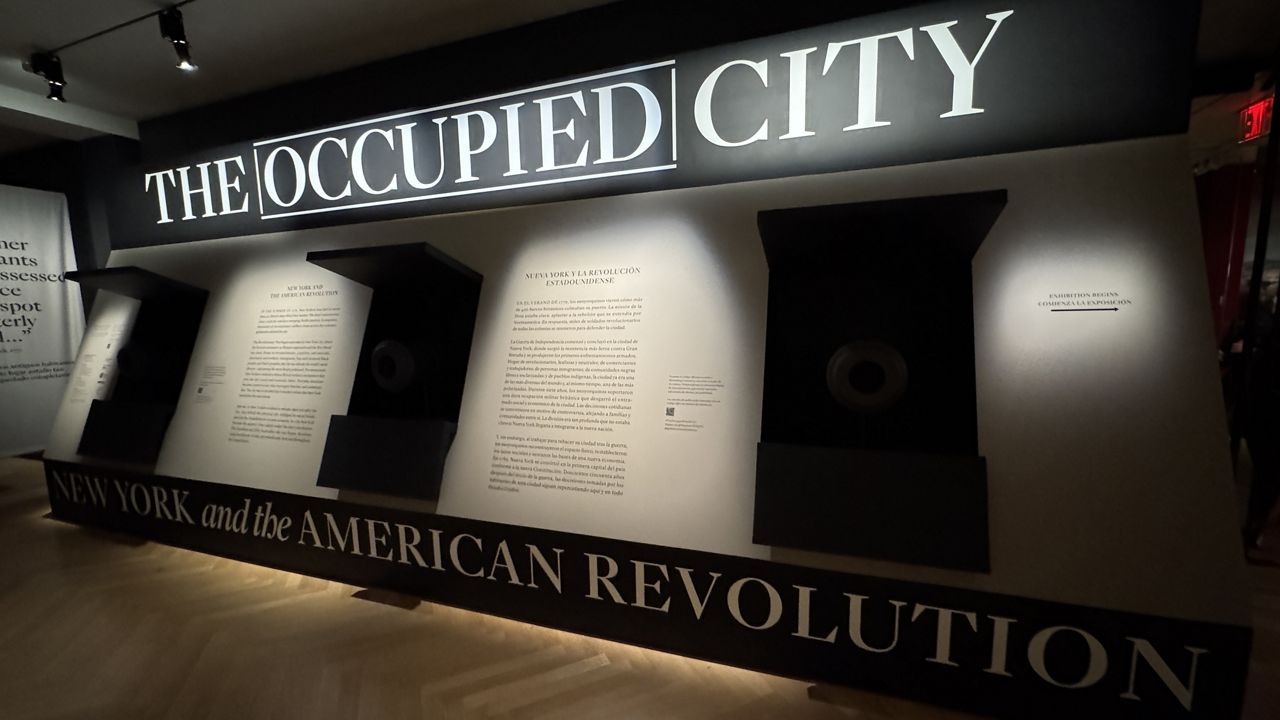
It was the summer of 1776, when just weeks after the signing of the Declaration of Independence, the British military began a campaign to capture New York during the American Revolutionary War.
“New York was the key to the Hudson River, and if you could capture New York, you could split the Massachusetts folks from the Virginia folks and just slice the revolution in half,” said Sarah Henry, a senior scholar and curator emerita at the Museum of the City of New York.
What You Need To Know
“The Occupied City: New York and the American Revolution” is a new exhibition at the Museum of the City of New York
It features historical objects, interactive media and immersive environments to bring visitors to Revolutionary-era New York
The exhibition explores New York’s role in the Revolution and how it was impacted by the war and occupation by the British
George Washington’s army couldn’t stop it. The British would occupy New York until November 1783.
Hence, the name of the gigantic exhibition at the museum in East Harlem called “The Occupied City: New York and the American Revolution.” The museum partnered with the Gotham Center for New York City History at the CUNY Graduate Center on the exhibition, which has been in the works for two years.
“The revolution has been called by historians since the 1970s the nation’s first civil war, and, in New York City, you get a much better sense than that than say in Boston or Philadelphia, so the story we are telling here in the city that was the most diverse place in the country back then as it is now, is a story about incredible division but ultimately a triumph,” said Peter-Christian Aigner, the Gotham Center cirector.
He is also the co-founder of the NYC Revolutionary Trail, a digital tour now available as a mobile app.
The exhibition, which takes over the museum’s entire third floor, features artifacts from the war like cannonballs found all over the city. There are treasures from the museum’s collection, like Alexander Hamilton’s desk and chair, plus the stories of everyday New Yorkers, from loyalists and revolutionaries to enslaved and free Black New Yorkers and indigenous peoples.
It’s a special exhibition for Henry, who has been with the museum for nearly 25 years. She said it’s her last big project, the largest show she has ever worked on, and arguably the biggest the museum has ever done.
“This revolution is not a story that happened out there somewhere, this is a story that belongs to us and it happened here,” she said.
Henry added that visitors will learn that New York was profoundly shaped by the American Revolution. Plan your visit by clicking here.